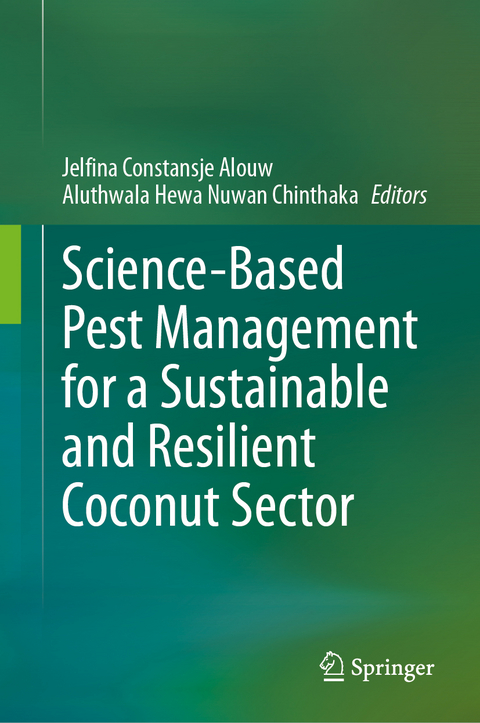
Science-Based Pest Management for a Sustainable and Resilient Coconut Sector
Springer International Publishing (Verlag)
978-3-031-84265-8 (ISBN)
This book offers a practical and innovative guide to managing the complex relationship between coconut plantations and insect pests. It focuses on effective solutions for pest identification, monitoring, and management through a blend of cutting-edge technologies and traditional approaches.
The coconut palm, aptly called the "tree of life," sustains millions of people across tropical regions, providing food, income, and livelihoods. Cultivated on approximately 12 million hectares globally, coconut production faces unprecedented challenges. Meeting the growing demand for diverse coconut products-from coconut water and oil to emerging uses like sustainable aviation fuel (SAF)-requires balancing food security with renewable energy needs.
Adding to these challenges are pest infestations, including insects, mites, and vertebrates, which can cause crop losses of up to 30%. These threats not only lower yields but also jeopardise income and food security for coconut-dependent communities.
Across the chapters, prominent coconut sector researchers and academics delve into pest biology, ecology, plant-pest interactions, climate change effects, organic farming, molecular tools, regulatory frameworks, and best practices for pest management. It contains detailed strategies for breeding coconut palms with enhanced pest resistance and addresses critical topics such as biosecurity and the global exchange of coconut germplasm.
With its unique emphasis on practices and real-world applications, this volume is an essential resource for researchers, agricultural professionals, practitioners, and policymakers committed to building a resilient coconut sector.
Jelfina Constansje Alouw is the Director General of the International Coconut Community (ICC) an intergovernment organisation with 21 member countries based in Jakarta, Indonesia. She obtained her B.S. Agriculture degree in 1992 from The University of Sam Ratulangi Manado, Indonesia; her M.Sc. degree in Entomology and Management from the University of the Philippines at Los Banos in 2002. Ph.D. degree in Entomology from the University of Nebraska Lincoln USA in 2015. She worked as a researcher at the National Research and Innovation Agency of Indonesia, Head of Coconut Research Laboratory, and Deputy Director of Collaboration and Dissemination at the Indonesian Centre for Estate Crop Research and Development. Has published several national and international papers on the coconut sector in globally indexed journals since 1994. Editor-in-Chief, CORD Journal and COCOINFO International magazine, a member of the Steering Committee of the International Coconut Genetic Resources Networks (COGENT).
Aluthwala Hewa Nuwan Chinthaka is the Deputy Director General, International Coconut Community (ICC), Jakarta, Indonesia is a Post Graduate M. Sc. (Ag) in Plant Pathology, Odisha University of Agriculture & Technology, Bhubaneshwar. He also holds the Post Graduate Diploma in Marketing Management (Madurai Kamaraj University, Madurai & Plant Protection (NPPTI, Hyderabad). Assistant Director, of ICC Instrumental in coordinating the activities with all the 21 member countries; Coordinating and supporting the publications of ICC, monthly Newsletter Cocommunity and Coco info International and Associated Editor for CORD scientific Journal of ICC. Supporting and coordinating the program of ICC on International Coconut Genetic Resources Network (COGENT).
Part I. Introduction to Coconut and Its Importance.- Chapter 1. The Economic, Social and Environmental Importance of Coconut.- Chapter 2. Pests' and Diseases' Impact on Coconut Production.- Part II. Fundamentals of Plant-Pest Interactions.- Chapter 3. Plant-Insect Interactions.- Chapter 4. Climate Change and Impacts on Coconut Pest Population, Distribution and Management Strategies.- Chapter 5. Pests and Diseases Symptoms vs. Nutrient Deficiencies.- Chapter 6. Climate Change Impacts on Coconut Pest Populations.- Part III. Molecular and Biotechnology Approaches in Coconut Pest Management.- Chapter 7. Molecular Tools in Coconut Insect Pest Management: Discerning Cryptic species, Polymorphs, and Resistant Biotypes.- Chapter 8. Harnessing Biotechnology for Enhanced Pest and Disease Resistance in Coconut.- Chapter 9. Genome Studies for Effective Coconut Pest Identification and Management.- Part IV. Advanced Techniques in Pest Management and Resistance.- Chapter 10. Pheromone-Based Monitoring System in Coconut: Principles, Challenges and Opportunities for Improving Its Role.- Chapter 11. Innovative Approaches to Coconut Pest Control: The Interplay of Pheromones and Plant Interactions.- Chapter 12. Plants Resistant to Coconut Pests and Diseases: An Overview.- Chapter 13. Breeding for Pest Resistance in Coconut Palm.- Part V. Sustainable and Integrated Pest Management Strategies.- Chapter 14. Coconut Pest Management Principles in Organic Farming.- Chapter 15. Enhancing Integrated Pest Management of Coconut Insect Pests through Biological Control Implementation.- Chapter 16. Feasibility of Polyculture Cropping Systems and Its Pest Management.- Chapter 17. Livestock and Coconut Industry of Sri Lanka and South Asia.- Part VI. Major Coconut Pests and Their Management.- Chapter 18. Advanced Strategies for Managing of Red Palm Weevil (Rhynchophorus ferrugineus): Innovative Technologies and Integrated Solutions.- Chapter 19. Pests of Coconut and Its Innovative Management Strategies: Integrated Pests Management of Coconut Rhinoceros Beetle, Oryctes rhinoceros (Coleoptera: Scarabaeidae).- Chapter 20. Coconut Mites and Its Management.- Chapter 21. Integrated Pest Management of Slug and Nettle Caterpillars in Coconut Plantation.- Chapter 22. Pests of Coconut and Its Innovative Management Strategies: Brontispa longissima Gestro (Coleoptera: Chrysomelidae).- Chapter 23. Strategy for Controlling Promecotheca Cumingii Baly (Coleoptera: Chrysomelidae) in Coconut Plantations.- Chapter 24. Integrated Pest Management of Plesispa reichei Chapuis (Coleoptera : Chrysomelidae).- Chapter 25. Strategies for Controlling Plesispa reichei in Coconut Plantations.- Chapter 26. Eco-Friendly Pest Management System for Sexava.- Chapter 27. The Invasive Coconut Scale, Aspidiotus rigidus (Hemiptera: Diaspididae): A Continuing IPM Challenge in the Philippines.- Chapter 28. Coconut Stick Insect: A Pacific Islands Perspective on Biology and Management.- Chapter 29. Biological Control of Coconut Scale Outbreaks with Coccinellid Predator Chilocorus politus: A Success Story in Indonesia.- Part VII.Regulatory Frameworks and Biosecurity.- Chapter 30. Regulatory Frameworks and Best Practices for Coconut Pest Management: Ensuring Sustainability and Resilience in The Coconut Sector.
| Erscheinungsdatum | 31.05.2025 |
|---|---|
| Zusatzinfo | XVII, 540 p. 115 illus., 110 illus. in color. |
| Verlagsort | Cham |
| Sprache | englisch |
| Maße | 155 x 235 mm |
| Themenwelt | Naturwissenschaften ► Biologie ► Botanik |
| Weitere Fachgebiete ► Land- / Forstwirtschaft / Fischerei | |
| Schlagworte | Biological Control • coconut palm insects identification • Integrated Pest Management • Organic Farming • pest resistance breeding |
| ISBN-10 | 3-031-84265-0 / 3031842650 |
| ISBN-13 | 978-3-031-84265-8 / 9783031842658 |
| Zustand | Neuware |
| Informationen gemäß Produktsicherheitsverordnung (GPSR) | |
| Haben Sie eine Frage zum Produkt? |
aus dem Bereich