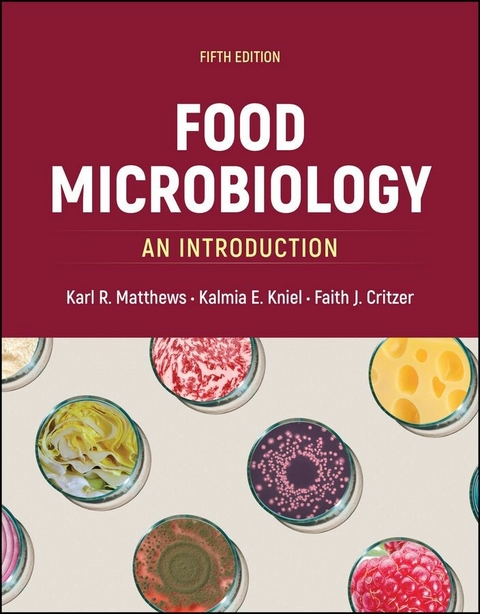
Food Microbiology (eBook)
1322 Seiten
ASM Press (Verlag)
978-1-68367-451-1 (ISBN)
Leading textbook presenting all aspects of food microbiology
Food Microbiology: An Introduction presents the basics of microorganisms that impact food safety and quality, the roles of beneficial microbes, food safety regulations, and proper practices for safe and healthy foods throughout all aspects of the supply chain. This Fifth Edition has been updated to reflect advances in research and technology and threats to the global food supply while retaining the pedagogy and structure that students and professors appreciate.
Written in a clear and easy-to-understand style, the book is divided into four sections: Part I introduces the fundamentals of food microbiology, including a brief history of the field, the growth processes of food microorganisms, the biology of spores and sporeformers, techniques for enumeration and detection of organisms in food, description of rapid and automated microbial methods, and a new chapter focused on antimicrobial resistance. Part II addresses important regulatory issues and focuses on foodborne pathogenic microorganisms with chapters describing the most common bacterial species that cause foodborne diseases, as well as discussion of parasites, viruses, and prions. Part III explores nonpathogenic microbes important in food, including those responsible for fermentations and food spoilage. Part IV focuses on the control of microorganisms in food, including chemical antimicrobials, biological and physical methods of food preservation, nonthermal processing, and food safety systems.
Food Microbiology: An Introduction also includes updated information on:
- The growing threats of antimicrobial resistance and climate change and their potential impacts on the global food supply
- Use of next-generation sequencing techniques in the identification of microbes in food
- Expanded discussion on sanitizers, disinfectants, and nonthermal processing treatments
- Up-to-date information on the Food Safety Modernization Act, hazard analysis and critical control points, and good manufacturing practices
Food Microbiology: An Introduction is an essential textbook for undergraduate and graduate students in food science, nutrition, and microbiology, providing the knowledge and tools necessary to navigate the complexities of food microbiology in the 21st century.
Karl R. Matthews is Professor of Microbial Food Safety at Rutgers University. Dr. Matthews has earned an international reputation for his work on the interaction of foodborne pathogens with fresh fruits and vegetables.
Kalmia E. Kniel is Professor of Microbial Food Safety in the Department of Animal and Food Sciences at the University of Delaware.
Faith J. Critzer is Associate Professor & Produce Safety Extension Specialist at the School of Food Science at Washington State University.
1
The Trajectory of Food Microbiology
- Introduction
- The Beginning?
- Food Microbiology, Past and Present
- What’s Next
- Summary
- Suggested reading
- Questions for critical thought
Learning Objectives
The information in this chapter will enable the student to:
- increase awareness of the antiquity of microbial life and the newness of food microbiology as a scientific field
- appreciate how fundamental discoveries in microbiology still influence the practice of food microbiology
- understand the origins of food microbiology and thus anticipate its forward path
INTRODUCTION
The field of food microbiology has gained increased prominence as the result of global complexity of the food supply and consumer desire for new foods. Food microbiology is a subdivision of microbiology encompassing the study of microbes that grow in food and how food environments influence microbes. Keeping pace with other subdivisions of microbiology, food microbiology has progressed considerably in many ways; genetic and immunological probes have replaced older biochemical tests and reduced testing time from days to minutes. In other ways, food microbiology is still near the beginning. Louis Pasteur would find his pipettes in a modern laboratory. Julius Richard Petri would find his plates (albeit plastic rather than glass). Hans Christian Gram would find all the reagents required for his stain. However, food microbiologists are moving beyond studying only the microbes that we can see under the microscope and grow on agar media in petri dishes. Advanced approaches are being used to study food‐associated microbes that are difficult to culture (Box 1.1).
This chapter’s discussion of microbes per se sets the stage for a historical review of food microbiology. The bulk of the discussion in this chapter, and indeed in most of this book, concerns bacteria. Viruses, parasites, and prions are covered but to a lesser extent. This chapter ends with some thoughts about future developments in the field.
Box 1.1
Preparing for the future
Membership in professional societies is a great way to advance professionally, even as a student (who benefits from reduced membership fees and is eligible for a variety of scholarships). Professional societies provide continuing education and employment services to their members, provide expertise to those making laws and public policies, have annual meetings for presentation of the latest science, and publish books and journals. The three main societies for food microbiologists are listed below. Applications for membership can be obtained from their websites. The American Society for Microbiology (ASM) (https://asm.org/) is the largest single life science membership organization in the world, with more than 36,000 members globally. It covers all facets of microbiology from microbial pathogenesis to clinical and public health to antimicrobial agents to food microbiology, and it publishes many scholarly journals. The Institute of Food Technologists (IFT) (https://www.ift.org/) devotes itself to all areas of food science by discipline (food microbiology, food chemistry, and food engineering), as well as by commodity (cereals, fruits and vegetables, and seafood) and by processing (refrigerated foods). The IFT is a nonprofit scientific society with more than 12,000 members across over 90 countries working in food science, food technology, and related professions in industry, academia, and government. The IFT publishes two journals, sponsors a variety of short courses, and contributes to public policy and opinion at national, state, and local levels. The International Association for Food Protection (IAFP) (https://www.foodprotection.org/) is the only professional society devoted exclusively to food safety microbiology. IAFP is dedicated to the education and service of its members, as well as industry personnel. Members keep informed of the latest scientific, technical, and practical developments in food safety and sanitation. IAFP publishes two scientific journals, Food Protection Trends and Journal of Food Protection.
THE BEGINNING?
Let there be no doubt about it: the microbes were here first. It is a microbial world. If the earth came into being at 12:01 a.m. of a 24‐hour day, microbes would arrive at dawn and remain the only living things until well after dusk. Around 9 p.m., larger animals would emerge, and a few seconds before midnight, humans would appear. The microbes were here first, they cohabit the planet with us, and they will be here after humans are gone. Life is not sterile. Microbes can never be (nor should they be) conquered, once and for all. The food microbiologist can only create foods that microbes do not “like,” manipulate the growth of microbes that are in food, inactivate them, or exclude them by physical barriers.
Bacteria live in airless bogs, thermal vents, boiling geysers, us, and foods. We are lucky that they are here, for microbes form the foundation of the biosphere. We could not exist without microbes, but they would do just fine without us. Photosynthetic bacteria fix carbon into usable forms and make much of our oxygen. Rhizobium bacteria fix air’s elemental nitrogen into ammonia that can be used for a variety of life processes. Degradative enzymes allow ruminants to digest cellulose. Microbes recycle the dead into basic components that can be used again and again. Microbes in our intestines aid in digestion, produce vitamins, and prevent colonization by pathogens. For the most part, microbes are our friends.
FOOD MICROBIOLOGY, PAST AND PRESENT
From the dawn of civilization until about 10,000 years ago, humans were hunter‐gatherers. Humans were lucky to have enough. There was neither surplus nor a settled place to store it. Preservation was not an issue. With the shift to agricultural societies, storage, spoilage, and preservation became important challenges. The first preservation methods were undoubtedly accidental. Sun‐dried, salted, or frozen foods did not spoil. In the classic “turning lemons into lemonade” style, early humans learned that “spoiled” milk could be acceptable or even desirable if viewed as “fermented.” Fermenting food became an organized activity around 8000 B.C.E. (Table 1.1). Breweries and bakeries sprang up long before the idea of yeast was conceived.
Humans remained ignorant of microbes for thousands of years. In 1665, Robert Hooke published Micrographia, the first illustrated book on microscopy that detailed the structure of Mucor, a microscopic fungus. In 1676, Antonie van Leeuwenhoek used a crude microscope of Hooke’s design to see small living things in pond water. Microbiology was born!
Table 1.1 Significant events in the history of food microbiologya
| Decade | Event |
|---|
| ∼8000 B.C.E. | Fermentation of food becomes an organized activity. |
| 1670 C.E. | Hooke and van Leeuwenhoek observe microscopic fungi and bacteria; microbiology is born. |
| 1760 | Spallanzani’s experiments with boiled beef strike a blow against spontaneous generation. |
| 1800 | Nicolas Appert invents the canning process. Amazingly, this is still a mainstay of food processing 200 years later. |
| 1810 | Peter Durand patents the tin can, making Appert’s life much easier. |
| 1850 | Appert and Raymond Chevallier‐Appert are issued a patent for steam sterilization (retort). The use of steam under pressure increases process temperatures, decreases process times, and radically improves the quality of canned food. Louis Pasteur demonstrates that living organisms cause lactic and alcoholic fermentations. |
| 1860 | Pasteur disproves spontaneous generation. Life can come only from other life. Joseph Lister develops the concept of antiseptic practice. Persuading surgeons to wash their hands saves thousands of lives. |
| 1880 | Robert Koch postulates bacteria as causative agents of disease. To this day, Koch’s postulates remain the “gold standard” for proving that bacteria cause disease. Hans Christian Gram invents the Gram stain. Julius Richard Petri invents the petri dish. Petri worked in Koch’s laboratory, where the usefulness of agar was also discovered. A. A. Gartner isolates Salmonella enterica serovar Enteritidis from a foodborne illness outbreak. A century later, salmonellae are still the leading cause of death among people consuming foodborne microbes. |
| 1890 | Pasteurization of milk begins in the United States. |
| 1900 | The Food and Drug Act is passed in response to Upton Sinclair’s exposé of the meat... |
| Erscheint lt. Verlag | 17.12.2024 |
|---|---|
| Reihe/Serie | ASM Books |
| Sprache | englisch |
| Themenwelt | Naturwissenschaften ► Biologie |
| Weitere Fachgebiete ► Land- / Forstwirtschaft / Fischerei | |
| Schlagworte | beneficial microbes • Food microorganisms • food safety practices • food safety programs. Foodborne pathogenic bacteria • food safety regulations • food science • microbial growth in food • Microbiology • Nutrition • sporeformers • Spores |
| ISBN-10 | 1-68367-451-0 / 1683674510 |
| ISBN-13 | 978-1-68367-451-1 / 9781683674511 |
| Informationen gemäß Produktsicherheitsverordnung (GPSR) | |
| Haben Sie eine Frage zum Produkt? |
 EPUB (Adobe DRM)
Kopierschutz: Adobe-DRM
Adobe-DRM ist ein Kopierschutz, der das eBook vor Mißbrauch schützen soll. Dabei wird das eBook bereits beim Download auf Ihre persönliche Adobe-ID autorisiert. Lesen können Sie das eBook dann nur auf den Geräten, welche ebenfalls auf Ihre Adobe-ID registriert sind.
Details zum Adobe-DRM
Dateiformat: EPUB (Electronic Publication)
EPUB ist ein offener Standard für eBooks und eignet sich besonders zur Darstellung von Belletristik und Sachbüchern. Der Fließtext wird dynamisch an die Display- und Schriftgröße angepasst. Auch für mobile Lesegeräte ist EPUB daher gut geeignet.
Systemvoraussetzungen:
PC/Mac: Mit einem PC oder Mac können Sie dieses eBook lesen. Sie benötigen eine
eReader: Dieses eBook kann mit (fast) allen eBook-Readern gelesen werden. Mit dem amazon-Kindle ist es aber nicht kompatibel.
Smartphone/Tablet: Egal ob Apple oder Android, dieses eBook können Sie lesen. Sie benötigen eine
Geräteliste und zusätzliche Hinweise
Buying eBooks from abroad
For tax law reasons we can sell eBooks just within Germany and Switzerland. Regrettably we cannot fulfill eBook-orders from other countries.
aus dem Bereich