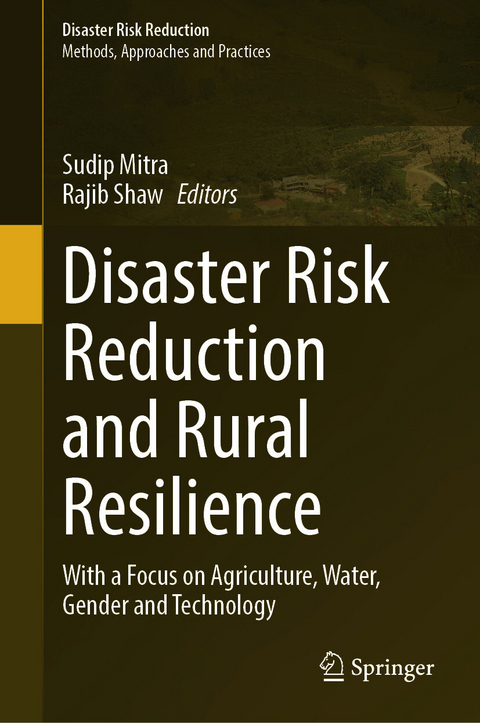
Disaster Risk Reduction and Rural Resilience (eBook)
317 Seiten
Springer Nature Singapore (Verlag)
978-981-97-6671-0 (ISBN)
Even though frequent disaster losses occur in rural and agricultural areas, a substantial number of the prevailing disaster research has focused on urban areas, often failing to notice rural populations, communities, and rural development as a whole. It is critical to assess how the needs and vulnerabilities in rural communities impact the creation of resilience, especially in countries with a large area under rural regions. For disaster managers, rural areas present different opportunities and challenges from their urban counterparts. Rural communities’ position after a disaster is different from that of urban communities. Efficient DRR (disaster risk reduction) is the key to sustainable rural development.
Disasters can cause human and animal life loss, field crops, stored seeds, agricultural equipment/materials, supply systems (e.g., infrastructure), livelihood, and associated indigenous knowledge. Such impacts have its short-term repercussions and affect the long-term sustainability of the rural sector. Rural regions of the developing world can be remote, with high concentrations of mass poverty, food insecurity, and illiteracy; hence access to food, shelter, and communication related to relief and recovery is a challenge after a disaster. In rural areas, farmers strongly rely on natural resources and have no alternative source of income or employment, making them more vulnerable to a crisis. Role of women in rural development and agricultural activities is of paramount importance. Yet they are the most affected ones during any disaster. Vulnerabilities of children and especially abled people in the rural sector are untouched areas that require more attention in days to come.
This book deliberates on the aspects as mentioned above related to disaster risk reduction, preparedness, and management. Apart from the introduction, the book has four parts: (1) Food and Agriculture, (2) Water andSanitation, (3) Gender and Social Issues, and (4) Technology. Overall, this book is a valuable resource material for students, researchers, academia, policymakers, and development practitioners.
Even though frequent disaster losses occur in rural and agricultural areas, a substantial number of the prevailing disaster research has focused on urban areas, often failing to notice rural populations, communities, and rural development as a whole. It is critical to assess how the needs and vulnerabilities in rural communities impact the creation of resilience, especially in countries with a large area under rural regions. For disaster managers, rural areas present different opportunities and challenges from their urban counterparts. Rural communities' position after a disaster is different from that of urban communities. Efficient DRR (disaster risk reduction) is the key to sustainable rural development.Disasters can cause human and animal life loss, field crops, stored seeds, agricultural equipment/materials, supply systems (e.g., infrastructure), livelihood, and associated indigenous knowledge. Such impacts have its short-term repercussions and affect the long-term sustainability of the rural sector. Rural regions of the developing world can be remote, with high concentrations of mass poverty, food insecurity, and illiteracy; hence access to food, shelter, and communication related to relief and recovery is a challenge after a disaster. In rural areas, farmers strongly rely on natural resources and have no alternative source of income or employment, making them more vulnerable to a crisis. Role of women in rural development and agricultural activities is of paramount importance. Yet they are the most affected ones during any disaster. Vulnerabilities of children and especially abled people in the rural sector are untouched areas that require more attention in days to come.This book deliberates on the aspects as mentioned above related to disaster risk reduction, preparedness, and management. Apart from the introduction, the book has four parts: (1) Food and Agriculture, (2) Water andSanitation, (3) Gender and Social Issues, and (4) Technology. Overall, this book is a valuable resource material for students, researchers, academia, policymakers, and development practitioners.
| Erscheint lt. Verlag | 30.10.2024 |
|---|---|
| Reihe/Serie | Disaster Risk Reduction |
| Zusatzinfo | XIV, 317 p. 51 illus., 46 illus. in color. |
| Sprache | englisch |
| Themenwelt | Naturwissenschaften ► Biologie ► Ökologie / Naturschutz |
| Naturwissenschaften ► Geowissenschaften ► Hydrologie / Ozeanografie | |
| Sozialwissenschaften ► Politik / Verwaltung | |
| Sozialwissenschaften ► Soziologie ► Gender Studies | |
| Technik ► Lebensmitteltechnologie | |
| Wirtschaft ► Betriebswirtschaft / Management ► Allgemeines / Lexika | |
| Weitere Fachgebiete ► Land- / Forstwirtschaft / Fischerei | |
| Schlagworte | Agriculture and Food Security • Gender and social issues • Rural resilience • Rural technology • water and sanitation |
| ISBN-10 | 981-97-6671-0 / 9819766710 |
| ISBN-13 | 978-981-97-6671-0 / 9789819766710 |
| Informationen gemäß Produktsicherheitsverordnung (GPSR) | |
| Haben Sie eine Frage zum Produkt? |
 PDF (Wasserzeichen)
DRM: Digitales Wasserzeichen
Dieses eBook enthält ein digitales Wasserzeichen und ist damit für Sie personalisiert. Bei einer missbräuchlichen Weitergabe des eBooks an Dritte ist eine Rückverfolgung an die Quelle möglich.
Dateiformat: PDF (Portable Document Format)
Mit einem festen Seitenlayout eignet sich die PDF besonders für Fachbücher mit Spalten, Tabellen und Abbildungen. Eine PDF kann auf fast allen Geräten angezeigt werden, ist aber für kleine Displays (Smartphone, eReader) nur eingeschränkt geeignet.
Systemvoraussetzungen:
PC/Mac: Mit einem PC oder Mac können Sie dieses eBook lesen. Sie benötigen dafür einen PDF-Viewer - z.B. den Adobe Reader oder Adobe Digital Editions.
eReader: Dieses eBook kann mit (fast) allen eBook-Readern gelesen werden. Mit dem amazon-Kindle ist es aber nicht kompatibel.
Smartphone/Tablet: Egal ob Apple oder Android, dieses eBook können Sie lesen. Sie benötigen dafür einen PDF-Viewer - z.B. die kostenlose Adobe Digital Editions-App.
Buying eBooks from abroad
For tax law reasons we can sell eBooks just within Germany and Switzerland. Regrettably we cannot fulfill eBook-orders from other countries.
aus dem Bereich