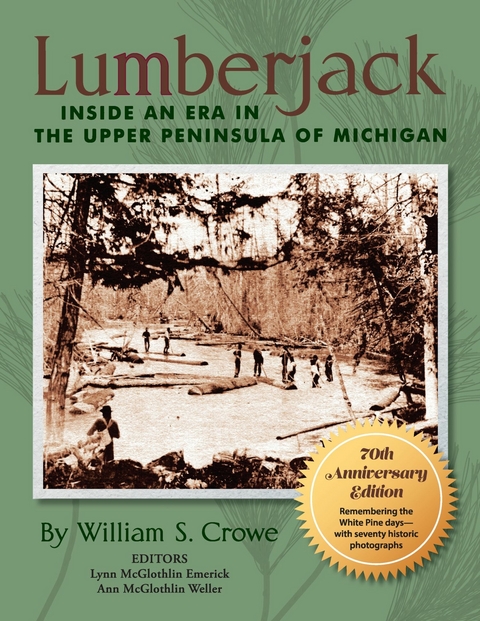
Lumberjack (eBook)
144 Seiten
Modern History Press (Verlag)
978-1-61599-809-8 (ISBN)
Winner--Best Biography/Memoir of 2002, Midwest Book Awards (St. Paul, MN)
Lumberjack is a firsthand account of the lumbering era during the white pine boom years of the late 1800s - early 1900s in the northern U.S. Millions of board feet of logs were cut in deep woods camps, driven down the rivers to the sawmills, and shipped by schooner and barge to build a nation. This edition includes 78 historical photographs and illustrations, a glossary, editors' notes, maps, and much more.
'The lumber barons, the lumberjacks, and the town people who worked in the mills--as well as the happenings of that period... are recalled by one who lived among them. I hope it will be an inspiration to others to set down their memories of the days of falling pine and belt-driven sawmills. Already too much of this story has passed beyond recall... a valuable addition not only to the history of Manistique, but to the state as well.'
--Ferris E. Lewis, Michigan History, Lansing
'An authentic first-hand account... which tells the whole story of big-scale lumbering during the 1890s and early 1900s. Chapter by enthralling chapter, Crowe recounts the times involved in the 'big pine' operations... it rivals anything so far written... rich in description and alive with thrilling episodes.'
--Marquette Mining Journal
'First-hand accounts of the dramatic 'big cut' by participant-observers are always illuminating. William S. Crowe's reminiscence of his years in the woods and the early days of Manistique, at the north end of Lake Michigan in Michigan's Upper Peninsula, was a classic in the 1950s. His granddaughters Lynn McGlothin Emerick and Ann McGlothin Weller have done a real service by republishing his book with ample photos and notes.'
-- Mary Hoffman Hunt, Midwestern Guides
'Focusing on Manistique and meticulously researched, Lumberjack explores the early days of logging and the lifestyles of the countless loggers that filled the woods in Michigan's Upper Peninsula. William Crowe, the author, was a logger himself who collected and relates real stories from the men who were there. This is a mandatory book for anyone interested in the history of the Upper Peninsula.'
--Mikel B. Classen, author/historian, True Tales: The Forgotten History of the U.P. and Faces Places & Days Gone By: A Pictorial History of the U.P.
From Modern History Press
Winner--Best Biography/Memoir of 2002, Midwest Book Awards (St. Paul, MN) Lumberjack is a firsthand account of the lumbering era during the white pine boom years of the late 1800s - early 1900s in the northern U.S. Millions of board feet of logs were cut in deep woods camps, driven down the rivers to the sawmills, and shipped by schooner and barge to build a nation. This edition includes 78 historical photographs and illustrations, a glossary, editors' notes, maps, and much more. "e;The lumber barons, the lumberjacks, and the town people who worked in the mills--as well as the happenings of that period... are recalled by one who lived among them. I hope it will be an inspiration to others to set down their memories of the days of falling pine and belt-driven sawmills. Already too much of this story has passed beyond recall... a valuable addition not only to the history of Manistique, but to the state as well."e; --Ferris E. Lewis, Michigan History, Lansing "e;An authentic first-hand account... which tells the whole story of big-scale lumbering during the 1890s and early 1900s. Chapter by enthralling chapter, Crowe recounts the times involved in the 'big pine' operations... it rivals anything so far written... rich in description and alive with thrilling episodes."e; --Marquette Mining Journal "e;First-hand accounts of the dramatic 'big cut' by participant-observers are always illuminating. William S. Crowe's reminiscence of his years in the woods and the early days of Manistique, at the north end of Lake Michigan in Michigan's Upper Peninsula, was a classic in the 1950s. His granddaughters Lynn McGlothin Emerick and Ann McGlothin Weller have done a real service by republishing his book with ample photos and notes."e; -- Mary Hoffman Hunt, Midwestern Guides "e;Focusing on Manistique and meticulously researched, Lumberjack explores the early days of logging and the lifestyles of the countless loggers that filled the woods in Michigan's Upper Peninsula. William Crowe, the author, was a logger himself who collected and relates real stories from the men who were there. This is a mandatory book for anyone interested in the history of the Upper Peninsula."e; --Mikel B. Classen, author/historian, True Tales: The Forgotten History of the U.P. and Faces Places & Days Gone By: A Pictorial History of the U.P. From Modern History Press
CHAPTER ONE
Lumbering Towns and Company Men
he identity of the mysterious marks found on lumber sawed from deadhead logs was quite clear to me because I was once head bookkeeper for the Chicago Lumbering Company of Michigan (C. L. Co.) and the Weston Lumber Company (W. L. Co.), and have lived in Manistique for over seventy years.
Since Manistique, like many other towns in Michigan during the colorful white pine days, was an almost one hundred percent pure lumber town, the story is mostly about lumberjacks, woods, big sawmills and lake shipping. As bookkeeper for one of the largest lumber companies during the seven years when the industry was at its peak, I had splendid opportunity for firsthand observation.
When it comes to a matter of detail and recreating the atmosphere of those days, the stories of the other lumber towns of Michigan are exactly the same as Manistique; residents lived their daily lives as we did here. The faces changed and the proprietors, the “Lumber Barons,” were all different, but lumbering was the same.
“There is no other tree in all the world which has so much of romance … as the white pine.”
There is no other tree in all the world which has so much of romance, and was so closely associated with people’s daily lives and manner of living, as the white pine, which is now almost extinct except for some tracts of closely related sugar pine on the west coast.
And I believe there were no more colorful or interesting or exciting segments of American life than the lumber industries, nor a more picturesque individual than the old-time lumberjack and river driver. They were in direct contact and conflict with Mother Nature in the raw—a comparable industry in this respect being the cattle ranches of the great plains and the western cowboy. I lived for two years on a cattle ranch in Colorado before coming to Michigan so I had good opportunities to get first-hand impressions of both the lumberjack and the western cow-puncher.
A more completely different stage, background and environment could hardly be imagined than the immense pine forests and the treeless, seemingly endless plain, nor two more different individuals than the lumberjack and the cowboy. A cowboy would have been lost almost at once in the great pine forests, and a lumberjack would have been lost even more quickly on rolling treeless plains.
Log marks from Upper Peninsula lumber companies: (1) Goodenough & Hinds, Delta County, 1889; (2) Garth Lumber Co., Delta County, 1894 (also used by Weston Lumber Co., Schoolcraft County); (3) Charles Mann, Delta County, 1902; (4) J. A. Jamieson & Co., Mackinac County, 1908; (5) Marsh, Koehn & Co., Menominee Count)’, 1904; (6) Oliver Iron Mining Co., Menominee County, 1938; (7) McMillan Bros., Ontonagon County, 1902.
But although environments and ways of life differ, people are fundamentally about the same wherever you find them, and the cowboys and the lumberjacks had the same spirit of daring, resourcefulness, initiative, independence and romance bred by close contact with nature at her best and worst in a vast, free country.
One thing common to cowboy and lumberjack was the similarity of the cattle brands and log marks. The W. L. Co.’s “Barred O” and “Circle 0” were duplicated on the cattle ranges, and a big western ranch’s “Cobhouse” brand was exactly the same as the C. L. Co’s “Cobhouse” log mark.
The quadruple cross was the familiar C. L. Co. “Cobhouse,” and the cross in a circle was the W. L. Co’s “Barred O” . These marks and the Weston Lumber Company’s “Circle O” accounted for about ninety percent of the roughly four billion feet of white pine and red, or Norway, pine these companies cut in their forty-one years of operations, 1872-1912.1, 2
Other marks which frequently came up C. L. and W. L. jack ladders were Hall & Buell’s , the Delta Lumber Company’s triangle , JDW logs cut from J. D. Weston land, Edward Hines & Company and the marks of Alger, Smith and Co. , which operated a big mill at Grand Marais supplied by their own railroad to Seney, Germfask and Curtis. The C. L. Co., with a branch office at Seney, operated in that territory at the same time and sometimes cut isolated forties for Alger, Smith and Co. and ran the logs to Manistique in their main river drive.
A single company might have more than one hundred log marks. Delta County in the Upper Peninsula received so many registrations that the Log Mark sheet was developed for recording purposes.
General Russell A. Alger, President William McKinley’s Secretary of War, was the principal stockholder in Alger, Smith and he and Abijah Weston were great friends.
In the 1880s and 1890s, Hall & Buell had a large sawmill at South Manistique. a community of about 1,200 people on Lake Michigan one mile southwest of Manistique. Not a vestige of South Manistique remains except part of Hall & Buell’s old log pond. Their mill was supplied by a railroad from their Indian Lake pull-up and from another pull-up on the Manistique River just above the C. L. Co.’s dump. When the C. L. Co. built the Manistique and Northwestern Railway (now part of the Ann Arbor system) to Steuben and Shingleton in 1896, they bought Hall & Buell’s railroad to have access across the Soo Line.3
The Delta Lumber Company had a sawmill at Thompson (population about 500 in 1893) supplied by a railroad from a pull-up on the Indian River north of the Big Spring, with branches here and there on the plains between Indian Lake and Cooks west of Delta Junction. A railroad along Lake Michigan connected Thompson with South Manistique and Manistique. The combined population of the three communities in the 1890s was about 5,500.
All told there were over twenty log marks, and a scaler at the head of the jack ladder in each of the five mills entered the scale of every log under its particular mark on a scale sheet. The C. L. and W. L. companies used the combination Doyle-Scribner rule: Doyle for small logs up to twenty-eight inches in diameter, and Scribner for large logs over twenty-eight inches. The mill lumber scale usually was higher than the log scale from ten to thirty percent. In 1913 the lumber scale overran the log scale almost exactly thirty percent.
Manistique Harbor in the early days.
A NEW DAWN
When I landed at Manistique from the Goodrich Line’s City of Ludington at exactly midnight, May 29, 1893, I stepped into a strange new world such as I had never seen or even dreamed of. I was only seventeen and had lived for two years on a cattle ranch on the treeless plains of eastern Colorado northeast of Fort Lupton. I had never seen a ship, a large body of water, a sawmill or even a big tree. The screaming saws in five big mills, running twenty-four hours a day; the scent of new lumber and the pine woods; the hoarse whistles of lake steamers; the tall masts of lumber schooners in the harbor; and the flickering flames and red glow from the open burners reflected across the water and in the sky against the dark and somber background of the immense forest—all gave me a feeling early pioneers must have experienced when they discovered a new and unexplored area. I could hardly wait for morning to dawn.
Chicago Lumbering Company saw mills and lumber yards at Manistique.
The Chicago Lumbering Company of Michigan was organized in the summer of 1863 by certain Chicago interests who operated a small mill with two circular saws and one gang saw until 1871, when Abijah Weston and Alanson J. Fox came up from Painted Post, New York, and bought the company. From that time until December 1912, when Mr. Lou Yalomstein (then manager of the C. L. Store) and I organized the Consolidated Lumber Company and purchased all their properties, the Chicago Lumbering Company of Michigan and the Weston Lumber Company (they had the same stockholders) were the whole thing in Manistique and Schoolcraft County. The C. L. and W. L. companies owned at this time all of Schoolcraft County, parts of Delta and Mackinac counties and all of Manistique except the wooden saloons in the Flatiron block on Pearl Street, schools, churches and six or seven stores on Cedar and Oak Streets.4
The board of directors of the Chicago Lumbering Company of Michigan and Weston Lumber Company. Standing, left to right: William H. Hill, William E. Wheeler, John D. Mesereau, N. P. Wheeler. Seated: George H. Orr, Alanson J. Fox, Abijah Weston, M. H. Quick.
Abijah Weston, Fox and their associates were very wealthy men, and when they took over in 1871 things commenced to hum in Manistique.5 In 1893 when I started to work as time boy, they were operating three large mills, a planing mill, a charcoal iron furnace and about twenty-six other departments that covered almost every activity found in a community of four thousand people. They employed about twelve hundred men then and I became well acquainted with their various managers and foremen, including: John Quick, C. L. Mill; W. C. Bronson, W. L. Mill No. 1; Sam Mix, W. L. Mill No. 2; John Woodruff, C. L. Lath Mill; E. A. Rose, W. L. No. 2 Lath Mill; R. B. Waddell, Weston Mfg. Co. Planing Mill; H. Duval, Weston Furnace Co.; Arthur DuBois, Manistique Telephone Co.; C. P. Hill, C. L. Store; I. S. Phippeny, W. L. Store; E. W. Miller, Warehouses and Docks; Capt. Lossing, C. L. Dredge; Capt. John McWilliams, Tug Elmer; R. P. Foley, Ossawinamakee Hotel; George Wickwire, Retail Lumber;...
| Erscheint lt. Verlag | 1.4.2024 |
|---|---|
| Sprache | englisch |
| Themenwelt | Literatur ► Biografien / Erfahrungsberichte |
| Literatur ► Romane / Erzählungen | |
| Sachbuch/Ratgeber ► Geschichte / Politik ► Regional- / Landesgeschichte | |
| Geisteswissenschaften ► Geschichte ► Regional- / Ländergeschichte | |
| Technik | |
| Wirtschaft | |
| Weitere Fachgebiete ► Land- / Forstwirtschaft / Fischerei | |
| Schlagworte | Agriculture • business • Economics • Engineering • forestry • History • Ia • IL • In • Industries • KS • Local • mi • Midwest • MN • Mo • Natural Resource Extraction • Nd • Ne • Oh • SD • State • Technology • United States • WI |
| ISBN-10 | 1-61599-809-8 / 1615998098 |
| ISBN-13 | 978-1-61599-809-8 / 9781615998098 |
| Informationen gemäß Produktsicherheitsverordnung (GPSR) | |
| Haben Sie eine Frage zum Produkt? |
 EPUB (Ohne DRM)
Digital Rights Management: ohne DRM
Dieses eBook enthält kein DRM oder Kopierschutz. Eine Weitergabe an Dritte ist jedoch rechtlich nicht zulässig, weil Sie beim Kauf nur die Rechte an der persönlichen Nutzung erwerben.
Dateiformat: EPUB (Electronic Publication)
EPUB ist ein offener Standard für eBooks und eignet sich besonders zur Darstellung von Belletristik und Sachbüchern. Der Fließtext wird dynamisch an die Display- und Schriftgröße angepasst. Auch für mobile Lesegeräte ist EPUB daher gut geeignet.
Systemvoraussetzungen:
PC/Mac: Mit einem PC oder Mac können Sie dieses eBook lesen. Sie benötigen dafür die kostenlose Software Adobe Digital Editions.
eReader: Dieses eBook kann mit (fast) allen eBook-Readern gelesen werden. Mit dem amazon-Kindle ist es aber nicht kompatibel.
Smartphone/Tablet: Egal ob Apple oder Android, dieses eBook können Sie lesen. Sie benötigen dafür eine kostenlose App.
Geräteliste und zusätzliche Hinweise
Buying eBooks from abroad
For tax law reasons we can sell eBooks just within Germany and Switzerland. Regrettably we cannot fulfill eBook-orders from other countries.
aus dem Bereich