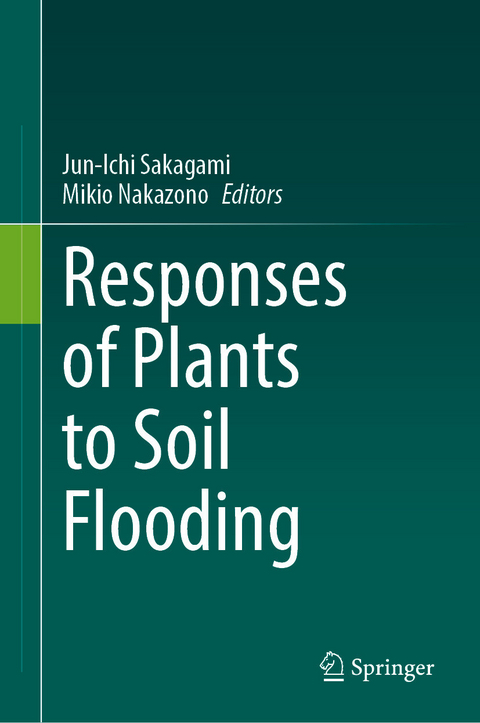
Responses of Plants to Soil Flooding (eBook)
185 Seiten
Springer Nature Singapore (Verlag)
978-981-99-9112-9 (ISBN)
In this book, leading researchers from this field systematically explain the latest research results on anaerobic responses in plants. The book is characterized by its in-depth coverage of the tolerance functions of plants under hypoxic conditions from a variety of perspectives, with a particular focus on research areas related to molecular biology and genetics. Although drought responses have dominated water stress research in the past, recent floods and attempts to introduce new cropping systems have made it necessary to take measures against excessive water stress injury, and systematic research is needed for this purpose. From this point of view, the approach taken in this book is new and interesting in that it covers basic research and adaptation technologies in the field, and can be applied to various different situations. The focus of this book is how plants can adapt to poor environments and improve productivity under the conditions of soil hypoxia caused by excess water, such as heavy rains and typhoons. From this point of view, the reader will be able to understand the various adaptations of plants to climate change, which will clarify the future directions of research and show the possibility of applying the knowledge and techniques gained in this book to the field.
The Sixth Report of the Intergovernmental Panel on Climate Change (2021) warns that global warming will proceed faster than previously assumed and that all regions of the world will face increasing changes. “Climate Resilient Development” has been proposed as a key phrase to combat global warming, and it is important to identify the adaptive capacity of plants and improve it where possible. In this regard, the publication of this book, which includes ideas for mitigating flood damage caused by global warming, is extremely important, timely, and rational.
In this book, leading researchers from this field systematically explain the latest research results on anaerobic responses in plants. The book is characterized by its in-depth coverage of the tolerance functions of plants under hypoxic conditions from a variety of perspectives, with a particular focus on research areas related to molecular biology and genetics. Although drought responses have dominated water stress research in the past, recent floods and attempts to introduce new cropping systems have made it necessary to take measures against excessive water stress injury, and systematic research is needed for this purpose. From this point of view, the approach taken in this book is new and interesting in that it covers basic research and adaptation technologies in the field, and can be applied to various different situations. The focus of this book is how plants can adapt to poor environments and improve productivity under the conditions of soil hypoxia caused by excess water, such as heavy rains and typhoons. From this point of view, the reader will be able to understand the various adaptations of plants to climate change, which will clarify the future directions of research and show the possibility of applying the knowledge and techniques gained in this book to the field.The Sixth Report of the Intergovernmental Panel on Climate Change (2021) warns that global warming will proceed faster than previously assumed and that all regions of the world will face increasing changes. "e;Climate Resilient Development"e; has been proposed as a key phrase to combat global warming, and it is important to identify the adaptive capacity of plants and improve it where possible. In this regard, the publication of this book, which includes ideas for mitigating flood damage caused by global warming, is extremely important, timely, and rational.
| Erscheint lt. Verlag | 20.5.2024 |
|---|---|
| Zusatzinfo | VIII, 185 p. 43 illus., 26 illus. in color. |
| Sprache | englisch |
| Themenwelt | Naturwissenschaften ► Biologie ► Botanik |
| Naturwissenschaften ► Biologie ► Ökologie / Naturschutz | |
| Naturwissenschaften ► Geowissenschaften ► Geologie | |
| Weitere Fachgebiete ► Land- / Forstwirtschaft / Fischerei | |
| Schlagworte | Aeranchyma formation • Anaerobic response • anoxia • Antioxidants system • global warming • Hypoxia • oxygen transport • ROL barriers • root plasticity • Underwater photosynthesis |
| ISBN-10 | 981-99-9112-9 / 9819991129 |
| ISBN-13 | 978-981-99-9112-9 / 9789819991129 |
| Informationen gemäß Produktsicherheitsverordnung (GPSR) | |
| Haben Sie eine Frage zum Produkt? |
 PDF (Wasserzeichen)
DRM: Digitales Wasserzeichen
Dieses eBook enthält ein digitales Wasserzeichen und ist damit für Sie personalisiert. Bei einer missbräuchlichen Weitergabe des eBooks an Dritte ist eine Rückverfolgung an die Quelle möglich.
Dateiformat: PDF (Portable Document Format)
Mit einem festen Seitenlayout eignet sich die PDF besonders für Fachbücher mit Spalten, Tabellen und Abbildungen. Eine PDF kann auf fast allen Geräten angezeigt werden, ist aber für kleine Displays (Smartphone, eReader) nur eingeschränkt geeignet.
Systemvoraussetzungen:
PC/Mac: Mit einem PC oder Mac können Sie dieses eBook lesen. Sie benötigen dafür einen PDF-Viewer - z.B. den Adobe Reader oder Adobe Digital Editions.
eReader: Dieses eBook kann mit (fast) allen eBook-Readern gelesen werden. Mit dem amazon-Kindle ist es aber nicht kompatibel.
Smartphone/Tablet: Egal ob Apple oder Android, dieses eBook können Sie lesen. Sie benötigen dafür einen PDF-Viewer - z.B. die kostenlose Adobe Digital Editions-App.
Buying eBooks from abroad
For tax law reasons we can sell eBooks just within Germany and Switzerland. Regrettably we cannot fulfill eBook-orders from other countries.
aus dem Bereich