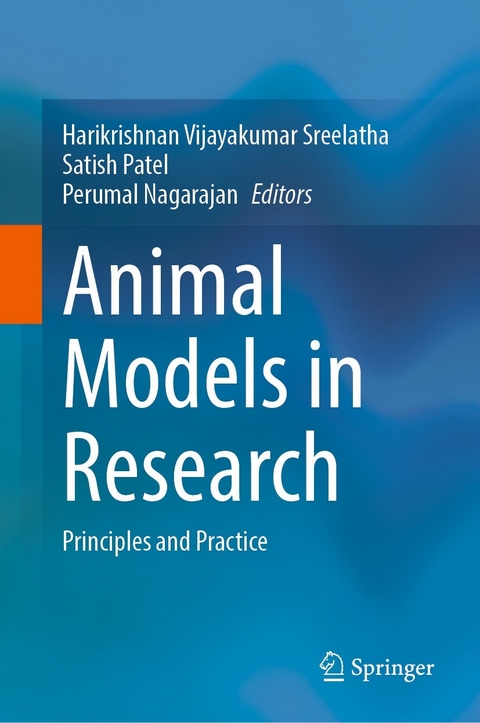
Animal Models in Research (eBook)
640 Seiten
Springer Nature Singapore (Verlag)
978-981-97-0048-6 (ISBN)
This book describes the development of animal models widely used in biomedical research using step-wise instructions and photographs. Showcasing a wide range of species from zebra fishes, birds, rodents, rabbits, dogs, and pigs, the book includes detailed methodology on how to work with these species and to develop various models. The animal models in neurology including stroke, Alzheimer’s disease, Parkinson’s disease, and Schizophrenia; Animal models in cancer research, sleep disorders, and cardiovascular diseases are described to meet the understanding of researchers who plan to replicate these models in their laboratories. In depth detailing on the development of targeted gene knockouts and transgenics, implantation models that are used in toxicology studies, and pharmacokinetic studies in pigs and dogs are a highlight. Further, the book describes pharmacologic, chemically induced, surgically induced, microbiologically induced, infectious models, models for neurobehavioral studies, oncology research, and pain research. The book has dedicated sections on anesthesia and analgesia and teaches procedures like venous cut-downs and cannulations in pigs and dogs, and endotracheal intubation, mechanical ventilation and thoracotomy in rodents and will serve as a self-training tool. Concepts in the field of animal model development are explained using examples. Sample size selection, study design, and statistical evaluation of experiments involving laboratory animals are explained to enable young researchers to practically understand the nuances. This book will be a valuable tool for academicians, students, scientists, and veterinarians and will benefit equally who are new to the field and who are already working with laboratory animals.
This book describes the development of animal models widely used in biomedical research using step-wise instructions and photographs. Showcasing a wide range of species from zebra fishes, birds, rodents, rabbits, dogs, and pigs, the book includes detailed methodology on how to work with these species and to develop various models. The animal models in neurology including stroke, Alzheimer's disease, Parkinson's disease, and Schizophrenia; Animal models in cancer research, sleep disorders, and cardiovascular diseases are described to meet the understanding of researchers who plan to replicate these models in their laboratories. In depth detailing on the development of targeted gene knockouts and transgenics, implantation models that are used in toxicology studies, and pharmacokinetic studies in pigs and dogs are a highlight. Further, the book describes pharmacologic, chemically induced, surgically induced, microbiologically induced, infectious models, models for neurobehavioral studies, oncology research, and pain research. The book has dedicated sections on anesthesia and analgesia and teaches procedures like venous cut-downs and cannulations in pigs and dogs, and endotracheal intubation, mechanical ventilation and thoracotomy in rodents and will serve as a self-training tool. Concepts in the field of animal model development are explained using examples. Sample size selection, study design, and statistical evaluation of experiments involving laboratory animals are explained to enable young researchers to practically understand the nuances. This book will be a valuable tool for academicians, students, scientists, and veterinarians and will benefit equally who are new to the field and who are already working with laboratory animals.
| Erscheint lt. Verlag | 3.4.2024 |
|---|---|
| Zusatzinfo | XV, 640 p. 308 illus., 230 illus. in color. |
| Sprache | englisch |
| Themenwelt | Medizin / Pharmazie ► Medizinische Fachgebiete ► Laboratoriumsmedizin |
| Naturwissenschaften ► Biologie | |
| Veterinärmedizin ► Klinische Fächer ► Versuchstiere | |
| Weitere Fachgebiete ► Land- / Forstwirtschaft / Fischerei | |
| Schlagworte | Animal Models • Disease biology • Genetics • Nutrition • pharmacology • Surgery |
| ISBN-10 | 981-97-0048-5 / 9819700485 |
| ISBN-13 | 978-981-97-0048-6 / 9789819700486 |
| Informationen gemäß Produktsicherheitsverordnung (GPSR) | |
| Haben Sie eine Frage zum Produkt? |
 PDF (Wasserzeichen)
DRM: Digitales Wasserzeichen
Dieses eBook enthält ein digitales Wasserzeichen und ist damit für Sie personalisiert. Bei einer missbräuchlichen Weitergabe des eBooks an Dritte ist eine Rückverfolgung an die Quelle möglich.
Dateiformat: PDF (Portable Document Format)
Mit einem festen Seitenlayout eignet sich die PDF besonders für Fachbücher mit Spalten, Tabellen und Abbildungen. Eine PDF kann auf fast allen Geräten angezeigt werden, ist aber für kleine Displays (Smartphone, eReader) nur eingeschränkt geeignet.
Systemvoraussetzungen:
PC/Mac: Mit einem PC oder Mac können Sie dieses eBook lesen. Sie benötigen dafür einen PDF-Viewer - z.B. den Adobe Reader oder Adobe Digital Editions.
eReader: Dieses eBook kann mit (fast) allen eBook-Readern gelesen werden. Mit dem amazon-Kindle ist es aber nicht kompatibel.
Smartphone/Tablet: Egal ob Apple oder Android, dieses eBook können Sie lesen. Sie benötigen dafür einen PDF-Viewer - z.B. die kostenlose Adobe Digital Editions-App.
Buying eBooks from abroad
For tax law reasons we can sell eBooks just within Germany and Switzerland. Regrettably we cannot fulfill eBook-orders from other countries.
aus dem Bereich