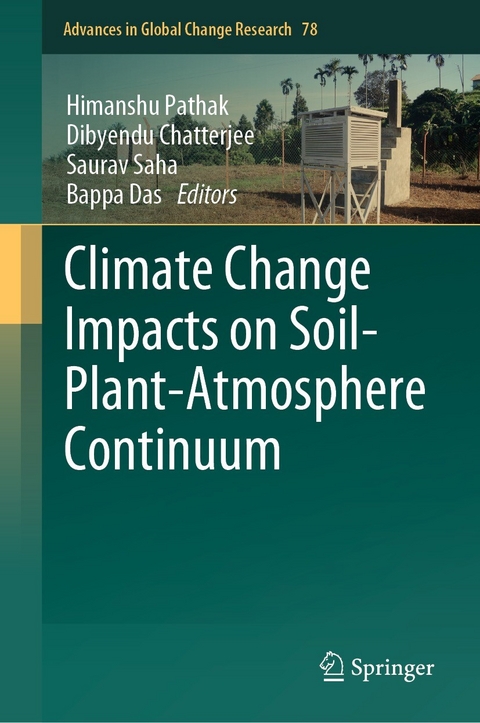
Climate Change Impacts on Soil-Plant-Atmosphere Continuum (eBook)
790 Seiten
Springer Nature Singapore (Verlag)
978-981-99-7935-6 (ISBN)
This book explores the interaction between climate change phenomena and the soil–plant–atmosphere continuum (SPAC), which inspects the crucial role of anthropogenic greenhouse gas emissions in modifying the net ecosystem response towards the modified environment. Increasing concentration of anthropogenic greenhouse gases (carbon dioxide, methane and nitrous oxide) from massive deforestation, fossil fuel burning and rapid industrialization in the post-nineteenth century have led to adverse changes in our global climate system. The book evaluates the net impact of climate change on soil, plants and the atmosphere individually and in totality. Among the topics it covers are the impact of climate change on soil environment which encompasses soil processes, nutrient cycling, soil carbon sequestration, soil biota response and soil health management. Also included are the impact on plants with respect to the dry matter assimilation pattern, modification in resource use efficiency, rhizosphere interactions, management of biotic and abiotic stress factors, and regulatory mechanisms of biotic stress factors in modifying the net agroecosystem response towards climate change. Moreover, potential genetic engineering options for establishing C4 or Crassulacean acid metabolism (CAM) in C3 plants, heat–drought stress on pollen biology, breeding ideotype, ecological indicators and crop simulation modelling are considered. Lastly, the impact on the atmosphere takes into account greenhouse gas measurements, mitigation options, eddy covariance measurement of greenhouse gasses, satellite-based monitoring, ecosystem services, abiotic stress management options, air pollution and atmospheric modelling. This book is a valuable resource for researchers, students and policymakers in understanding climate change impacts on interaction processes among the atmosphere, soil and plants from the local to regional scales.
This book explores the interaction between climate change phenomena and the soil-plant-atmosphere continuum (SPAC), which inspects the crucial role of anthropogenic greenhouse gas emissions in modifying the net ecosystem response towards the modified environment. Increasing concentration of anthropogenic greenhouse gases (carbon dioxide, methane and nitrous oxide) from massive deforestation, fossil fuel burning and rapid industrialization in the post-nineteenth century have led to adverse changes in our global climate system. The book evaluates the net impact of climate change on soil, plants and the atmosphere individually and in totality. Among the topics it covers are the impact of climate change on soil environment which encompasses soil processes, nutrient cycling, soil carbon sequestration, soil biota response and soil health management. Also included are the impact on plants with respect to the dry matter assimilation pattern, modification in resource use efficiency, rhizosphere interactions, management of biotic and abiotic stress factors, and regulatory mechanisms of biotic stress factors in modifying the net agroecosystem response towards climate change. Moreover, potential genetic engineering options for establishing C4 or Crassulacean acid metabolism (CAM) in C3 plants, heat-drought stress on pollen biology, breeding ideotype, ecological indicators and crop simulation modelling are considered. Lastly, the impact on the atmosphere takes into account greenhouse gas measurements, mitigation options, eddy covariance measurement of greenhouse gasses, satellite-based monitoring, ecosystem services, abiotic stress management options, air pollution and atmospheric modelling. This book is a valuable resource for researchers, students and policymakers in understanding climate change impacts on interaction processes among the atmosphere, soil and plants from the local to regional scales.
| Erscheint lt. Verlag | 1.4.2024 |
|---|---|
| Reihe/Serie | Advances in Global Change Research |
| Zusatzinfo | XVII, 790 p. 107 illus., 96 illus. in color. |
| Sprache | englisch |
| Themenwelt | Naturwissenschaften ► Biologie ► Botanik |
| Naturwissenschaften ► Biologie ► Ökologie / Naturschutz | |
| Naturwissenschaften ► Geowissenschaften ► Geologie | |
| Naturwissenschaften ► Geowissenschaften ► Meteorologie / Klimatologie | |
| Technik | |
| Weitere Fachgebiete ► Land- / Forstwirtschaft / Fischerei | |
| Schlagworte | climate change • Climate Monitoring • greenhouse gas emission • Resource use efficiency • Simulation modelling |
| ISBN-10 | 981-99-7935-8 / 9819979358 |
| ISBN-13 | 978-981-99-7935-6 / 9789819979356 |
| Informationen gemäß Produktsicherheitsverordnung (GPSR) | |
| Haben Sie eine Frage zum Produkt? |
 PDF (Wasserzeichen)
DRM: Digitales Wasserzeichen
Dieses eBook enthält ein digitales Wasserzeichen und ist damit für Sie personalisiert. Bei einer missbräuchlichen Weitergabe des eBooks an Dritte ist eine Rückverfolgung an die Quelle möglich.
Dateiformat: PDF (Portable Document Format)
Mit einem festen Seitenlayout eignet sich die PDF besonders für Fachbücher mit Spalten, Tabellen und Abbildungen. Eine PDF kann auf fast allen Geräten angezeigt werden, ist aber für kleine Displays (Smartphone, eReader) nur eingeschränkt geeignet.
Systemvoraussetzungen:
PC/Mac: Mit einem PC oder Mac können Sie dieses eBook lesen. Sie benötigen dafür einen PDF-Viewer - z.B. den Adobe Reader oder Adobe Digital Editions.
eReader: Dieses eBook kann mit (fast) allen eBook-Readern gelesen werden. Mit dem amazon-Kindle ist es aber nicht kompatibel.
Smartphone/Tablet: Egal ob Apple oder Android, dieses eBook können Sie lesen. Sie benötigen dafür einen PDF-Viewer - z.B. die kostenlose Adobe Digital Editions-App.
Buying eBooks from abroad
For tax law reasons we can sell eBooks just within Germany and Switzerland. Regrettably we cannot fulfill eBook-orders from other countries.
aus dem Bereich