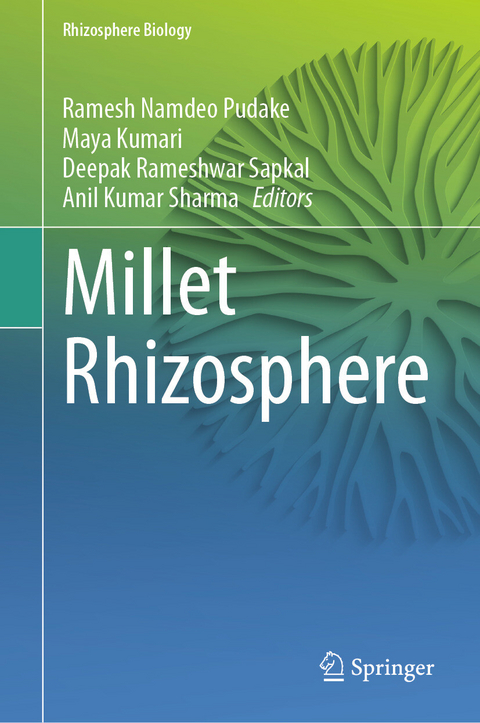
Millet Rhizosphere (eBook)
348 Seiten
Springer Nature Singapore (Verlag)
978-981-99-2166-9 (ISBN)
This edited volume is the first book that explicitly explains the link between the extraordinarily small-scale microbial processes and the growth and yield attributes of millet crops. This book includes chapters emphasizing on the effects of rhizosphere biology on long-term millet crop management. Millets are a collection of small-grained cereal grasses that are grown for human carbohydrate needs. They are among the oldest crops, mainly divided into two groups: major and small millets based on seed size. Major millets are composed of sorghum (Sorghum bicolor) and pearl millet (Pennisetum glaucum); while small millets are composed of six species that includes finger millet (Eleusine coracana (L.)), little millet (Panicum sumatrense), kodo millet (Paspalum scrobiculatum (L.)), foxtail millet (Setaria italica (L.)), barnyard millet (Echinochloa frumentacea (L.)), and proso millet (Panicum miliaceum (L.). These crops are earlier considered as orphan crops, but recently due to their nutritional values it is gaining the importance. Various reports are published based on role of rhizosphere on growth and health of these crops. The rhizosphere being a dynamic interface among the plant roots and soil microbes provides a number of advantages to the millets too. The soil properties in rhizospheric region are also different as compared to the bulk soil. This book discovers the functional attributes of rhizosphere in promoting the healthy growth of millet crop and achieving higher yield during the changing climatic condition. This book is of interest to university teachers, scientists working in the millets, and policymakers in agricultural departments. Also, the book serves as additional reading material for undergraduate and graduate students of agriculture, biotechnology, microbiology, genetics, and soil science.
| Erscheint lt. Verlag | 11.9.2023 |
|---|---|
| Reihe/Serie | Rhizosphere Biology | Rhizosphere Biology |
| Zusatzinfo | XIII, 348 p. 31 illus., 25 illus. in color. |
| Sprache | englisch |
| Themenwelt | Naturwissenschaften ► Biologie ► Botanik |
| Naturwissenschaften ► Biologie ► Mikrobiologie / Immunologie | |
| Naturwissenschaften ► Geowissenschaften ► Geologie | |
| Weitere Fachgebiete ► Land- / Forstwirtschaft / Fischerei | |
| Schlagworte | abiotic stress • Metabolic functions • Metagenomics • Millets • PGPR • rhizosphere • yield |
| ISBN-10 | 981-99-2166-X / 981992166X |
| ISBN-13 | 978-981-99-2166-9 / 9789819921669 |
| Informationen gemäß Produktsicherheitsverordnung (GPSR) | |
| Haben Sie eine Frage zum Produkt? |
 PDF (Wasserzeichen)
DRM: Digitales Wasserzeichen
Dieses eBook enthält ein digitales Wasserzeichen und ist damit für Sie personalisiert. Bei einer missbräuchlichen Weitergabe des eBooks an Dritte ist eine Rückverfolgung an die Quelle möglich.
Dateiformat: PDF (Portable Document Format)
Mit einem festen Seitenlayout eignet sich die PDF besonders für Fachbücher mit Spalten, Tabellen und Abbildungen. Eine PDF kann auf fast allen Geräten angezeigt werden, ist aber für kleine Displays (Smartphone, eReader) nur eingeschränkt geeignet.
Systemvoraussetzungen:
PC/Mac: Mit einem PC oder Mac können Sie dieses eBook lesen. Sie benötigen dafür einen PDF-Viewer - z.B. den Adobe Reader oder Adobe Digital Editions.
eReader: Dieses eBook kann mit (fast) allen eBook-Readern gelesen werden. Mit dem amazon-Kindle ist es aber nicht kompatibel.
Smartphone/Tablet: Egal ob Apple oder Android, dieses eBook können Sie lesen. Sie benötigen dafür einen PDF-Viewer - z.B. die kostenlose Adobe Digital Editions-App.
Buying eBooks from abroad
For tax law reasons we can sell eBooks just within Germany and Switzerland. Regrettably we cannot fulfill eBook-orders from other countries.
aus dem Bereich