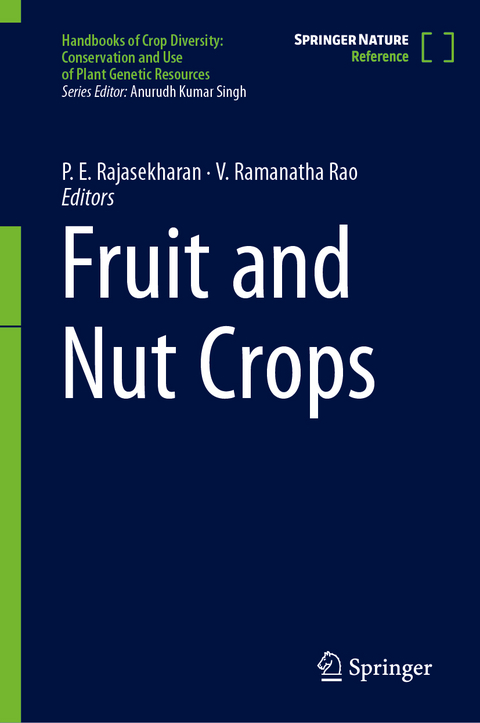
Fruit and Nut Crops
Springer Verlag, Singapore
978-981-99-5347-9 (ISBN)
Several fruit and nut species are semi-wild and domestication of these tree species helps to inculcate a secondary or tertiary gene pool and evolved for a new set of genome adapted for the agro ecological condition and biotic/abiotic stresses. Apparent lack of diversity in many modern cultivars can seriously limit our capacity to breed for both qualitative and quantitative traits. A better understanding of domestication acrossmany crop species may provide crucial information that may be needed to breed better fruit and nut crops for the future. Even then, the limited access to genetic diversity among the tree species creates an urgent need for exploration, evaluation and conservation. Conservation of genetic resources through complementary approaches will provide a sustainable and evolution friendly strategies. Utilization of these genetic resources, directly or indirectly (including in breeding programme) will improve the economic and social status of several communities, this will inturn contribute to the national social, cultural and economic betterment. The knowledge about the tree crop, its origin, diversity, distribution, taxonomy and botany will help the breeder to choose the appropriate parent and breeding strategy. Breeding of perennial fruit species is a long-term activity involving a high investment as compared to annual crops due to two challenges: long juvenile periods and large plant size. Despite these difficulties, breeding programmes have been developed in all important perennial fruit crops, aimed at the improved economic profitability of the crops by increasing yields, altering the harvest window, creating new fruit types, and improving fruit quality while simplifying management. The recent increase in activity has been encouraged by the integration of the intellectual property rights (IP rights) in fruit production which has created substantial research incentive in private and public spheres for innovation in the fruit industry.
This volume will be useful in fruit and nut genetic resources conservation and its effective utilization to breed improved crop cultivars. It should provide as a springboard for all fruit breeders desiring an update on the latest technologies, horticulturalists who wonder what is being done in fruit breeding.
Dr. P.E. Rajasekharan, until recently serving as a Principal Scientist at ICAR Indian Institute of Horticultural Research, boasts an impressive 38years of research experience in the fields of Horticultural genetic resources, Conservation and Management, and Intellectual Property Rights.Dr. Rajasekharan's academic journey reflects brilliance, securing a rank in M.Sc. (Botany) from Calicut University. He further achieved the top rank in the Agricultural Research Service All India competitive examination in Economic Botany. His academic pursuits culminated in a Ph.D. focused on the conservation of threatened medicinal plants from the Department of Botany, Bangalore University.In addition to his extensive research, Dr. Rajasekharan holds three postgraduate diplomas in IPR, HRD, and Ecology & Environment. He has successfully completed three certificate courses in Biotechnology, Genetic Engineering, and UPOV.Dr. Rajasekharan's research spans various areas, including cryopreservation of seed, pollen, and organelles of horticultural crops. His notable achievements include the establishment of a pollen cryobank comprising over 700 samples and the development of conservation protocols for RET (Rare, Endangered, and Threatened) medicinal plants, namely Madhuca insignis and Mappia foetida. His research findings have been published in more than 200 research papers across renowned national and international journals. His pioneering work in pollen cryopreservation has been recognized globally, with technology transfers to seed industries and the establishment of a pollen cryobank, earning a place in the Limca Book of Records-2001.. He has attracted external funding through projects from various agencies and conducted national-level training programs on Conservation and IPR.With an H index of 18 and an I index of 39 on Google Scholar, Dr. Rajasekharan has published over 200 research papers in national and international journals. He co-authored two books andedited 4volume for Springer Nature .: Dr. Rajasekharan's contributions have been acknowledged through various fellowships, including being elected as a Fellow of the Indian Society for Plant Genetic Resources and the Indian Association of Angiosperm Taxonomy. He actively participates as a councilor in professional societies and serves on advisory committees for prestigious institutions.Dr. Rajasekharan's commitment to education is evident through his role as a recognized faculty in various institutions and his guidance of numerous students at both the master's and doctoral levels. He continues to make significant contributions to academia, blending teaching with research and creating awareness about Intellectual Property Rights.In summary, Dr. P.E. Rajasekharan's career reflects a remarkable journey marked by scholarly achievements, global collaborations, impactful research, and a dedication to nurturing the next generation of researchers. Dr. Ramanatha Rao holdsa Ph.D. in Genetics and Plant Breeding, and his illustrious career has been marked by significant contributions to the field of genetic resources and plant breeding. From 1976 to 1989, he served at the International Crop Research Institute for the Semi-Arid Tropics, where he dedicated himself to the study of genetic resources of wild and cultivated groundnuts. During a year-long sabbatical at CENERGEN/EMBRAPA in Brasilia, Brazil (1983-84), he expanded his expertise in this domain. Throughout his tenure, Dr. Rao amassed a formidable collection of over 10,000 accessions, establishing himself as a leading authority in genetic diversity. Subsequently, from 1989 to 2007, he played a pivotal role at the International Board for Plant Genetic Resources, now known as Bioversity International. His assignments spanned diverse locations including Rome, Italy (1989-92), Singapore (1992-97), and Kuala Lumpur, Malaysia (1997-2007). Dr. Rao's work centered on the genetic diversity, conservation, and utilization of genetic resources for various crops, encompassing horticultural and forest species. His overarching goal was to contribute to the improvement of livelihoods in rural communities. A key aspect of his legacy is the instrumental role he played in establishing and enhancing National Plant Genetic Resources Programmes (NPGRS) in numerous countries across Asia and the Pacific. Post-retirement, Dr. Rao continued to make valuable contributions as an Honorary Research Fellow from 2007 to 2014. Notably, he assisted Bioversity International in developing and successfully implementing a proposal for the conservation and utilization of tropical tree fruits. This ambitious project, funded by the Global Environment Facility/United Nations Environment Programme (GEF/UNEP), built upon the foundations laid by an earlier fruit tree project funded by the Asian Development Bank (ADB). Dr. Ramanatha Rao's influence extends beyond his hands-on contributions, as reflected in his extensive publication record comprising over 300 publications. These encompass a variety of categories, including edited books published by esteemed institutions such as the National Museum, Osaka; Routledge, UK; the Centre for Agriculture and Bioscience International (CABI), UK; and Springer. His scholarly impact underscores his commitment to advancing the understanding and utilization of plant genetic resources on a global scale.
lt;p>Apple Malus pumila Mill.- Black currant, Ribesnigrum L.- Strawberry, Fragariaspp.- Grape, Vitis vinifera L.- Prunus spp.: Prunus amygdalusBatsch, Almond; Prunus armeniacaL., Apricot; Prunus persica(L.) Batsch., Peach & others - Papaya Pyrus Spp.- Pyruscommunis L., Pear & other Pyrus spp.- Banana Species - Guava, Psidiumguvjava L.- Litchi, Lychee, LitchichinensisSonn.- MangoMangiferaindica l. and other Mangifera spp.- Oranges and other citrus fruit, Citrus spp.- Pomegranate, Punicagranatum L. - Walnut - Cashew nut - Custard apple, Annona squamosa L. &otherAnnona spp.- Date palm, Phoenix dactylifera L., - Fig, FicuscaricaL. & other Ficusspp.- Phyllanthus emblica L - Java plum, Syzygiumcumini (L.) Skeels, and Syzygium spp.- Aegle marmelosL., Bael.- Capparis decidua (Frosk.) Edgew, Ker.- Cordia myxaRoxb., Lasoda.- Carissa carandasL., Karonda.- Garcinia mangostanaL., Mangosteen; GrewiaasiaticaL., Grewia.- Tamarindusindica L., Tamarind.- Feronia limonia L. Kaith, etc.) - Indian Pear (Pyrus pashia) - Melons (Watermelon, Cantaloupe, Honeydew).
| Erscheinungsdatum | 02.05.2024 |
|---|---|
| Reihe/Serie | Handbooks of Crop Diversity: Conservation and Use of Plant Genetic Resources |
| Zusatzinfo | 39 Illustrations, color; 1 Illustrations, black and white |
| Verlagsort | Singapore |
| Sprache | englisch |
| Maße | 155 x 235 mm |
| Themenwelt | Naturwissenschaften ► Biologie ► Botanik |
| Naturwissenschaften ► Biologie ► Evolution | |
| Naturwissenschaften ► Biologie ► Ökologie / Naturschutz | |
| Weitere Fachgebiete ► Land- / Forstwirtschaft / Fischerei | |
| Schlagworte | Agrobiodiversity • conservation • Crop utilization • Fruit and nuts crop • Genomic Diversity • plant genetic resources |
| ISBN-10 | 981-99-5347-2 / 9819953472 |
| ISBN-13 | 978-981-99-5347-9 / 9789819953479 |
| Zustand | Neuware |
| Informationen gemäß Produktsicherheitsverordnung (GPSR) | |
| Haben Sie eine Frage zum Produkt? |
aus dem Bereich