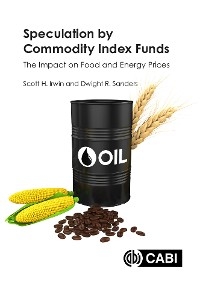
Speculation by Commodity Index Funds (eBook)
288 Seiten
CABI (Verlag)
978-1-80062-210-4 (ISBN)
Commodity futures prices exploded in 2007-2008 and concerns about a new type of speculative participant in commodity futures markets began to emerge. The main argument was that unprecedented buying pressure from new "commodity index" investors created massive bubbles that resulted in prices substantially exceeding fundamental value. At the time, it was not uncommon to link concerns about speculation and high prices to world hunger, food crises, and civil unrest. Naturally, this outcry resulted in numerous regulatory proposals to restrict speculation in commodity futures markets.
At the core, these assertions raised major economic questions about the efficiency of price discovery in commodity futures markets. Moreover, these so-called remedies did not come without a potential cost. Burdensome regulations would increase compliance and risk sharing costs across the global food system, lowering prices for producers and increasing costs to consumers.
This book presents important research on the impact of index investment on commodity futures prices that the authors conducted over the last fifteen years. The eleven articles presented in the book follow the timeline of our involvement in the world-wide debate about index funds as it evolved after 2007. We also include an introductory chapter, new author forewords for each article chapter, and a lessons learned chapter to round out the book. Policy-makers, researchers, and market participants will find the book not only functions as useful documentation of the debate; but, also as a natural starting point when high commodity prices inevitably create the next speculation backlash.
This collection of papers by Irwin and Sanders, spanning their decade plus of collaboration on commodity futures markets and the impacts of index fund investing on those markets, is greater than the sim of its parts.
The authors have included additional insights and backstories in new forewords to each of the eleven papers collected here. These alone are worth the price of admission. If you study, invest in, or regulate commodity futures markets, this book is essential reading.
Many observers and policy makers are convinced that participation in commodity markets by speculators and financial investors contributed to the volatility in commodity prices over the last two decades. Irwin and Sanders have been at the forefront of careful academic investigation of the evidence that could support this conclusion. The studies in this book use data on the positions of index fund traders in commodity futures markets, roll yields and rollover effects, and order-flow costs together with the economic theory and practical understanding of how futures markets function. This evidence is must reading for anyone who has concluded that we need to tighten limits on participation in these markets.
When food prices began spiking around the world in late 2007 - and multiple times since then - observers offered a range of competing explanations. One popular explanation was the 'financialization' of agricultural commodity markets.
One popular explanation was the 'financialization' of agricultural commodity markets. The idea that financial speculators were diversifying from more traditional financial securities into commodity futures, including through new commodity index fund structures, and that this innovation was enriching a few while immiserating millions captured popular and policymakers' imaginations. The correlational evidence indeed seemed consistent with that hypothesis. Two experts in agricultural finance, Scott Irwin and Dwight Sanders, took those concerns seriously. Using the best available theory, methods and data they rigorously tested a range of hypotheses around the central claim: financial speculation increasingly drives food prices globally. Their findings are the most convincing evidence available on the topic, largely showing the correlation is largely spurious, not causal.
This book pulls together various papers they wrote on the topic into a coherent, compelling narrative. It is a must read for anyone interested in this topic at a serious level.
| Erscheint lt. Verlag | 25.4.2023 |
|---|---|
| Verlagsort | Oxford |
| Sprache | englisch |
| Themenwelt | Recht / Steuern ► Wirtschaftsrecht |
| Technik | |
| Wirtschaft ► Betriebswirtschaft / Management ► Finanzierung | |
| Weitere Fachgebiete ► Land- / Forstwirtschaft / Fischerei | |
| Schlagworte | Agricultural Economics • commodities markets • Commodity prices • financial index investment • Food Prices • food security • Futures Markets • grain futures • Index Funds • Speculation • swap funds |
| ISBN-10 | 1-80062-210-4 / 1800622104 |
| ISBN-13 | 978-1-80062-210-4 / 9781800622104 |
| Informationen gemäß Produktsicherheitsverordnung (GPSR) | |
| Haben Sie eine Frage zum Produkt? |
 EPUB (Adobe DRM)
Kopierschutz: Adobe-DRM
Adobe-DRM ist ein Kopierschutz, der das eBook vor Mißbrauch schützen soll. Dabei wird das eBook bereits beim Download auf Ihre persönliche Adobe-ID autorisiert. Lesen können Sie das eBook dann nur auf den Geräten, welche ebenfalls auf Ihre Adobe-ID registriert sind.
Details zum Adobe-DRM
Dateiformat: EPUB (Electronic Publication)
EPUB ist ein offener Standard für eBooks und eignet sich besonders zur Darstellung von Belletristik und Sachbüchern. Der Fließtext wird dynamisch an die Display- und Schriftgröße angepasst. Auch für mobile Lesegeräte ist EPUB daher gut geeignet.
Systemvoraussetzungen:
PC/Mac: Mit einem PC oder Mac können Sie dieses eBook lesen. Sie benötigen eine
eReader: Dieses eBook kann mit (fast) allen eBook-Readern gelesen werden. Mit dem amazon-Kindle ist es aber nicht kompatibel.
Smartphone/Tablet: Egal ob Apple oder Android, dieses eBook können Sie lesen. Sie benötigen eine
Geräteliste und zusätzliche Hinweise
Buying eBooks from abroad
For tax law reasons we can sell eBooks just within Germany and Switzerland. Regrettably we cannot fulfill eBook-orders from other countries.
aus dem Bereich