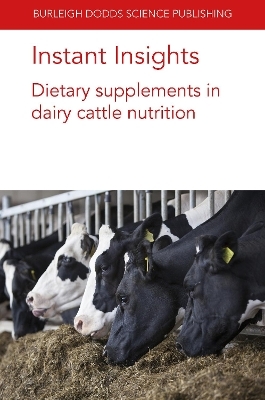
Instant Insights: Dietary Supplements in Dairy Cattle Nutrition
Burleigh Dodds Science Publishing Limited (Verlag)
978-1-80146-425-3 (ISBN)
The first chapter addresses the manipulation of rumen fermentation to maximise the efficiency of feed utilisation and increase ruminant productivity. It considers a wide variety of approaches, including the use of dietary buffers.
The second chapter reviews the use of probiotics as supplements for ruminants to promote digestive efficiency and productivity. The chapter summarises the benefits and modes of action of probiotics, as well as their role in optimising feed efficiency and reducing methane production.
The third chapter considers the beneficial roles of plant secondary compounds in sustainable ruminant nutrition. It describes the effects and composition of the three major groups of plant secondary compounds: essential oils, tannins and saponins.
The fourth chapter discusses the growing need for alternative feed sources as a result of increasing demand for meat and dairy products. The chapter reviews the nutritional composition of seaweed and introduces it as a potential novel protein supplement in animal feeds.
The final chapter evaluates the role of macroalgae as a potential anti-methanogenic ruminant feed resource and reviews its impact on animal production and performance.
Chapter 1 - Feed supplements for dairy cattle: C. Jamie Newbold, Aberystwyth University, UK; 1 Introduction 2 Dietary buffers to control rumen acidity 3 Antibiotics for improved production 4 Fat supplementation 5 Immunological control of the rumen microbial population 6 Plant extracts to manipulate rumen fermentation, boost production and decrease emissions 7 Direct-fed microbials, probiotics and exogenous fibrolytic enzymes 8 Other supplements to control GHG emissions 9 Conclusion 10 Where to look for further information 11 References
Chapter taken from: Webster, J. (ed.), Achieving sustainable production of milk – Volume 3: Dairy herd management and welfare, Burleigh Dodds Science Publishing, Cambridge, UK, 2017, (ISBN 978 1 78676 052 4)
Chapter 2 - The use of probiotics as supplements for ruminants: Frédérique Chaucheyras-Durand and Lysiane Dunière, Lallemand Animal Nutrition and Université Clermont Auvergne, INRAE, UMR 454 MEDIS, France; 1 Introduction 2 Critical periods in the ruminant lifecycle as targets for probiotics 3 Definitions, delivery mechanisms and regulation 4 Benefits and modes of action of probiotics: young ruminants 5 Benefits and modes of action of probiotics: feed efficiency in adult ruminants 6 Benefits and modes of action of probiotics: methane production 7 Benefits and modes of action of probiotics: pathogen control 8 Benefits and modes of action of probiotics: effects on the immune system 9 Conclusions and future trends 10 Acknowledgments 11 Where to look for further information section 12 References
Chapter taken from: McSweeney, C. S. and Mackie, R. I. (eds.), Improving rumen function, Burleigh Dodds Science Publishing, Cambridge, UK, 2020, (ISBN 978 1 78676 332 7)
Chapter 3 - Plant secondary compounds: beneficial roles in sustainable ruminant nutrition and productivity: David R. Yáñez-Ruiz and Alejandro Belanche, Estación Experimental del Zaidín, CSIC, Spain; 1 Introduction 2 Essential oils (EO) 3 Tannins 4 Saponins 5 Future trends and conclusion 6 References
Chapter taken from: McSweeney, C. S. and Mackie, R. I. (eds.), Improving rumen function, Burleigh Dodds Science Publishing, Cambridge, UK, 2020, (ISBN 978 1 78676 332 7)
Chapter 4 - Seaweed as a potential protein supplement in animal feeds: Sung Woo Kim, North Carolina State University, USA; 1 Introduction 2 Novel protein sources for animal feeds 3 Seaweed production for foods and feeds 4 Nutrient composition of seaweeds 5 Seaweeds as protein supplements in feeds 6 Conclusion 7 Where to look for further information 8 References
Chapter taken from: Lei, X. G. (ed.), Seaweed and microalgae as alternative sources of protein, Burleigh Dodds Science Publishing, Cambridge, UK, 2021, (ISBN 978 1 78676 620 5)
Chapter 5 - Nutritional and anti-methanogenic potentials of macroalgae for ruminants: Deepak Pandey, Nord University, Norway; Morteza Mansouryar, University of Copenhagen, Denmark; Margarita Novoa-Garrido, Geir Næss and Viswanath Kiron, Nord University, Norway; Hanne Helene Hansen, University of Copenhagen, Denmark; Mette Olaf Nielsen, Aarhus University, Denmark; and Prabhat Khanal, Nord University, Norway; 1 Introduction 2 Nutritional value of macroalgae 3 Digestibility of macroalgae as a feed or feed ingredients 4 Anti-methanogenic properties of macroalgae 5 Processing and seasonal effects on anti-methanogenic properties of macroalgae 6 Future perspectives 7 Conclusion 8 Where to look for further information 9 Funding 10 References
Chapter taken from: Lei, X. G. (ed.), Seaweed and microalgae as alternative sources of protein, Burleigh Dodds Science Publishing, Cambridge, UK, 2021, (ISBN 978 1 78676 620 5)
| Erscheinungsdatum | 26.09.2022 |
|---|---|
| Reihe/Serie | Burleigh Dodds Science: Instant Insights |
| Zusatzinfo | Color tables, photos and figures |
| Verlagsort | Cambridge |
| Sprache | englisch |
| Maße | 152 x 229 mm |
| Gewicht | 260 g |
| Themenwelt | Weitere Fachgebiete ► Land- / Forstwirtschaft / Fischerei |
| ISBN-10 | 1-80146-425-1 / 1801464251 |
| ISBN-13 | 978-1-80146-425-3 / 9781801464253 |
| Zustand | Neuware |
| Informationen gemäß Produktsicherheitsverordnung (GPSR) | |
| Haben Sie eine Frage zum Produkt? |
aus dem Bereich