Forest Ecology (eBook)
John Wiley & Sons (Verlag)
978-1-119-70441-6 (ISBN)
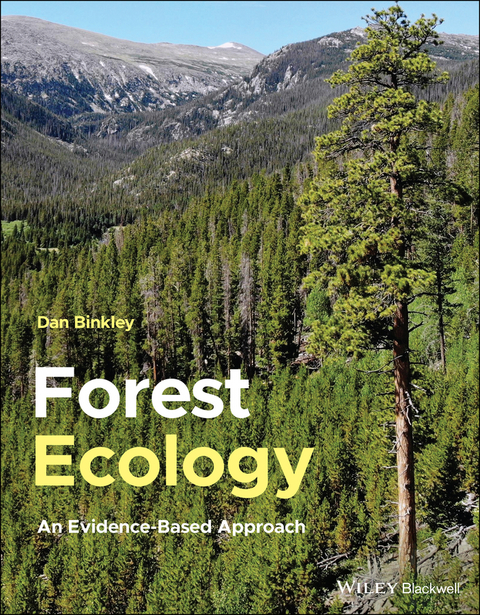
Forest Ecology
An Evidence-Based Approach
Forest ecology is the science that deals with everything in forests, including plants and animals (and their interactions), the features of the environment that affect plants and animals, and the interactions of humans and forests. All of these components of forests interact across scales of space and time. Some interactions are constrained, deterministic, and predictable; but most are indeterminant, contingent, and only broadly predictable.
Forest Ecology: An Evidence-Based Approach examines the features common to all forests, and those unique cases that illustrate the importance of site-specific factors in determining the structure, function, and future of a forest. The author emphasizes the role of evidence in forest ecology, because appealing, simple stories often lead to misunderstandings about how forests work. A reliance on evidence is central to distinguishing between appealing stories and stories that actually fit real forests.
The evidence-based approach emphasizes the importance of real-world, observable science in forests. Classical approaches to ecology in the twentieth century often over-emphasized appealing concepts that were not sufficiently based on real forests. The vast amount of information now available on forests allows a more complete coverage of forest ecology that relies on a strong, empirical foundation.
Forest Ecology: An Evidence-Based Approach is the ideal companion text for the teaching of upper-level undergraduate and graduate courses in forest ecology.
About the Author
Dan Binkley is Adjunct Professor in the School of Forestry at Northern Arizona University, USA.
About the Author Dan Binkley is Adjunct Professor in the School of Forestry at Northern Arizona University, USA.
Dedication
Acknowledgements
Preface
Chapter 1: The nature of forest
Chapter 2: Forest environments
Chapter 3: Evolution and adaptation in forests
Chapter 4: Physiology and life history of trees
Chapter 5: Ecology of wildlife in forests
Chapter 6: Forest soils, nutrient cycling, and hydrology
Chapter 7: Ecology of growth of trees and forests
Chapter 8: Forests across space
Chapter 9: Forests through time
Chapter 10: Events in forests: winds, insects and diseases
Chapter 11: Events in forests: fire
Chapter 12: Events in forests: management
Chapter 13: Conservation, sustainability and restoration of forests
Chapter 14: Forests of the future
References
Index
Preface
How Do We Come to Understand Forests?
This book supports learning about forest ecology. A good place to start is with a few points about knowledge, followed by a framework on how to approach forest ecology, some key features of using graphs to interpret information, and finally coming around to how to think about questions and answers in forests.
Humans try to understand complex worlds through a range of perspectives. Art tries to capture some essential features of a complex world, emphasizing how parts interact to form wholes. Religions explain how worlds work now, how the worlds came to be, and what will come next. Both art and religion develop from ideas and concepts, originated by individual artists or passed down by religious societies. How do we know if a work of art or an idea in religion represents the real world accurately? This question generally isn’t important. Art that satisfies the artist is good art, and religions are accepted on faith.
Art and religion have been evolving for more than 100 000 years, and lands and forests have been part of that development. One of the first written stories is a religious one from the Epic of Gilgamesh, from more than 4000 years ago from the Mesopotamian city of Uruk (now within Iraq). Gilgamesh and a companion traveled to the distant, sacred Cedar Mountain to cut trees. Lines from the epic poem include (based on Al‐Rawi and George 2014):
They stood there marveling at the forest, observing the height of the cedars … They were gazing at the Cedar Mountain, dwelling of gods, sweet was its shade, full of delight. All tangled was the thorny undergrowth, the forest a thick canopy, cedars so entangled it had no ways in. For one league on all sides cedars sent forth saplings, cypresses for two‐thirds of a league. Through all the forest a bird began to sing … answering one another, a constant din was the noise. A solitary tree‐cricket set off a noisy chorus. A wood pigeon was moaning, a turtle dove calling in answer. At the call of the stork, the forest exults. At the cry of the francolin bird, the forest exults in plenty. Monkey mothers sing aloud, a youngster monkey shrieks like a band of musicians and drummers, daily they bash out a rhythm …
And after slaying the demigod who protected the forest, Gilgamesh's companion laments:
My friend, we have cut down a lofty cedar, whose top abutted the heavens … We have reduced the forest to a wasteland.
What would actually happen if cedar trees were cut on a mountain? Would more cedar trees establish, would the post‐cutting landscape provide suitable habitat for the birds and monkeys? Would floods result? Anything could happen next in a story, but understanding which stories about the real world warrant confidence depends on the strength of evidence.
The core of understanding is knowing how one thing connects to another, and if the connections are the same everywhere and all the time, or if local details strongly influence the connections. The seasonal movements of the sun across the sky are consistent across years, but appear to differ from southern to northern locations. Multiple stories might explain the Sun's march with reasonable accuracy. Patterns etched on rocks by ancient artists may line up with key points in the Sun's seasonal patterns, and the movements of the Sun may reliably follow ceremonies convened by a society with the goal of ensuring the Sun's path. With art and religion, people may have understood the movement of the sun through the year was actually caused by the etchings on rocks or by ceremonial rites. These ideas may or may not have been true, but stories do not have to be true to be useful. Stories can persist as long as they are not so harmful that a society would be undermined. This idea is the same as genes in a population; natural selection does not aim toward retaining the best genes across generations, it only tends to remove genes that are harmful.
The human drive to understand cause and effect entered a new dimension when the notion developed of trying to figure out if an appealing idea might be wrong. Ideas of Newtonian physics and especially relativistic physics not only chart the apparent movement of the sun with more precision than would be possible from rock etchings or ceremonies, they also would be very, very easy to prove to be wrong. A deviation as small as one part in one million could prove the expectations of physicists were wrong. This innovation of science, based on investigating if an idea is wrong, developed very slowly alongside art and religion, and then exploded over the past four centuries to change the world.
Scientific thinking comes with two parts: creative new ideas about how the world works, and tough challenges that find out if the idea warrants confidence. Clearly most of the creative new ideas that scientists developed were wrong, either fundamentally or just around the edges. The ideas that withstood the challenges of testing have transformed the planet, feeding billions more people than our historical planet could have fed, sending machines across the solar system, and giving us an understanding of how our atoms formed in a collapsing star and how those same stellar reactions can be harnessed to obliterate cities. The idea that investigating whether an idea might be wrong has proven to be the most powerful insight humans have ever developed.
Returning to forests, trees and forests continue to be parts of art, religion, and science. When it comes to the scientific understanding of forests, both parts of science are needed: the generation of creative ideas and the challenging of those ideas to see if they warrant confidence. How do creative ideas about forests arise? That complex question has no simple answer, though creative ideas might arouse observation, learning, thinking, and pondering. The second part is more straightforward; once an idea is expressed, the hard work can begin on challenging the idea, to see if it's a better idea for accounting how forests differ across space and time.
A key point in science is being clear on which of these two aspects is being developed. The generation of a creative idea should not be mistaken for a reliable, challenge‐based conclusion. Challenging an existing idea is important, though real gains in insights might depend on new ideas and new methods of measuring and interpreting.
How Confident Should You Be?
The confidence warranted in the truth of art or religion does not depend on the strength of evidence. The confidence warranted in scientific ideas always depends on evidence. Some scientific ideas warrant more confidence than others, and a scale of increasing confidence would be:
- Weakest: Ideas based on appealing thoughts or concepts;
- Weak: Analogies where well‐tested insights from another area of knowledge are extended to a new area;
- Moderately strong: Ideas supported by good evidence from one or a few case studies or experiments; and
- Strong: Evidence‐based ideas with robust trends across many locations and periods of time.
This is also a scale representing how surprising it would be to find out an idea was wrong, with the level of surprise increasing down the list. These distinctions may seem a bit dull and uninteresting, but the differences are as important as a person trying to fly on a magic carpet, to fly like a bird, to fly in an experimental airplane, or to fly in airplane certified to be safe with a record of thousands of hours of safe flights. Which approach to flying warrants the highest confidence for arriving safely at a distant destination?
One of the most common sources of creative ideas is making analogies. This tree has fruits that look like acorns, just like oaks have acorns, so this tree belongs with the group of oak species. Another analogy would be that aspen trees regenerate across burned hillsides and so do lodgepole pine trees, so aspen belongs in the group that lodgepole pine belongs in. Analogies may be true or false, but the key is to recognize that analogies represent only an initial, incomplete step of science. An analogy is reliably useful only when challenged by evidence. The acorn example could be challenged in many ways, including comparing other features of the tree with other oak trees, or especially by comparing DNA and genes. The analogy between the aspen and pine is not so obviously useful. If a grouping included trees that do well after severe fires, the trees indeed share useful features. For any other grouping, such as a suitability to feed beavers or mountain pine beetles, they clearly do not.
Creative ideas may begin as concepts or analogies, but gauging confidence depends on taking the next step to list the similarities and differences between the objects or sets of objects. An analogy might have more potential for useful insights when the similarities include major, diverse features. Analogies are less useful (or even harmful) when the list of key differences is substantial (Neustadt and May 1986).
All Forest Ecology Fits Into a Framework and a Method
Whether a creative idea originated in a concept, an analogy or another line of reasoning, science is incomplete if the idea is not challenged by evidence. The challenge needs to include ways that have a chance to show the idea to be wrong. This book raises questions about how forests work, and examines how the ideas have been challenged by evidence.
A good step for thinking about complex systems is developing a framework for understanding pieces of the system, and how the pieces interact. This book uses a...
| Erscheint lt. Verlag | 26.7.2021 |
|---|---|
| Sprache | englisch |
| Themenwelt | Naturwissenschaften ► Biologie ► Ökologie / Naturschutz |
| Naturwissenschaften ► Geowissenschaften ► Geologie | |
| Weitere Fachgebiete ► Land- / Forstwirtschaft / Fischerei | |
| Schlagworte | Agriculture • Angewandte Ökologie • Applied Ecology • Biowissenschaften • Environmental Science • Environmental Studies • forestry • Forstwirtschaft • Landwirtschaft • Life Sciences • Ökologie • Umweltforschung • Umweltwissenschaften |
| ISBN-10 | 1-119-70441-3 / 1119704413 |
| ISBN-13 | 978-1-119-70441-6 / 9781119704416 |
| Informationen gemäß Produktsicherheitsverordnung (GPSR) | |
| Haben Sie eine Frage zum Produkt? |
 EPUB (Adobe DRM)
Kopierschutz: Adobe-DRM
Adobe-DRM ist ein Kopierschutz, der das eBook vor Mißbrauch schützen soll. Dabei wird das eBook bereits beim Download auf Ihre persönliche Adobe-ID autorisiert. Lesen können Sie das eBook dann nur auf den Geräten, welche ebenfalls auf Ihre Adobe-ID registriert sind.
Details zum Adobe-DRM
Dateiformat: EPUB (Electronic Publication)
EPUB ist ein offener Standard für eBooks und eignet sich besonders zur Darstellung von Belletristik und Sachbüchern. Der Fließtext wird dynamisch an die Display- und Schriftgröße angepasst. Auch für mobile Lesegeräte ist EPUB daher gut geeignet.
Systemvoraussetzungen:
PC/Mac: Mit einem PC oder Mac können Sie dieses eBook lesen. Sie benötigen eine
eReader: Dieses eBook kann mit (fast) allen eBook-Readern gelesen werden. Mit dem amazon-Kindle ist es aber nicht kompatibel.
Smartphone/Tablet: Egal ob Apple oder Android, dieses eBook können Sie lesen. Sie benötigen eine
Geräteliste und zusätzliche Hinweise
Buying eBooks from abroad
For tax law reasons we can sell eBooks just within Germany and Switzerland. Regrettably we cannot fulfill eBook-orders from other countries.
aus dem Bereich