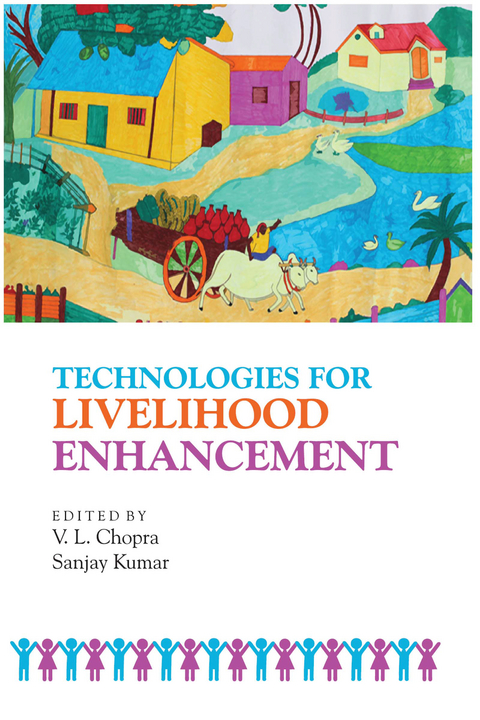
Technologies For Livelihood Enhancement (eBook)
634 Seiten
New India Publishing Agency (NIPA) (Verlag)
978-93-89130-36-2 (ISBN)
Twenty five s in this book are grouped into six sections: o setting the stage: topics relevant to livelihoods context, o crop agriculture, o vegetables and fruits, o animal sciences and fisheries, o agroforestry, o other livelihood options. Section on “setting the stage topics relevant to livelihoods context” (s 1-4) deals with a range of livelihood options, and addresses the issue of livelihood promotion, protection, and sustenance including under the emerging scenario of climate change. This section also deals with corporate social responsibility and the criticality of water as fundamental to livelihood The second section on “crop agriculture” (s 5-9) highlights the relevance and importance of technologies that have the potential of boosting productivity of food, feed and horticultural crops for enhancing livelihood security and quality of life of farmers. Discussion here deals with approaches for combating abiotic and biotic stresses for improving production stability and efficiency with focus on combining productivity with stress tolerance. Importance of weed management and early warning systems for disaster management is also highlighted for safeguarding livelihoods. The vegetables and fruits section (s 10-14) discusses use of traditional and emerging technologies, hybrid technology, green-house and related protected cultivation technologies, and appropriate policies to empower farmers to boost their income. Protection against insect-pest and deployment of disease tolerant crops not only improves socio-economic status of farmers but also ensures cleaner environment. Realizing the vast potential of animals and fisheries for reducing poverty and enhancing livelihood, the next section has five presentations (s 15-19) covering issues ranging from cold water fishes to highlander yak. The importance of cattle, the relevance of veterinarians and the criticality of currently available and futuristic technologies is also underlined. Where relevant, the section undertakes SWOT analysis and discusses issues emerging from climate change. The agroforestry section (s 20-22) propagates the value of synergy of agriculture with appropriate forestry technologies to evolve a profitable and sustainable land-use system. The section details with many potentially powerful agroforestry technologies, the range of available tradable bioresources and important pursuable options pertaining to medicinal and aromatic plants. Indigenous food products, bee keeping and silk productions are three important issues grouped under “other livelihood options” (s 23-25). This section discusses the importance, need of introducing scientific and technological interventions, and improving policy decision making for improving livelihood via agro-industrial development.
| Erscheint lt. Verlag | 8.5.2020 |
|---|---|
| Verlagsort | New Delhi |
| Sprache | englisch |
| Themenwelt | Schulbuch / Wörterbuch ► Lexikon / Chroniken |
| Sozialwissenschaften ► Pädagogik | |
| Sozialwissenschaften ► Soziologie | |
| Technik ► Lebensmitteltechnologie | |
| Wirtschaft ► Betriebswirtschaft / Management | |
| Weitere Fachgebiete ► Land- / Forstwirtschaft / Fischerei | |
| ISBN-10 | 93-89130-36-0 / 9389130360 |
| ISBN-13 | 978-93-89130-36-2 / 9789389130362 |
| Informationen gemäß Produktsicherheitsverordnung (GPSR) | |
| Haben Sie eine Frage zum Produkt? |
 PDF (Adobe DRM)
Kopierschutz: Adobe-DRM
Adobe-DRM ist ein Kopierschutz, der das eBook vor Mißbrauch schützen soll. Dabei wird das eBook bereits beim Download auf Ihre persönliche Adobe-ID autorisiert. Lesen können Sie das eBook dann nur auf den Geräten, welche ebenfalls auf Ihre Adobe-ID registriert sind.
Details zum Adobe-DRM
Dateiformat: PDF (Portable Document Format)
Mit einem festen Seitenlayout eignet sich die PDF besonders für Fachbücher mit Spalten, Tabellen und Abbildungen. Eine PDF kann auf fast allen Geräten angezeigt werden, ist aber für kleine Displays (Smartphone, eReader) nur eingeschränkt geeignet.
Systemvoraussetzungen:
PC/Mac: Mit einem PC oder Mac können Sie dieses eBook lesen. Sie benötigen eine
eReader: Dieses eBook kann mit (fast) allen eBook-Readern gelesen werden. Mit dem amazon-Kindle ist es aber nicht kompatibel.
Smartphone/Tablet: Egal ob Apple oder Android, dieses eBook können Sie lesen. Sie benötigen eine
Geräteliste und zusätzliche Hinweise
Buying eBooks from abroad
For tax law reasons we can sell eBooks just within Germany and Switzerland. Regrettably we cannot fulfill eBook-orders from other countries.
aus dem Bereich