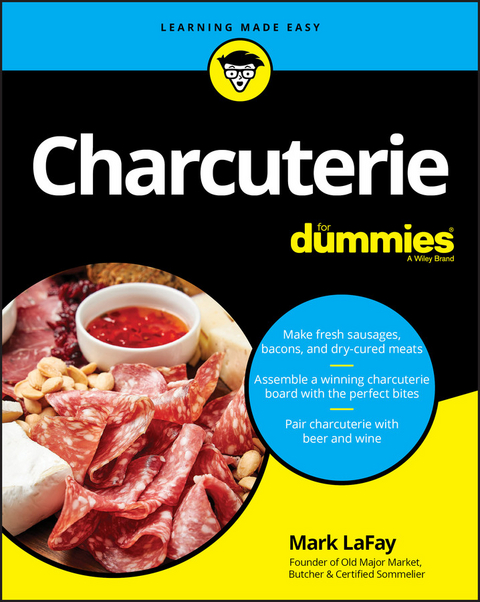
Charcuterie For Dummies (eBook)
John Wiley & Sons (Verlag)
978-1-119-74870-0 (ISBN)
The world of charcuterie is at your fingertips
Even if you've never cooked a slab of bacon in your life, you can prepare sausage and cured meats at home! In Charcuterie for Dummies, you'll learn everything you could possibly need to get started, from choosing the right gear and finding quality raw ingredients, all the way through taking your parties to the next level with epic charcuterie boards.
Salami, bacon, prosciutto, and good-old-fashioned sausage are all on the menu with Charcuterie for Dummies. Author and meat master Mark LaFay will help you keep things safe and sanitary, equip you with some seriously awesome recipes, and teach you a thing or two about which beers and wines to serve up with your meat. Choose a chapter and get started!
- Get started curing meats at home with the highest quality raw ingredients, equipment, and recipes
- Make everything from sausage and bacon to prosciutto, salami, and more
- Learn how to pair your homemade meats with jams, nuts, cheeses, and pickles for epic charcuterie boards
- Take your new hobby to the next level with more advanced recipes and beverage pairings
Whether you're a total beginner or coming in with some previous knowledge, Charcuterie for Dummies will unleash your culinary creativity!
Mark LaFay is the founder of Old Major Market, a virtual artisanal butcher shop in Indianapolis. He started in 2016 with a vision for a new way of retailing artisanal meats and provisions directly to consumers without a brick and mortar store. LaFay is a serial entrepreneur, butcher, certified sommelier, the Abe Frohman of Indianapolis, and the 2015 and 2017 Indiana State Fair Backyard BBQ Grand Champion.
The world of charcuterie is at your fingertips Even if you ve never cooked a slab of bacon in your life, you can prepare sausage and cured meats at home! In Charcuterie for Dummies, you ll learn everything you could possibly need to get started, from choosing the right gear and finding quality raw ingredients, all the way through taking your parties to the next level with epic charcuterie boards. Salami, bacon, prosciutto, and good-old-fashioned sausage are all on the menu with Charcuterie for Dummies. Author and meat master Mark LaFay will help you keep things safe and sanitary, equip you with some seriously awesome recipes, and teach you a thing or two about which beers and wines to serve up with your meat. Choose a chapter and get started! Get started curing meats at home with the highest quality raw ingredients, equipment, and recipes Make everything from sausage and bacon to prosciutto, salami, and more Learn how to pair your homemade meats with jams, nuts, cheeses, and pickles for epic charcuterie boards Take your new hobby to the next level with more advanced recipes and beverage pairings Whether you re a total beginner or coming in with some previous knowledge, Charcuterie for Dummies will unleash your culinary creativity!
Mark LaFay is the founder of Old Major Market, a virtual artisanal butcher shop in Indianapolis. He started in 2016 with a vision for a new way of retailing artisanal meats and provisions directly to consumers without a brick and mortar store. LaFay is a serial entrepreneur, butcher, certified sommelier, the Abe Frohman of Indianapolis, and the 2015 and 2017 Indiana State Fair Backyard BBQ Grand Champion.
Introduction 1
Part 1: Getting Started With Charcuterie 5
Chapter 1: Get the Gear 7
Chapter 2: Working with Potentially Hazardous Food 25
Chapter 3: Quality In, Quality Out 39
Part 2: Making Meat Treats 53
Chapter 4: Fresh and Dry-Cured Whole Muscles 55
Chapter 5: Grinding and Stuffing Sausage 81
Chapter 6: Getting Fresh with Sausages 101
Chapter 7: You Say Salami, I Say Salame 113
Part 3: Entertaining with Charcuterie 137
Chapter 8: Always the Entertainer 139
Chapter 9: Wine and Charcuterie 161
Chapter 10: Beer and Charcuterie 177
Part 4: The Part of Tens 187
Chapter 11: Ten Wines Under $25 to Impress Your Guests 189
Chapter 12: Ten Meats You Must Try 197
Index 209
Chapter 1
Get the Gear
IN THIS CHAPTER
Learning what gear you need
Navigating where to buy gear
Using and caring for your gear
Staying safe with your gear
In any craft, an artisan has a specific set of tools to help get the job done. Having the right tools for the job makes it much easier to execute successfully. For example, you can use any number of blunt objects to knock a nail into a board, but the right tool for that job is a hammer. Hammers make nailing much easier. Taking it step further, a nail gun would make nailing even easier than using a hammer. Regardless of how big, bad, and awesome your tools are, the correct tool is essential for doing a job well.
Successfully making sausages, bacon, cured meats, or any other type of charcuterie, requires very specific tools and equipment. Using the right equipment not only simplifies the process of crafting meats, but also helps you make products that are safe to eat. In this chapter, I identify the various tools that you need to execute the processes in this book. Of course, the right tool is just the starting point; you also need to know how to use that tool. Proper use of your tools is critical to achieving great results. In this chapter, you learn how to find the right tools, use those tools, care for them, and stay safe with them.
Meat Grinders
Meat grinders are specialized machines designed for the sole purpose of breaking pieces of meat and fat into smaller pieces by forcing them through a metal plate containing several small holes. Not all meat grinders are equal, and several factors differentiate them, including the following:
- Power source (electric or manual)
- Speed of grinding
- Volume of grinding
- Size of the grinder
- Construction of the grinder
All grinders can be broken down into the same core parts, and understanding what each part does will help you decide which grinder is right for you. These parts are shown in Figure 1-1 and include the following:
- Body and hopper. The body and hopper is generally one solid piece and houses all of the moving parts (excluding the motor).
- Worm (auger). The worm is inserted into the motor through the body. This is the screw-like part that draws meat down the hopper and through the body toward the knife.
- Knife. The knife is a cutting implement with four blades and looks like a propeller on a plane. The knife fits onto the end of the worm and spins at the same rate. As the meat passes down the body via the worm, it is first cut by the knife as it is forced through the plate.
- Plate. The plate is a thick, round piece of steel containing several holes. It fits onto the end of the body and holds the worm in position as it spins. The size of the holes on the plate determines how coarse or fine your ground meat will be.
- Locking ring. The locking ring holds the plate in place, securing all of the moving parts of your grinder.
For the purposes of this book, I will discuss three types of meat grinders. The size of the grinder you choose will be largely determined by the amount of meat that you plan to grind. This will also determine the size of the grinder you choose.
Photo by David Pluimer
FIGURE 1-1: Meat grinder parts.
Manual meat grinders
Manual meat grinders are exactly what you might imagine: grinders that are human powered. The working parts are the same as previously described, but instead of an electric motor to turn the worm and knife, you have a hand crank, as shown in Figure 1-2.
Manual meat grinders cost less than electric meat grinders because they don’t contain any motorized parts. This is probably how your grandma or grandpa used to make sausage. Manual meat grinders must be clamped onto a hard surface like a table- or countertop. Manual meat grinders are lower in cost and maintenance than their electric workhorse big brothers, which is why they are a great starting point. Manual grinders can also be used anywhere because they do not require electricity.
KitchenAid mixer attachment grinder
Several years ago I bought my wife a KitchenAid mixer for Christmas. In all honesty, I bought it for myself but told my wife it was for her. This was a wonderful upgrade to our kitchen because of all the delightful baked goods we could make without all the excessive manual labor. I’m kind of like Tim “The Tool Man” Taylor: I like more power when it comes to my cooking tools!
© Getty Images/The Washington Post
FIGURE 1-2: Manual meat grinder.
If you happen to have a KitchenAid mixer, then you’ll notice that the front of the mixer has a place for attaching add-on equipment. One of the attachments you can purchase from KitchenAid for your mixer is a meat grinder, pictured in Figure 1-3.
Photo by David Pluimer
FIGURE 1-3: KitchenAid attachment port and grinder attachment.
The KitchenAid grinder attachment is great for testing the waters of making sausage. The parts are all the same as on a manual grinder, but you get a nice upgrade from the laborious task of manually grinding by using the grinder attachment with your KitchenAid mixer. This is, however, not a good long-term solution. Your mixer was specifically designed as a mixer, not a meat grinder, and so excessive use as a grinder with the attachment can greatly shorten the lifespan of your KitchenAid mixer.
Electric meat grinders
As you navigate your own internal decision tree, give yourself a little time when it comes to selecting your meat grinder. Unless you have compelling reasons for not getting an electric grinder, like budget or access to power, this is where you should really focus your research. Electric meat grinders are the right tool for the job when it comes to grinding meat! They come in all shapes and sizes, which are largely determined by the intended volume of use. As with the KitchenAid attachment and the manual meat grinder, the parts of an electric meat grinder are the same with the exception of the electric motor, as shown in Figure 1-4.
Photo by David Pluimer
FIGURE 1-4: Electric meat grinder.
Budget and intended use are major determining factors when selecting a meat grinder. If you plan to use your meat grinder more than once a year or to grind more than ten pounds of meat at a time, then you should consider an electric grinder. This will save you time, energy, and blisters.
Sizing and choosing your grinder
Grinder size is determined by the size of the plate that the grinder uses.
The plate is a circular piece of steel covered in holes that fits on the end of the worm and determines how coarse or fine your ground meat will be.
The grinder size is denoted by a number, and this number corresponds to the diameter of the plate. The correlation of grinder size to plate size is shown in the following table:
| Grinder Size | 5 | 8 | 12 | 22 | 32 |
| Diameter of Plate | 2 1/8” | 2 1/2” | 2 3/4” | 3 1/4” | 3 7/8” |
Generally speaking, the larger the size of the grinder, the larger the motor, and thus the higher the cost of the grinder. If you are planning to use your grinder a few times a year to grind less than a few hundred pounds of meat, then you can definitely get by with a number 5 or 8 grinder. For a comparison, Figure 1-5 illustrates some of the different sizes of grinder plates up to number 32.
Photo by David Pluimer
FIGURE 1-5: Sausage grinder plates of different sizes.
One other determining factor when choosing a grinder is the materials from which your grinder is made. Stainless steel is the industry standard because it is durable, easy to clean, and resistant to rust. However, you can save money by going with plastic or aluminum options.
Sausage Stuffers
A sausage stuffer’s job is simple: to get ground meat into some sort of casing. There are a few types of sausage stuffer, but the most useful stuffer is called a vertical sausage stuffer (see Figure 1-6). Strictly speaking, stuffers are quite simple and are composed of the following parts:
- Cylinder. The cylinder holds your meat mixture.
- Piston. The piston fits perfectly into the cylinder and forces your meat mixture down through the cylinder. The piston is forced down by a hand crank.
- Horn. The horn attaches to the bottom of the cylinder and is the approximate diameter of the sausage you are stuffing. Your casing fits onto the horn.
Photo by David Pluimer
FIGURE 1-6: Vertical stuffer and parts.
Vertical stuffers are ideal because their orientation gives you the greatest mechanical advantage as you crank the piston down. They are also ideal for stuffing a wet mixture like the emulsified sausages discussed in Chapter 6.
Cranking a stuffer can at times require some shoulder and arm strength. Depending on how firm your meat mixture is, you will want to make sure that...
| Erscheint lt. Verlag | 14.7.2020 |
|---|---|
| Sprache | englisch |
| Themenwelt | Sachbuch/Ratgeber ► Essen / Trinken ► Themenkochbücher |
| Sachbuch/Ratgeber ► Natur / Technik | |
| Weitere Fachgebiete ► Land- / Forstwirtschaft / Fischerei | |
| Schlagworte | beginner’s guide to sausage making • beginner’s meat curing guide • best meat pairings • charcuterie • Charcuterie boards • charcuterie pairing ideas • curing meat at home • epic charcutierie boards • Fleisch • Fleisch, Fisch, Geflügel • Food Science & Technology • home-cured meat • homemade bacon • homemade salami • how to make bacon at home • how to make sausage • Lebensmittelforschung u. -technologie • <p>For Dummies • Meat, Fish & Poultry • pairings homemade meats • sausage recipes • what to serve with homemade meats</p> |
| ISBN-10 | 1-119-74870-4 / 1119748704 |
| ISBN-13 | 978-1-119-74870-0 / 9781119748700 |
| Informationen gemäß Produktsicherheitsverordnung (GPSR) | |
| Haben Sie eine Frage zum Produkt? |
 EPUB (Adobe DRM)
Kopierschutz: Adobe-DRM
Adobe-DRM ist ein Kopierschutz, der das eBook vor Mißbrauch schützen soll. Dabei wird das eBook bereits beim Download auf Ihre persönliche Adobe-ID autorisiert. Lesen können Sie das eBook dann nur auf den Geräten, welche ebenfalls auf Ihre Adobe-ID registriert sind.
Details zum Adobe-DRM
Dateiformat: EPUB (Electronic Publication)
EPUB ist ein offener Standard für eBooks und eignet sich besonders zur Darstellung von Belletristik und Sachbüchern. Der Fließtext wird dynamisch an die Display- und Schriftgröße angepasst. Auch für mobile Lesegeräte ist EPUB daher gut geeignet.
Systemvoraussetzungen:
PC/Mac: Mit einem PC oder Mac können Sie dieses eBook lesen. Sie benötigen eine
eReader: Dieses eBook kann mit (fast) allen eBook-Readern gelesen werden. Mit dem amazon-Kindle ist es aber nicht kompatibel.
Smartphone/Tablet: Egal ob Apple oder Android, dieses eBook können Sie lesen. Sie benötigen eine
Geräteliste und zusätzliche Hinweise
Buying eBooks from abroad
For tax law reasons we can sell eBooks just within Germany and Switzerland. Regrettably we cannot fulfill eBook-orders from other countries.
aus dem Bereich