


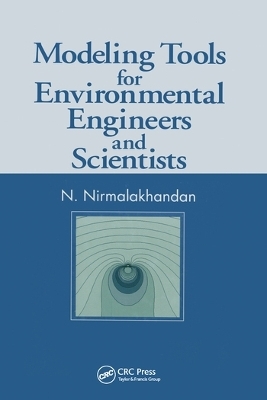
Modeling Tools for Environmental Engineers and Scientists
Seiten
2020
CRC Press (Verlag)
978-0-367-57870-1 (ISBN)
CRC Press (Verlag)
978-0-367-57870-1 (ISBN)
This book demonstrates how environmental professionals, faculty, and students with minimal computer programming skills can develop computer-based mathematical models for a wide range of natural and engineered environmental systems. The author illustrates how a syntax-free authoring software can be adapted to create customized, high-level models of
Modeling Tools for Environmental Engineers and Scientists enables environmental professionals, faculty, and students with minimal computer programming skills to develop computer-based mathematical models for natural and engineered environmental systems. The author illustrates how commercially available syntax-free authoring software can be adapted to create customized, high-level models of environmental phenomena in groundwater, soil, aquatic, and atmospheric systems, and in engineered reactors.
This book includes a review of mathematical modeling and fundamental concepts such as material balance, reactor configurations, and fate and transport of environmental contaminants. It illustrates, using numerous examples, how mathematical and dynamic modeling software can be applied in analyzing and simulating natural and engineered environmental systems. The tools and examples included are applicable to a wide range of problems, both in the classroom and in the field.
Modeling Tools for Environmental Engineers and Scientists enables environmental professionals, faculty, and students with minimal computer programming skills to develop computer-based mathematical models for natural and engineered environmental systems. The author illustrates how commercially available syntax-free authoring software can be adapted to create customized, high-level models of environmental phenomena in groundwater, soil, aquatic, and atmospheric systems, and in engineered reactors.
This book includes a review of mathematical modeling and fundamental concepts such as material balance, reactor configurations, and fate and transport of environmental contaminants. It illustrates, using numerous examples, how mathematical and dynamic modeling software can be applied in analyzing and simulating natural and engineered environmental systems. The tools and examples included are applicable to a wide range of problems, both in the classroom and in the field.
Nirmala Khandan
FUNDAMENTALS. Introduction to Modeling. Fundamentals of Mathematical Modeling. Primer on Mathematics. Fundamentals of Environmental Processes. Fundamentals of Engineered Systems. Fundamentals of Natural Systems. Software for Developing Mathematical Models. APPLICATIONS. Modeling Engineered Environmental Systems. Modeling Natural Environmental Systems.
| Erscheinungsdatum | 01.07.2020 |
|---|---|
| Verlagsort | London |
| Sprache | englisch |
| Maße | 152 x 229 mm |
| Gewicht | 453 g |
| Themenwelt | Mathematik / Informatik ► Mathematik ► Angewandte Mathematik |
| Technik ► Umwelttechnik / Biotechnologie | |
| Weitere Fachgebiete ► Land- / Forstwirtschaft / Fischerei | |
| ISBN-10 | 0-367-57870-0 / 0367578700 |
| ISBN-13 | 978-0-367-57870-1 / 9780367578701 |
| Zustand | Neuware |
| Informationen gemäß Produktsicherheitsverordnung (GPSR) | |
| Haben Sie eine Frage zum Produkt? |
Mehr entdecken
aus dem Bereich


aus dem Bereich
für Ingenieure und Naturwissenschaftler
Buch | Softcover (2024)
Springer Vieweg (Verlag)
CHF 48,95
Buch | Softcover (2025)
Springer Vieweg (Verlag)
CHF 62,95
Buch | Softcover (2025)
Springer Fachmedien Wiesbaden (Verlag)
CHF 69,95


