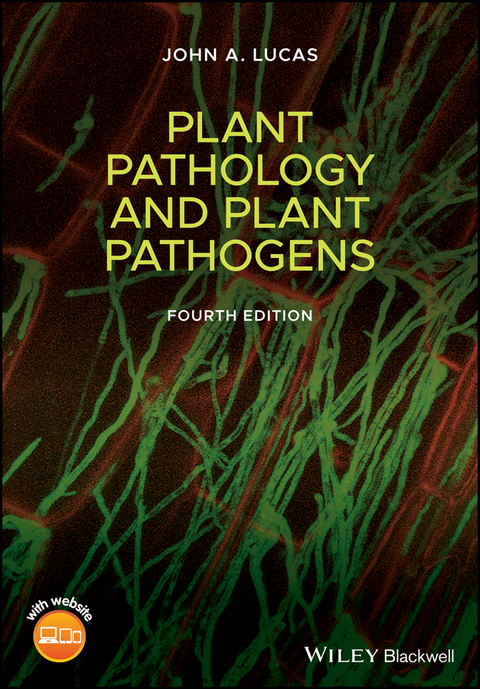
Plant Pathology and Plant Pathogens (eBook)
John Wiley & Sons (Verlag)
978-1-118-89385-2 (ISBN)
An updated guide to plant pathogens and their management
The impact of plant disease is far-reaching. Its effects are felt not only in the spheres of agriculture and horticulture, but also in human health and wellbeing. The challenges of population growth, climate change and global food security all increase the need to protect crops from disease and reduce the losses caused by plant pathogens. This requires ongoing research and novel solutions, making the detailed analysis offered by Plant Pathology and Plant Pathogens more relevant than ever.
Striking a balance between laboratory- and field-based aspects of its subject, this revised fourth edition of the text places plant disease in a wide biological context. Its contents cover causal agents and diagnosis, host-pathogen interactions, and disease management, including breeding for resistance, chemical, biological and integrated control. New to this edition are updated sections on molecular epidemiology, biosecurity, pathogenomics, and the biotechnological advances that are helping scientists make great strides in the fight against plant disease.
- Authored by a leading authority on plant pathology
- Offers new coverage of recent advances in molecular genetics and genomics, biotechnology, and plant breeding
- Places emphasis on interaction biology and biological concepts, such as immunity and comparisons with animal systems
- Includes access to a supplementary website featuring slides of all figures in the book
Plant Pathology and Plant Pathogens is an ideal textbook for graduate and upper-level undergraduate students in biology, botany, agricultural sciences, applied microbiology, plant-microbe interactions, and related subjects. It will also be a practical and enlightening resource for professionals in agricultural institutions, along with crop consultants seeking additional training or information.
JOHN A. LUCAS, Professor, Biointeractions and Crop Protection Department, Rothamsted Research, Harpenden, UK.
An updated guide to plant pathogens and their management The impact of plant disease is far-reaching. Its effects are felt not only in the spheres of agriculture and horticulture, but also in human health and wellbeing. The challenges of population growth, climate change and global food security all increase the need to protect crops from disease and reduce the losses caused by plant pathogens. This requires ongoing research and novel solutions, making the detailed analysis offered by Plant Pathology and Plant Pathogens more relevant than ever. Striking a balance between laboratory- and field-based aspects of its subject, this revised fourth edition of the text places plant disease in a wide biological context. Its contents cover causal agents and diagnosis, host pathogen interactions, and disease management, including breeding for resistance, chemical, biological and integrated control. New to this edition are updated sections on molecular epidemiology, biosecurity, pathogenomics, and the biotechnological advances that are helping scientists make great strides in the fight against plant disease. Authored by a leading authority on plant pathology Offers new coverage of recent advances in molecular genetics and genomics, biotechnology, and plant breeding Places emphasis on interaction biology and biological concepts, such as immunity and comparisons with animal systems Includes access to a supplementary website featuring slides of all figures in the book Plant Pathology and Plant Pathogens is an ideal textbook for graduate and upper-level undergraduate students in biology, botany, agricultural sciences, applied microbiology, plant-microbe interactions, and related subjects. It will also be a practical and enlightening resource for professionals in agricultural institutions, along with crop consultants seeking additional training or information.
JOHN A. LUCAS, Professor, Biointeractions and Crop Protection Department, Rothamsted Research, Harpenden, UK.
Preface vii
List of Abbreviations ix
About the Companion Website xi
Part I Plant Disease 1
1 The Diseased Plant 7
2 The Microbial Pathogens 31
3 Pathogen Biology 45
4 Disease Assessment and Forecasting 83
5 Plant Disease Epidemics 109
Part II Host-Pathogen Interactions 137
6 Entry and Colonization of the Host 141
7 The Physiology of Plant Disease 167
8 Microbial Pathogenicity 185
9 Plant Defense 209
10 Host-Pathogen Specificity 241
Part III Disease Management 273
11 Disease Management by Chemicals 279
12 Disease Management by Host Resistance 309
13 Biological Control of Plant Disease 337
14 An Integrated Approach to Disease Management 359
Appendix 1 Annotated List of Pathogens and the Diseases they Cause 375
Appendix 2 Reference Sources for Figures 387
Index 395
Part I
Plant Disease
We see our cattle fall and our plants wither without being able to render them assistance, lacking as we do understanding of their condition.
(J.C. Fabricius, 1745–1808)
The health of green plants is of vital importance to everyone, although few people may realize it. As the primary producers in the ecosystem, green plants provide the energy and carbon skeletons upon which almost all other organisms depend. The growth and productivity of plants determine the food supply of animal populations, including the human population. Factors affecting plant productivity, including disease, therefore affect the quantity, quality, and availability of staple foods throughout the world. Nowadays crop failure, due to adverse climate, pests, weeds, or diseases, is rare in developed agriculture, and instead there are surpluses of some foods. Nevertheless, disease still takes a toll, and much time, effort, and money are spent on protecting crops from harmful agents. In developing countries, the consequences of plant disease may be more serious, and crop failure can damage local or national economies, and lead directly to famine and hardship. Improvements in the diagnosis and management of plant disease are a priority in such instances. Furthermore, the pressures on plant productivity are increasing. The area of cultivated land available per person on the planet declined from around 0.4 ha in the 1960s to less than 0.3 by the year 2000 (FAO data), and as the human population continues to multiply the area will further decrease.
As well as supplying staple foods, plants provide many other vital commodities such as timber, fibers, oils, spices, and drugs. The use of plants as alternative renewable sources of energy and chemical feedstocks is becoming more and more important, as other resources such as fossil fuels are depleted and the need to mitigate climate change becomes a priority. Finally, the quality of the natural environment, from wilderness areas to urban parks, sports fields, and gardens, also depends to a large extent on the health of plants.
Healthy plants provide a series of benefits for the farmer, food chain, and the environment (Table 1). The yield and quality of crop products are ensured, and healthy plants are more efficient at using precious resources such as water and nutrients. In doing so, they also prevent losses of nitrogen and other nutrients to the wider environment, and reduce pollution of rivers and ground water, which in many areas is a potential problem for drinking supplies. Vigorous, healthy plants are more competitive with weeds, and are easier to harvest than crops that are stunted or collapsed. Plant root systems play an important role in reducing soil erosion, and thereby help to conserve another precious resource. Finally, given the mounting concerns about climate change, it should be noted that healthy crops have a lower carbon footprint than diseased crops, due to their greater productivity and more efficient use of inputs per area of cultivated land.
Table 1 Benefits of healthy plants
|
The science of plant pathology is the study of all aspects of disease in plants, including causal agents, their diagnosis, physiological effects, population dynamics and control. It is a science of synthesis, using data and techniques from fields as diverse as agriculture, microbiology, meteorology, engineering, genetics, genomics, and biochemistry. But first and foremost, plant pathology is an applied science, concerned with practical solutions to the problem of plant disease. Part of the appeal of the subject is to be found in this mixture of pure and applied aspects of biology.
The scope of plant pathology is difficult to define. On a practical level, any shortcoming in the performance of a crop is a problem for the plant pathologist. In the field, he or she may well be regarded in the same way as the family doctor – expected to provide advice on all aspects of plant health! A distinction is often drawn between disease caused by infectious agents and disorders due to noninfectious agents such as mineral deficiency, chemical pollutants, or adverse climatic factors. The main emphasis of this book is on disease caused by plant pathogenic microorganisms such as fungi, oomycetes, bacteria, and viruses. Under favorable conditions, these pathogens can multiply and spread rapidly through plant populations to cause destructive disease epidemics. Many of the principles discussed apply equally well, however, to other damaging agents such as insect pests and nematodes.
A fundamental concept in plant pathology is the disease triangle (Figure 1) which shows that disease results from an interaction between the host plant, the pathogen, and the environment. This can be enlarged to include a further component, the host–pathogen complex (Figure 1), which is not simply the sum of the two partners, as the properties of each are changed by the presence of the other.
A comprehensive analysis of plant disease must take all four components into account. Obviously, one needs to be familiar with the characteristics of the host and the pathogen in isolation. The successful establishment of a pathogen in its host gives rise to the host–pathogen complex. Unraveling the dynamic sequence of events during infection, the molecular “cross‐talk” taking place between the partners, is one of the most challenging problems in experimental biology. In addition, the effects of the environment on each of other components must be understood. This includes not only physical and chemical factors but also macro‐ and microbiological agents. The two‐way arrow between the host and the environment in Figure 1b should not be overlooked, as populations of crop plants often have important effects on their surrounding microclimate. For example, the relative humidity within a crop canopy is higher than that outside and this will favor the development of some microorganisms. Plants attacked by pests and pathogens often produce volatile compounds that can act as signals sensed by neighboring plants. Effects of pathogens on the environment are more subtle but may be significant; some fungi, for instance, produce the volatile hormone ethylene, which can in turn affect the development of adjacent host plants.
Figure 1 The disease triangle (a) incorporating the host–pathogen complex (b).
This book is intended to provide an outline of the main elements of modern plant pathology. The approach is designed to achieve a balance between laboratory and field aspects of the subject, and to place the phenomenon of plant disease in a wider biological context. Research in plant pathology can be broadly divided into tactical and strategic aspects. The former is concerned with providing solutions to disease problems by identifying causal agents and evaluating the most cost‐effective options for their control. The latter is longer term and aims to understand fundamental aspects of plant disease such as pathogen ecology, population biology, host–pathogen interactions, and plant immunity. This knowledge can then be applied to devise improved methods of disease control.
The book is divided into three parts. The first focuses on the problem of plant disease, the causal agents and their significance, disease diagnosis, and the development of epidemics in plant populations. This account highlights the influence of environmental factors on the multiplication and spread of pathogens, and the use of climate data in disease prediction. The second part deals with host–pathogen interactions: how pathogens gain entry to the host, how their growth and development in the plant lead to disease symptoms, and how the plant responds. The outcome of any host–pathogen confrontation depends on a dynamic interplay between factors determining microbial pathogenicity and the active mechanisms of plant immunity. This interaction ultimately determines host–pathogen specificity, whereby any pathogen is able to cause disease in only a restricted range of host plants. Plant and molecular biologists are studying host–pathogen systems as experimental models to probe the mechanisms of gene expression and regulation, and to reveal details of the evolutionary “arms race” taking place between plants and pathogens. Part III deals with the practical business of disease control, often described as crop protection. This covers the management of disease by means of chemicals, breeding for resistance, and alternative biological approaches. Finally, the combined use of cultural practices and all these other measures to provide sustainable, integrated systems for disease control is described.
A comprehensive treatment of individual diseases and the methods used in their control is beyond the scope of a text of this length. For the sake of brevity, specific pathogens or the diseases they cause are often mentioned without further explanation. This approach may be likened to that adopted in many ecology texts, in which the reader is expected to be familiar with most of the higher plants or animals discussed therein. There is, however, an appendix listing all the pathogens and diseases...
| Erscheint lt. Verlag | 15.4.2020 |
|---|---|
| Sprache | englisch |
| Themenwelt | Naturwissenschaften ► Biologie ► Botanik |
| Weitere Fachgebiete ► Land- / Forstwirtschaft / Fischerei | |
| Schlagworte | Agriculture • Biotechnology • Biowissenschaften • blight • Botanik • Botanik / Pathologie • Botany • crop protection • crops • Crop Science • Fungi • Garden • horticulture • Landwirtschaft • Life Sciences • <p>plant pathology • Microbiology • Pathogens • Pests, Diseases & Weeds • Plant • Plant Breeding • Plant disease • plant-microbe • plant pathogens • plant pathology • plants • plant science • plant science</p> • Schädlinge, Krankheiten u. Unkräuter |
| ISBN-10 | 1-118-89385-9 / 1118893859 |
| ISBN-13 | 978-1-118-89385-2 / 9781118893852 |
| Informationen gemäß Produktsicherheitsverordnung (GPSR) | |
| Haben Sie eine Frage zum Produkt? |
 EPUB (Adobe DRM)
Kopierschutz: Adobe-DRM
Adobe-DRM ist ein Kopierschutz, der das eBook vor Mißbrauch schützen soll. Dabei wird das eBook bereits beim Download auf Ihre persönliche Adobe-ID autorisiert. Lesen können Sie das eBook dann nur auf den Geräten, welche ebenfalls auf Ihre Adobe-ID registriert sind.
Details zum Adobe-DRM
Dateiformat: EPUB (Electronic Publication)
EPUB ist ein offener Standard für eBooks und eignet sich besonders zur Darstellung von Belletristik und Sachbüchern. Der Fließtext wird dynamisch an die Display- und Schriftgröße angepasst. Auch für mobile Lesegeräte ist EPUB daher gut geeignet.
Systemvoraussetzungen:
PC/Mac: Mit einem PC oder Mac können Sie dieses eBook lesen. Sie benötigen eine
eReader: Dieses eBook kann mit (fast) allen eBook-Readern gelesen werden. Mit dem amazon-Kindle ist es aber nicht kompatibel.
Smartphone/Tablet: Egal ob Apple oder Android, dieses eBook können Sie lesen. Sie benötigen eine
Geräteliste und zusätzliche Hinweise
Buying eBooks from abroad
For tax law reasons we can sell eBooks just within Germany and Switzerland. Regrettably we cannot fulfill eBook-orders from other countries.
aus dem Bereich