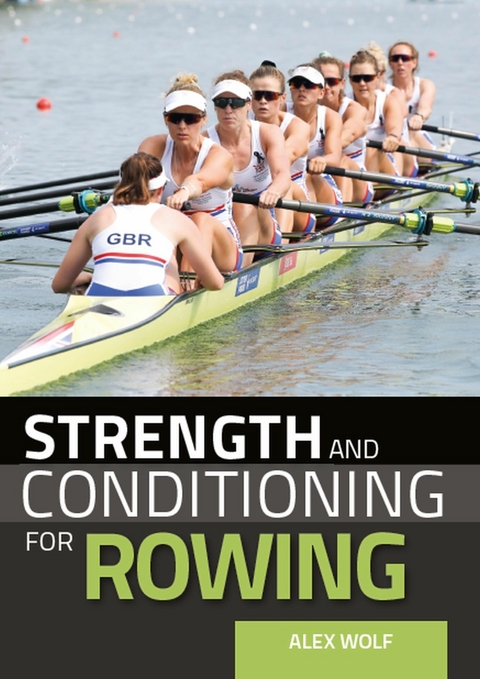
Strength and Conditioning for Rowing (eBook)
331 Seiten
Crowood (Verlag)
978-1-78500-742-2 (ISBN)
Alex Wolf consults widely to sports organizations internationally, including supporting Chinese Rowing. He has previously spent fifteen years working for the English Institute of Sport where he held the positions of Head of Strength and Conditioning and more recently Head of Learning. Alex spent five years working with the GB Rowing team in preparation for the London 2012 and Rio 2016 Olympic games.
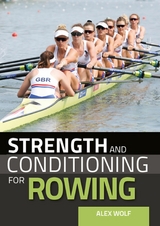
The field of strength and conditioning has grown exponentially over the last two decades, making both collaboration with others and recognition of the impact S&C coaches can have beyond the weight room more important than ever before. This book purposefully begins by sharing professional insights from both the individuals S&C coaches work with - the event coaches - and those individuals S&C coaches work for - the athletes - to examine how collaboration towards agreed, shared and understood performance goals works in practice. The latter chapters focus on applying S&C principles within rowing populations, which are easily transferred to any athlete. This includes: a 'performance backwards' approach to planning; exploring an adaptation approach to programming; common injuries across rowing populations; exercise selection, including specific trunk training assessment and programming; transfer of training to rowing performance, and finally, understanding the needs of Paralympic Rowers.
Alex Wolf consults widely to sports organizations internationally, including supporting Chinese Rowing. He has previously spent fifteen years working for the English Institute of Sport where he held the positions of Head of Strength and Conditioning and more recently Head of Learning. Alex spent five years working with the GB Rowing team in preparation for the London 2012 and Rio 2016 Olympic games.
| 2 | FUNDAMENTALS OF COACHING |
They may forget what you said – but they will never forget how you made them feel
Carl Buehner1
INTRODUCTION
It is possible to pick up any number of S&C texts or read online content and quickly lose sight of what S&C coaching actually is. Having been part of a high performance system for fifteen years, the iterations of what has felt important since joining the English Institute of Sport (EIS) as an intern to the point of leading the S&C team has changed. When starting on the venture of becoming an S&C coach, S&C was not a profession, nor really recognized within the UK until 2003 to 2004. What a good S&C coach looked like was unclear in the early days and has only really started to emerge recently within the UK. There have been clear influences on S&C from the US and the high performance system (UK Sports Institutes) has been influenced by the Australian high performance system too. The high performance system has also inadvertently influenced the wider profession of S&C within the UK. This has provided a unique identity within S&C, which is constantly evolving.
During the period I have been working with British Rowing, there has been an increasing demand for evidence-based practice. All the coaches within the EIS were being (rightly) asked questions around the reasoning for what is done, how did this emerge, how would change be determined and assessed and what the most effective methods were to effect change. While there is a strong belief that there is a need for an evidence base for what S&C coaches deliver, it felt like the pendulum had well and truly swung in a different direction. It felt like there was a stepping away from what was the original reasoning for becoming an S&C coach, or at the very least a reducing of the importance of the act of coaching.
During the early days working within the EIS, shaping what ‘good’ looked like for an S&C coach was not necessarily a priority, which allowed for a diverse array of S&C coaches, all with a unique way of delivering S&C support. Some were very strong on underpinning knowledge, others on technical expertise and others around the act of coaching. Having spent several years as a fitness coach and personal trainer prior to working at the EIS, I had a strong sense of not only being technically astute around exercise prescription and underpinning knowledge, but also the need to be able to connect with those that were being trained. It became quickly apparent that while self-employed, if the client did not like working with a personal trainer, that client would find someone else to train with. This would result in one less client and less income to support oneself. There was a direct reference point to measure the relationship between trainer and client, based on how long clients would stay with trainers. This provided a high degree of accountability of how trainers treated clients and how they made them feel. The depth of knowledge a trainer had did not matter nearly as much as how much the client felt cared for and how much the trainer shared an understanding of the goals the client was hoping to achieve. This resulted in greater trust and respect between clients and trainers. The observation was that clients made greater progress towards their goals with trainers that they trusted and had strong relationships with, regardless of the evidence base that trainer had for the practices and methods employed. This interaction with clients is no different to working with athletes and has been a strong part of the fulfilment of being an S&C coach. When this part of being an S&C coach felt marginalized, the role was not as fulfilling and left questions around what is really important when trying to be a good S&C coach.
Becoming the EIS Head of Strength and Conditioning gave me the opportunity to address this question. While fundamentally there is agreement that evidence-based practice is absolutely necessary and has provided a strong framework for a lot of the content of this book, it should not come at the expense of the act of being a coach and having strong relationships with athletes and coaches. There is a need for both evidence base and coaching practice to co-exist. During the earlier part of this tenure, a large amount of time and resource was devoted to reinstating the importance of coaching. This included providing opportunities for the S&C coaches to explore coaching and its meaning at an individual level. This allowed S&C coaches to recognize the strengths and areas of development around coaching, in the same way this was available for the more technical and evidence-based components of S&C.
COACHING IS A SOCIAL ACTIVITY
Stuart Pickering, a colleague from the EIS, completed a research project around the key characteristics and behaviours of elite S&C coaches. Elite coaches were those with ten or more years coaching experience working with high performance sport. By understanding what were the elite coaching characteristics and behaviours, the learning and development opportunities for less experienced S&C coaches can be anchored against some of the key findings.
Fig. 2.1 Characteristics of elite coaches.
Fig. 2.1 identifies the four key characteristics of elite coaches. The primary characteristic is that S&C coaches emerge as leaders, with the three secondary characteristics of adding value to the environment, building robust relationships and being critical reflectors.
Emerging as Leaders
Emergent leadership may be described as those who are able to operate in complex, challenging and unpredictable environments which require the individual to continually evolve; these individuals emerge as leaders and are either given or take responsibility for decision-making.2,3 Put simply, elite S&C coaches are able to adapt to continually evolving and unknown contexts and are able to make decisions in this complexity, leading others to the outcome of the decision made.
Most leadership definitions include a statement around influencing. Leaders are able to understand the current context and have awareness of the future demands or requirements and can persuade those within the team to take a course of action towards the future needs. Based on the research by Stuart Pickering, emergent leadership is an accurate description of elite S&C coaches. The S&C coaches interviewed all articulated experiences of significant influence within the performance support team and could almost be viewed as lieutenants to the head coach. The influence of these elite S&C coaches went beyond the realms of S&C and impacted the entire performance planning and athlete support.
An important question to ask is how were these elite S&C coaches able to emerge as leaders within their respective sports? The three secondary themes explore this further.
Build Robust Relationships
Building robust relationships covers many areas in which the elite S&C coaches were described to different degrees. Fig. 2.2 provides an overview of the twelve themes that came out of the research. There is no hierarchy of these themes, but a few will be discussed further to provide greater clarity on what is portrayed.
Fig. 2.2 Themes that underpin building robust relationships.
An often unspoken and perhaps uncomfortable truth is that relationships are influenced by credibility. If one side of the relationship does not value or recognize credibility of the other, building a robust relationship will be challenging. Credibility is linked to value and, in this example, the value that can be brought to improving performance. Elite S&C coaches are recognized as having credibility which is growing. Credibility cannot be fast tracked. It takes time to establish this and for others to recognize it. Those who have it will often not view the work or tasks done as building credibility, but simply getting on with the priorities at hand.
Resilience can be defined as the ability to recover from difficulties or as having toughness. This is an important characteristic when working in an unpredictable and complex environment where the only certainty is the uncertainty of performance optimization. It is the ability for an elite S&C coach to continually strive for better, even in adversity. The ability to continually step closer to individuals within a performance support team, or with athletes, knowing that the individual may never step closer, requires a toughness to continue doing it when knowing it is the right thing to do. This is linked closely to not taking things personally.
Management of self refers to the elite coach’s personal effectiveness. Elite S&C coaches are well organized. This will often be the basis for dependability. When an elite S&C coach states something will be done, it will be done to the standard required and in a timely manner. This gives confidence to the team and links to the growing credibility.
Seeing others as people first refers to the ability of elite S&C coaches to put role, whether it is athlete, coach or practitioner, secondary to the actual person. Regardless of position or rank, everyone is a person and it is connecting with that person and not the role held where true connections are made. Those in a position of power may be subject to more rewards or perks, but they are for the position held and not for the person who holds it. This is an important differentiation if robust relationships are to be built. Simon Sinek eloquently articulates this point in an Usher’s New Look Foundation Signature Event speech.4 The...
| Erscheint lt. Verlag | 30.9.2020 |
|---|---|
| Verlagsort | London |
| Sprache | englisch |
| Themenwelt | Sachbuch/Ratgeber ► Sport ► Segeln / Tauchen / Wassersport |
| Reisen ► Reiseberichte ► Deutschland | |
| Weitere Fachgebiete ► Sportwissenschaft | |
| Schlagworte | Anthropometrics • back squat • bench press • bench pull • box squat • British Rowing • Catch • Coach • Coaching • Conditioning • coxed eight • coxless four • coxless pair • Deadlift • double scull • Drive • Eis • elite coaches • end of drive • English Institute of Sport • ergometer assessment • explosive strength training • Frances Houghton • front squat • High Performance System • high repetition • hip thrust • jump assessment • Karen Bennett • lateral hold • low repetition • maximal force expression • maximal handle force • Mel Wilson • Olivia Carnegie-Brown • olympic rowing • Olympics • Paralympic rowing • performance support team • press up • prone extension • quadruple skull • rate of force • rate of force development • RDL • Romanian deadlift • Rower • rowing • rowing books • S&C • scull • session monitoring • strength and conditioning • strength training • stroke • supine hold • supine row • Tissue tolerance • Training • trunk training • watersports • work capacity |
| ISBN-10 | 1-78500-742-4 / 1785007424 |
| ISBN-13 | 978-1-78500-742-2 / 9781785007422 |
| Informationen gemäß Produktsicherheitsverordnung (GPSR) | |
| Haben Sie eine Frage zum Produkt? |
 EPUB (Adobe DRM)
Kopierschutz: Adobe-DRM
Adobe-DRM ist ein Kopierschutz, der das eBook vor Mißbrauch schützen soll. Dabei wird das eBook bereits beim Download auf Ihre persönliche Adobe-ID autorisiert. Lesen können Sie das eBook dann nur auf den Geräten, welche ebenfalls auf Ihre Adobe-ID registriert sind.
Details zum Adobe-DRM
Dateiformat: EPUB (Electronic Publication)
EPUB ist ein offener Standard für eBooks und eignet sich besonders zur Darstellung von Belletristik und Sachbüchern. Der Fließtext wird dynamisch an die Display- und Schriftgröße angepasst. Auch für mobile Lesegeräte ist EPUB daher gut geeignet.
Systemvoraussetzungen:
PC/Mac: Mit einem PC oder Mac können Sie dieses eBook lesen. Sie benötigen eine
eReader: Dieses eBook kann mit (fast) allen eBook-Readern gelesen werden. Mit dem amazon-Kindle ist es aber nicht kompatibel.
Smartphone/Tablet: Egal ob Apple oder Android, dieses eBook können Sie lesen. Sie benötigen eine
Geräteliste und zusätzliche Hinweise
Buying eBooks from abroad
For tax law reasons we can sell eBooks just within Germany and Switzerland. Regrettably we cannot fulfill eBook-orders from other countries.
aus dem Bereich