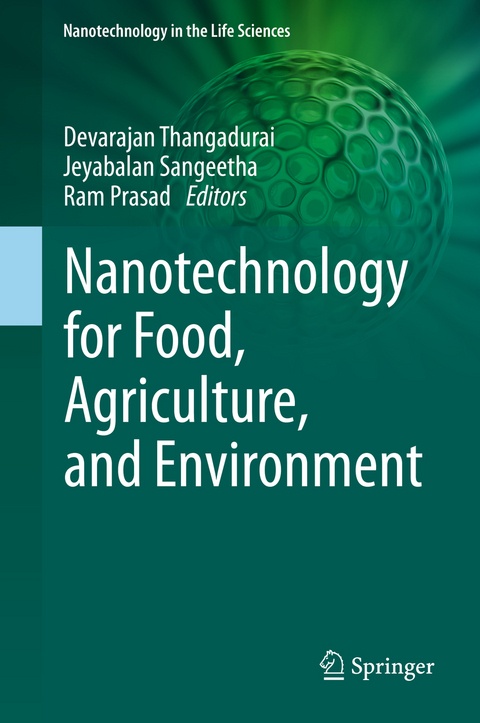
Nanotechnology progresses its concerts and suitability by improving its effectiveness, security and also reducing the impact and risk. Various chapters in this book are written by eminent scientists and prominent researchers in the field of nanotechnology across the world. This book is focused to put emerging techniques forward using nanoparticles for safe and nutritional food production, protecting crops from pests, increasing nutritional value and providing solutions for various environmental issues. The outcome of this book creates a path for wide usage of nanoparticles in food, agriculture and the environment fields.
This book has clear and simple illustrations, tables and case studies to understand the content even by non-experts. This book especially deals with the nanotechnology for controlling plant pathogens, food packaging and preservation, agricultural productivity, waste water treatment and bioenergy production. Hence, this book can be adopted and used by many researchers and academicians in the fields of food, agriculture, environment and nanotechnology for catering the needs of sustainable future. The salient features of this book are
• Describes nanotechnology as an interdisciplinary and emerging field in life sciences
• Useful for researchers in the cutting edge life science related fields of nanoscience, nanobiology and nanotechnology
• Deal with various problems in food, agriculture and environmental sector for sustainable solutions through the application of nanotechnology
• Supported with illustrations in color, tables and case studies (wherever applicable), and
• Contributed and well written by nanotechnology experts from across various disciplines
Devarajan Thangadurai is Assistant Professor at Karnatak University, Dharwad, Karnataka, India. He received his PhD in Botany from Sri Krishnadevaraya University in South India as CSIR Senior Research Fellow with funding from the Ministry of Science and Technology, Government of India. He served as a Postdoctoral Fellow at the University of Madeira, Portugal, University of Delhi, India and ICAR National Research Centre for Banana, India. He is the recipient of the Best Young Scientist Award with a Gold Medal from Acharya Nagarjuna University, India and the VGST-SMYSR Young Scientist Award of the Government of Karnataka, Republic of India. He has authored and edited more than twenty books with publishers of national/international reputation. He has also visited twenty three countries in Africa, Asia and Europe for academic visits, scientific meetings and international collaborations.
Jeyabalan Sangeetha is Assistant Professor in Central University of Kerala at Kasaragod, Kerala, India. She earned her BSc in Microbiology and PhD in Environmental Science from Bharathidasan University, Tiruchirappalli, Tamil Nadu, India. She holds an MSc in Environmental Science from Bharathiar University, Coimbatore, Tamil Nadu, India. She is the recipient of Tamil Nadu Government Scholarship and Rajiv Gandhi National Fellowship of University Grants Commission, Government of India for her doctoral studies. She served as Dr. D.S. Kothari Postdoctoral Fellow and UGC Postdoctoral Fellow at Karnatak University, Dharwad, South India during 2012-2016 with funding from University Grants Commission, Government of India, New Delhi. Her research interests are in the fields of Environmental Toxicology, Environmental Microbiology, Environmental Biotechnology and Environmental Nanotechnology.
Ram Prasad is associated with Amity Institute of Microbial Technology, Amity University, Uttar Pradesh, India, since 2005. His research interest includes plant-microbe interactions, sustainable agriculture and microbial nanobiotechnology. Dr. Prasad has more than hundred publications to his credit, including research papers, review articles and book chapters, and five patents issued or pending and edited or authored several books. Dr. Prasad has 12 years of teaching experience, and he has been awarded the Young Scientist Award (2007) and Prof. J.S. Datta Munshi Gold Medal (2009) by the International Society for Ecological Communications; FSAB fellowship (2010) by the Society for Applied Biotechnology; the American Cancer Society UICC International Fellowship for Beginning Investigators, USA (2014); Outstanding Scientist Award (2015) in the field of microbiology by Venus International Foundation; BRICPL Science Investigator Award (ICAABT-2017); and Research Excellence Award (2018). Previously, Dr. Prasad served as visiting assistant professor at Whiting School of Engineering, Department of Mechanical Engineering at Johns Hopkins University, USA, and presently, working as research associate professor at School of Environmental Science and Engineering, Sun Yat-Sen University, Guangzhou, China.


 PDF (Wasserzeichen)