Zum Hauptinhalt springen
Nicht aus der Schweiz? Besuchen Sie lehmanns.de
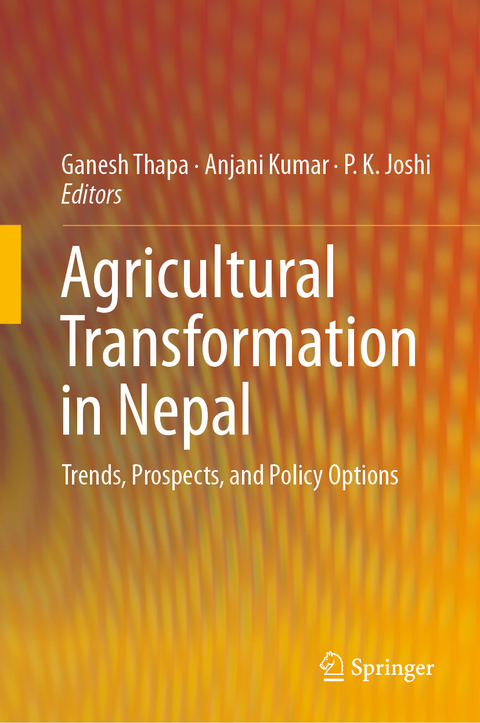
Agricultural Transformation in Nepal -

Agricultural Transformation in Nepal (eBook)

Trends, Prospects, and Policy Options
eBook Download: PDF
2019
628 Seiten
Springer Singapore (Verlag)
978-981-329-648-0 (ISBN)
Systemvoraussetzungen
149,79 inkl. MwSt
(CHF 146,30)
Der eBook-Verkauf erfolgt durch die Lehmanns Media GmbH (Berlin) zum Preis in Euro inkl. MwSt.
  • Download sofort lieferbar
  • Zahlungsarten anzeigen
This book addresses some key strategic questions related to agriculture in the context of major contemporary developments and emerging challenges in Nepal such as the changing role of agriculture with economic growth, structural transformation in reducing poverty, improving nutritional outcomes, and addressing the challenges of climate change. The book also suggests policy measures to improve the delivery of critical inputs and services and ensure the participation of marginal and smallholders in high-value chains. Further, it discusses how the new federal system and governance structure will affect the delivery of agricultural technology and services.   
The book is divided into five parts. Part I discusses macro-issues in the agriculture sector, while Part II focuses on agricultural productivity growth and its main drivers. The third part explores diversification in the agricultural and non-agricultural sectors by farmers and other rural people for livelihood improvement, while the fourth part deals with agricultural trade and marketing issues, highlighting policy implications and recommendations in the areas of immediate focus and further research. Lastly, Part V addresses institutions and governance issues, which are vital for agricultural development. In the final chapter, the editors summarize and synthesize the book's main findings and develop a policy agenda for addressing the many challenges faced by the agriculture sector in Nepal, so as to make it more productive, competitive, sustainable, and inclusive. 
The book offers a rich source of analytical information on various aspects of agricultural development in Nepal and will be of immense value to policymakers, development partners, civil society, students, and those interested in the economic and agricultural development of not only Nepal, but also other developing countries.


Dr. Ganesh Thapa worked for the International Fund for Agricultural Development (IFAD) from March 1998 to April 2014 as the Regional Economist for Asia and the Pacific region and as the Country Programme Manager for North Korea. He is currently a Visiting Scientist at the International Centre for Integrated Mountain Development (ICIMOD). He holds a Ph.D. in Agricultural Economics from Cornell University, USA, and degrees from the University of the Philippines and G.B. Pant University of Agriculture and Technology, India. As the Regional Economist, he led IFAD's work on policy analysis and strategy formulation for agricultural development and rural poverty reduction in Asia and the Pacific region. Prior to joining IFAD, he worked as the Country Director for Winrock International in Nepal and led a project on policy analysis in agriculture and natural resource management. He has also worked as a Senior Economist for the Ministry of Agriculture, Nepal. He has conducted research and published books and articles on such topics as risks, vulnerability, and poverty reduction; sustainability of microfinance; indigenous peoples and poverty reduction; effects of new agricultural technologies on income distribution; constraints on agricultural marketing; and food security and environmental policies. 
Dr. Anjani Kumar is a Research Fellow with the South Asian Chapter of the International Food Policy Research Institute (IFPRI) based in New Delhi, India. He obtained his Ph.D. in Dairy Economics from the National Dairy Research Institute (NDRI), Karnal, India, and has over two decades of research experience in dairy economics, trade, food safety issues, food and nutrition security, agricultural growth, etc. He has to his credit several awards including the Lal Bahadur Shastri Young Scientist award, and awards from the Dr. R. T. Doshi Foundation and National Academy of Agricultural Sciences. Prior to joining the IFPRI, he was a Principal Scientist at the National Institute of Agricultural Economics and Policy Research (NIAP) and at the International Crops Research Institute for the Semi-Arid Tropics (ICRISAT). He also worked as a Senior Agricultural Economist with the International Livestock Research Institute (ILRI). 
Dr. Pramod Kumar Joshi is Director, South Asia, of the International Food Policy Research Institute (IFPRI). He previously served as Director of the National Academy of Agricultural Research Management (NAARM) and National Institute of Agricultural Economics and Policy Research (NIAP). He holds a Ph.D. in Agricultural Economics from G.B. Pant University of Agriculture and Technology, Pantnagar, India. He has more than four decades of research experience in technology policy, research evaluation, impact assessment, agriculture marketing, institutional innovation, water markets, trade, etc., and is a recipient of several awards such as the Professor R. C. Agarwal Lifetime Award, Dr. M. S. Randhawa Memorial Award of the NAAS, D.K. Desai Award of the Indian Society of Agricultural Economics, and Dr. R. T. Doshi Foundation Award.

This book addresses some key strategic questions related to agriculture in the context of major contemporary developments and emerging challenges in Nepal such as the changing role of agriculture with economic growth, structural transformation in reducing poverty, improving nutritional outcomes, and addressing the challenges of climate change. The book also suggests policy measures to improve the delivery of critical inputs and services and ensure the participation of marginal and smallholders in high-value chains. Further, it discusses how the new federal system and governance structure will affect the delivery of agricultural technology and services.   The book is divided into five parts. Part I discusses macro-issues in the agriculture sector, while Part II focuses on agricultural productivity growth and its main drivers. The third part explores diversification in the agricultural and non-agricultural sectors by farmers and other rural people for livelihoodimprovement, while the fourth part deals with agricultural trade and marketing issues, highlighting policy implications and recommendations in the areas of immediate focus and further research. Lastly, Part V addresses institutions and governance issues, which are vital for agricultural development. In the final chapter, the editors summarize and synthesize the book's main findings and develop a policy agenda for addressing the many challenges faced by the agriculture sector in Nepal, so as to make it more productive, competitive, sustainable, and inclusive. The book offers a rich source of analytical information on various aspects of agricultural development in Nepal and will be of immense value to policymakers, development partners, civil society, students, and those interested in the economic and agricultural development of not only Nepal, but also other developing countries.
Erscheint lt. Verlag 25.11.2019
Zusatzinfo XLIII, 628 p. 90 illus., 79 illus. in color.
Sprache englisch
Themenwelt Naturwissenschaften Biologie
Sozialwissenschaften Politik / Verwaltung
Sozialwissenschaften Soziologie Spezielle Soziologien
Wirtschaft Volkswirtschaftslehre
Weitere Fachgebiete Land- / Forstwirtschaft / Fischerei
Schlagworte Agricultural Diversification • Agricultural growth • agricultural trade • Agriculture in Nepal • Agriculture Productivity • Development Policy • poverty reduction
ISBN-10 981-329-648-8 / 9813296488
ISBN-13 978-981-329-648-0 / 9789813296480
Informationen gemäß Produktsicherheitsverordnung (GPSR)
Haben Sie eine Frage zum Produkt?
PDFPDF (Wasserzeichen)

DRM: Digitales Wasserzeichen
Dieses eBook enthält ein digitales Wasser­zeichen und ist damit für Sie persona­lisiert. Bei einer missbräuch­lichen Weiter­gabe des eBooks an Dritte ist eine Rück­ver­folgung an die Quelle möglich.

Dateiformat: PDF (Portable Document Format)
Mit einem festen Seiten­layout eignet sich die PDF besonders für Fach­bücher mit Spalten, Tabellen und Abbild­ungen. Eine PDF kann auf fast allen Geräten ange­zeigt werden, ist aber für kleine Displays (Smart­phone, eReader) nur einge­schränkt geeignet.

Systemvoraussetzungen:
PC/Mac: Mit einem PC oder Mac können Sie dieses eBook lesen. Sie benötigen dafür einen PDF-Viewer - z.B. den Adobe Reader oder Adobe Digital Editions.
eReader: Dieses eBook kann mit (fast) allen eBook-Readern gelesen werden. Mit dem amazon-Kindle ist es aber nicht kompatibel.
Smartphone/Tablet: Egal ob Apple oder Android, dieses eBook können Sie lesen. Sie benötigen dafür einen PDF-Viewer - z.B. die kostenlose Adobe Digital Editions-App.

Buying eBooks from abroad
For tax law reasons we can sell eBooks just within Germany and Switzerland. Regrettably we cannot fulfill eBook-orders from other countries.

Mehr entdecken
aus dem Bereich
Transformative Kulturpolitik: Von der Polykrise zur systemischen …

von Davide Brocchi

eBook Download (2024)
Springer Fachmedien Wiesbaden (Verlag)
CHF 24,40
Soziologie des Verschwörungsdenkens

von Andreas Anton; Michael Schetsche; Michael K. Walter

eBook Download (2024)
Springer VS (Verlag)
CHF 32,20