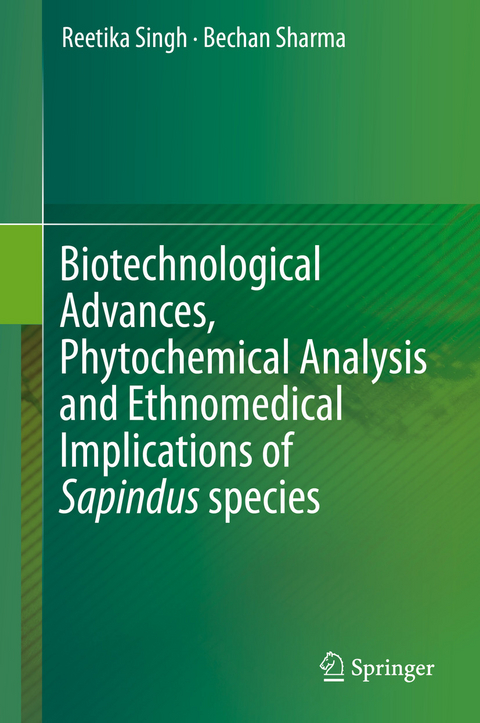
Biotechnological Advances, Phytochemical Analysis and Ethnomedical Implications of Sapindus species (eBook)
XX, 133 Seiten
Springer Singapore (Verlag)
978-981-329-189-8 (ISBN)
Plants have always occupied a prominent position in the life of every living being. Plants are the primary source of food, shelter and medicines. The global inclination toward herbal medicine has advanced the expansion of plant-based pharmaceutical industries to a vast extent. The production of traditional medicine at global market has been estimated to touch US $5 trillion by 2050. Some of the useful plant-based drugs include vinblastine, vincristine, taxol, podophyllotoxin, camptothecin, digoxigenin, morphine, codeine, aspirin, atropine, capscicine, allicin, curcumin, artemesinin and ephedrine.
Genus Sapindus is an important economical and medicinal trees, distributed over the world. Soap nuts contain higher amount of saponin, a natural detergent which can be used to clean clothes and hairs. Sapindus species possesses various pharmacological properties including antimicrobial, antioxidant, anti-inflammatory, anticancer, hepatoprotective, anti-trichomonas activity. Extracts of this plant are rich in various phytochemicals and polyphenolic compounds. All the pharmacological properties are due to presence of saponins. Biotechnological techniques can improve the saponin content; thus this chemical content can be produced at large scale and can be used as phytomedicine.
We hope that this book would be of great use to under graduates, postgraduates, scientists, researchers and faculty members who are studying, teaching or working in the field of Biotechnology, Phytochemistry and Ethnopharmacology. The techniques explained in this book could be of immense use for the researchers working in this area.We shall deeply appreciate receiving any critical comments and suggestions from the readers from the different parts of globe which would help us improve the first edition of this publication.
Dr. Reetika Singh, currently working as DST-SERB Scientist, has completed her PhD from Banaras Hindu University-Varanasi in Biotechnology. She has cleared several national level competitive exams like CSIR-JRF, ASRB-NET, GATE and secured higher rank. She was awarded with a prestigious National-Post Doctoral Fellowship (N-PDF) of DST-SERB, New Delhi in 2016. She has visited China as Indian delegates in the 2nd BRICS Young Scientist Forum 2017. She has published six technical research papers and one review article in reputed International Journals with high impact factors. She has also published eight book chapters in different edited book of various international publishers. She has attended several national and international symposia/ conferences and presented her research findings in many scientific meetings. She has been acting as a Reviewer and an Editor for couple of reputed international journals. She is also an active member of two reputed scientific societies in India.
Dr. Bechan Sharma is presently working as a Professor and Ex-Head, Department of Biochemistry Allahabad University, Allahabad. He has completed his higher education such as B.Sc. (Honours)-1980; M.Sc. (Biochemistry)-1982 and Ph.D. in Biochemistry (1988) from BHU-Varanasi. The areas of his research interest include Molecular Biology of HIV/AIDS, Tropical Diseases (Filariasis/Malaria), Drug design and development and Biochemical Toxicology. He has received number of Awards/ Honors and successfully completed numerous important Academic/ Administrative Assignments. He has thirty years of teaching / research experience. He has carried out several research projects and published over 200 research papers including book chapters, molecular methods in peer reviewed International and National Journals of repute. He has one US patent on HIV-1 genome structure based antiHIV-1 drugs design to his credit. He has supervised 18 PhDs and six PDFs. He is member/life member of several national/international scientific societies and attended numerous symposia/conferences in India and abroad. He is Chief-Editor/Associate Editor/Executive Editor and Member Editorial Board of over 130 peer reviewed International and National Journals. He has been acting as honorary reviewer for over 150 International/National scientific journals. His 4 books have been published by International publishers and 2 are in print. He has worked as a visiting scientist in USA for over three years and visited different labs at Italy, France, Iran, Thailand, Hong Kong, Japan, Germany and Brazil to conduct different collaborative research projects related to Molecular Virology and Drug resistance. Prof. Sharma has been awarded with ICMR's Senior Scientist Fellowship 2014-15 in Biomedical Sciences under Indo-USA joint research programme to work at NIEHS-NIH,NC, USA with Prof. Samuel Wilson on DNA repair. Recently Prof. Sharma has been included as a member in World Virology Society-Sweden and in an Indo-Japanese research initiative towards eradication of HIV/AIDS in India. Prof. B. Sharma is a Fellow of Academy of Environmental Biology (AEB) and Bioved Research Society (BRS).
Plants have always occupied a prominent position in the life of every living being. Plants are the primary source of food, shelter and medicines. The global inclination toward herbal medicine has advanced the expansion of plant-based pharmaceutical industries to a vast extent. The production of traditional medicine at global market has been estimated to touch US $5 trillion by 2050. Some of the useful plant-based drugs include vinblastine, vincristine, taxol, podophyllotoxin, camptothecin, digoxigenin, morphine, codeine, aspirin, atropine, capscicine, allicin, curcumin, artemesinin and ephedrine. Genus Sapindus is an important economical and medicinal trees, distributed over the world. Soap nuts contain higher amount of saponin, a natural detergent which can be used to clean clothes and hairs. Sapindus species possesses various pharmacological properties including antimicrobial, antioxidant, anti-inflammatory, anticancer, hepatoprotective, anti-trichomonas activity. Extracts of this plant are rich in various phytochemicals and polyphenolic compounds. All the pharmacological properties are due to presence of saponins. Biotechnological techniques can improve the saponin content; thus this chemical content can be produced at large scale and can be used as phytomedicine. We hope that this book would be of great use to under graduates, postgraduates, scientists, researchers and faculty members who are studying, teaching or working in the field of Biotechnology, Phytochemistry and Ethnopharmacology. The techniques explained in this book could be of immense use for the researchers working in this area. We shall deeply appreciate receiving any critical comments and suggestions from the readers from the different parts of globe which would help us improve the first edition of this publication.
| Erscheint lt. Verlag | 13.11.2019 |
|---|---|
| Zusatzinfo | XX, 133 p. 35 illus., 30 illus. in color. |
| Sprache | englisch |
| Themenwelt | Naturwissenschaften ► Biologie ► Botanik |
| Weitere Fachgebiete ► Land- / Forstwirtschaft / Fischerei | |
| Schlagworte | Biotechnology • Ethnomedicine • Molecular Biology • Phytochemicals • Sapindus sp. • tree biology |
| ISBN-10 | 981-329-189-3 / 9813291893 |
| ISBN-13 | 978-981-329-189-8 / 9789813291898 |
| Informationen gemäß Produktsicherheitsverordnung (GPSR) | |
| Haben Sie eine Frage zum Produkt? |
 PDF (Wasserzeichen)
DRM: Digitales Wasserzeichen
Dieses eBook enthält ein digitales Wasserzeichen und ist damit für Sie personalisiert. Bei einer missbräuchlichen Weitergabe des eBooks an Dritte ist eine Rückverfolgung an die Quelle möglich.
Dateiformat: PDF (Portable Document Format)
Mit einem festen Seitenlayout eignet sich die PDF besonders für Fachbücher mit Spalten, Tabellen und Abbildungen. Eine PDF kann auf fast allen Geräten angezeigt werden, ist aber für kleine Displays (Smartphone, eReader) nur eingeschränkt geeignet.
Systemvoraussetzungen:
PC/Mac: Mit einem PC oder Mac können Sie dieses eBook lesen. Sie benötigen dafür einen PDF-Viewer - z.B. den Adobe Reader oder Adobe Digital Editions.
eReader: Dieses eBook kann mit (fast) allen eBook-Readern gelesen werden. Mit dem amazon-Kindle ist es aber nicht kompatibel.
Smartphone/Tablet: Egal ob Apple oder Android, dieses eBook können Sie lesen. Sie benötigen dafür einen PDF-Viewer - z.B. die kostenlose Adobe Digital Editions-App.
Buying eBooks from abroad
For tax law reasons we can sell eBooks just within Germany and Switzerland. Regrettably we cannot fulfill eBook-orders from other countries.
aus dem Bereich