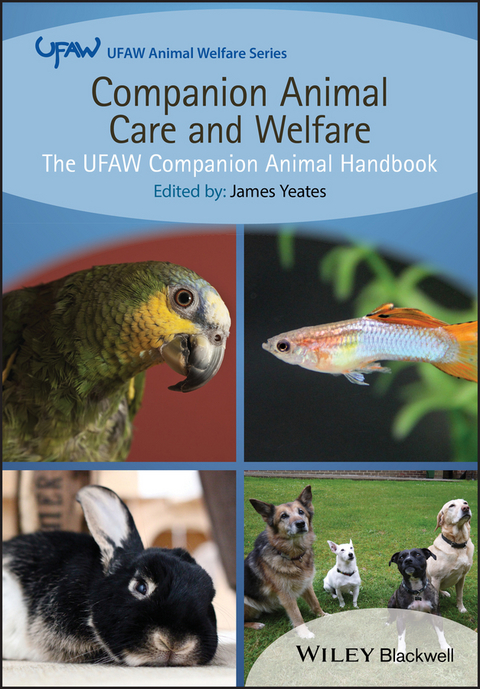
Companion Animal Care and Welfare (eBook)
John Wiley & Sons (Verlag)
978-1-118-68878-6 (ISBN)
- Identifies the needs of companion animals, explains how we know these needs, and gives scientifically-backed advice on how to meet these needs
- Promotes the most humane treatment and best possible care of our companion animals
- Addresses controversial issues such as selective breeding, companion animal showing, the keeping of exotic species, and the international pet trade
- Covers the husbandry and care of all major companion animal species, including mammals, birds, fish, reptiles and amphibians
About the Editor
James Yeates, Chief Executive Officer at Cats Protection; previously Chief Veterinary Officer at the RSPCA, UK; Chair of the BVA Ethics and Welfare Group; member of the SPVS Council, BSAVA Scientific Committee and Equine Disease Coalition; and author of Animal Welfare in Veterinary Practice (Wiley Blackwell) and Veterinary Science.
Companion Animal Care and Welfare: The UFAW Companion Animal Handbook presents a comprehensive, accessible and practical reference for all parties seeking information about the proper care of companion animals. Identifies the needs of companion animals, explains how we know these needs, and gives scientifically-backed advice on how to meet these needs Promotes the most humane treatment and best possible care of our companion animals Addresses controversial issues such as selective breeding, companion animal showing, the keeping of exotic species, and the international pet trade Covers the husbandry and care of all major companion animal species, including mammals, birds, fish, reptiles and amphibians
About the Editor James Yeates, Chief Executive Officer at Cats Protection; previously Chief Veterinary Officer at the RSPCA, UK; Chair of the BVA Ethics and Welfare Group; member of the SPVS Council, BSAVA Scientific Committee and Equine Disease Coalition; and author of Animal Welfare in Veterinary Practice (Wiley Blackwell) and Veterinary Science.
Contributor List vii
Foreword x
Robert Hubrecht
Prologue xii
James Yeates
1 Introduction: The Care and Animal Welfare of All Species 1
James Yeates
2 Carnivorans (Carnivora) 39
James Yeates
3 Cats (Felis silvestris catus) 52
Irene Rochlitz and James Yeates
4 Dogs (Canis familiaris) 81
Nicola Rooney and Kevin Stafford
5 Ferrets (Mustela putorius furo) 124
Claudia Vinke, Nico J. Schoemaker, and Yvonne R. A. van Zeeland
6 Rabbits and Rodents (Glires) 145
James Yeates and Vera Baumans
7 European Rabbits (Oryctolagus cuniculus) 163
Siobhan Mullan and Richard Saunders
8 Guinea Pigs, Chinchillas, and Degus (Caviomorphs) 185
Anne McBride and Anna Meredith
9 Golden Hamsters (Mesocricetus auratus) 203
Bryan Howard
10 Mongolian Gerbils (Meriones unguiculatus) 218
Elke Scheibler and Eva Waiblinger
11 Domestic Rats (Rattus norvegicus) 233
Oliver Burman
12 Ungulates (Ungulata) 249
James Yeates and Paul McGreevy
13 Horses (Equus caballus) 266
Paul McGreevy and James Yeates
14 Birds (Avia) 293
John Chitty and James Yeates
15 Zebra Finches (Taeniopygia guttata) 318
Graham Law, Rudolf Nager, and Michael Wilkinson
16 True Parrots (Psittacoidea) 338
Joy Mench, Joanne Paul-Murphy, Kirk Klasing, and Victoria Cussen
17 Pigeons (Columba livia) 355
John Chitty
18 Reptiles (Reptilia) 371
Joanna Hedley, Robert Johnson, and James Yeates
19 Central Bearded Dragons (Pogona vitticeps) 395
Robert Johnson and Sophie Adwick
20 Nonvenomous Colubrid Snakes (Colubridae) 412
Joanna Hedley and Kevin Eatwell
21 Mediterranean Tortoises (Testudo spp.) 425
Andrew C. Highfield
22 Ornamental Fish (Actinopterygii) 440
Lynne Sneddon and David Wolfenden
23 Goldfish (Carassius auratus) 467
Culum Brown, David Wolfenden, and Lynne Sneddon
Index 479
1
Introduction: The Care and Animal Welfare of All Species
James Yeates
1.1 Introduction: Concepts in Companion Animal Welfare
Owners have a duty of care to their companion animals. This is an ethical obligation, a vital part of good owner‐pet relationships, and a legal duty in many countries. The broad aim of this book is to provide an introduction to the welfare of companion animals. This chapter covers the key concepts in animal welfare, general principles of care, and signs of welfare that can, and should, be applied to our pets. Given the wide range of animals kept as pets and the limited amount of scientific data on some animals, this book focuses on certain groups of animals. For other animals, owners can use Chapters 2, 6, 12, 14, 18, and 22 or cautiously apply data from similar species. However, this chapter provides general guidelines that can apply to all species.
1.1.1 Natural Histories
Pets are animals and so are members of species with wild or feral relatives that may share many characteristics with their captive counterparts. We can therefore use information about animals’ natural biology and motivations to predict what pets need (in practice, this may sometimes be difficult when wild populations are rare or extinct). Where this information exists, it needs to be used intelligently, and there are several caveats to consider. First, animals may suffer welfare compromises while in the wild that owners should not replicate (e.g. predation and disease). Second, animals’ motivations and needs may depend on their personal experiences and learning (e.g. natural early life experiences) and the captive environment in which they are kept (e.g. animals may need extra ultraviolet [UV]‐B or vitamin D supplementation to compensate for insufficient sunlight). Third, many animals have been altered significantly from their wild ancestors, and animals kept as pets may have needs that differ from those of their wild ancestors (e.g. an altered tolerance of human company or a need for medical care to treat breed‐related diseases).
1.1.2 Domestic Histories
Pets are also companions. Humans have kept pets for at least 12 000 years (Serpell 1986), and some species are popular and widespread (Table 1.1). Some companion animals have been adapted to human company or captivity by ‘domestication’ through selective breeding and ‘taming’ through exposure and training. Knowing about this history may also help to determine what care these companions should receive. However, this information also needs to be used intelligently, and there are other caveats to consider before trying to domesticate or tame animals. First, animals may suffer welfare compromises during those processes (e.g. as a result of dystocia, fear of humans, starvation, or separation from their mother). Second, changes from artificial selection are not necessarily associated with improved welfare (e.g. breeding animals for different colours may be irrelevant to their welfare, and some breeding may create breed‐related diseases). Third, selective breeding may mean animals have particular needs that are harder to meet (e.g. stronger motivations for company).
Table 1.1 Estimated pet populations worldwide.
Source: American Health Alliance (Australia) (AHA 2014), American Pets Product Association (APPA 2014), Caixong (2015), Dray (2016), European Union (EU 2016), European Pet Food Industry Federation (FEDIAF 2017), Goldman Sachs (2014), New Zealand Companion Animal Council (NZCAC 2011), Pet Food Institute (PFI 2014), Pet Food Manufacturers Association (PFMA 2014), Zenoaq (2008).
| Group | Approximate Estimated Numbers (in Millions) of Owned Pets (2011–2016) |
| Australia | Brazil | China | Europeb | Japan | New Zealand | South Africa | UK | USA |
| Carnivoransa | 8 | 45 | 80 | 185 | 21–25 | 2 | 9 | 17 | 145–179 |
| Gliresa | — | — | 27 | 2 | 2 | 18 |
| Ungulatesa | — | — | 3 | 0.4 | 8 |
| Birds | 5 | — | 55 | 5 | 2 | 21 |
| Reptilesa | — | 6 | 7 | — | 1 | 12 |
| Amphibians | — | — | — | 0.2 | — |
| Fish | 11 | — | 17 | 9 | 40–45 | 159 |
| Humans | 24 | 200 | 1382 | 508 | 126 | 5 | 55 | 65 | 324 |
a Carnivoran figures based on reports on cats and dogs numbers; Glires figures for New Zealand are specifically for rabbits; Ungulates figures generally exclude ‘farm’ or ‘working’ animals (i.e. often relate to horse numbers); Reptile figures for China are specifically for tortoises. All figures to nearest whole million (except where less then 1)
b Historic figures for Europe include the UK (accepting the discrepancy regarding fish).
1.1.3 Sentience and Welfare
The expression animal welfare has two distinct uses. The first is a factual description of what animals experience. The second is an ethical prescription of what animals should experience. These two concepts overlap because we are concerned with understanding how our actions can harm or benefit animals. There are several different concepts of animal welfare. A classic division is among ‘feelings’, ‘function’, and ‘naturalness’ (Fraser et al. 1997; Fraser 2008). Function refers to the efficiency and effectiveness of biological processes, with particular regard to deviations from normality, disease, and injury. Naturalness refers to how animals live unaffected by human control. Feelings are subjective experiences of sentient animals.
Sentience may be defined as the ability to experience ‘feelings that matter’ (Webster 2005). These include affective feelings (e.g. pain and pleasure), motivations (e.g. wanting something), or moods (e.g. depression or happiness). Such feelings might matter more if they are more intense, long‐lasting, or frequent. Ultimately, companion animal welfare is about whether pets suffer or are happy, although scientific papers often avoid those terms.
Animals' feelings depend on the interaction between each animal and their environment. The external environment acts on various senses (usually mediated by chemicals, movement, or electromagnetism) and animals' bodies stimulate other senses (e.g. gastric stretching and proprioception). These external and internal inputs prompt various responses that may be pathological (e.g. diarrhoea), physiological (e.g. stress hormone levels), or behavioural (e.g. aggression). These responses may then alter the animal's environment (e.g. scaring off a competitor) and internal states (e.g. filling their stomach). These changes may, in turn, further affect the animal's future interactions with their environment. Such perceptions and responses may be associated with pleasant or unpleasant feelings.
Exactly what feelings each animal experiences, and how they respond, may depend on their particular needs, senses, and cognitive processes – and these may depend on their species, breed, age, sex, reproductive status, personality, abilities, learning, and personal preferences. This means animals cannot be treated as all the same. It also means there is debate about what forms of suffering different animals may experience and when. In fact, the ability to experience suffering need not actually require a high level of conscious cognitive reasoning, and there is increasing scientific evidence of subjective feelings such as pain in reptiles (e.g. Liang and Terashima 1993; Bennett 1998), amphibians (Machin 1999), and fish (e.g. Sneddon 2011, 2013). The evidence for invertebrates is less clear, but all pets should be given the benefit of the doubt (Figure 1.1).
Figure 1.1 Pet invertebrates such as Giant burrowing cockroaches (Macropanesthia rhinoceros) should be treated as if they may suffer.
(Source: courtesy of Robert Johnson)
The fact that all species differ in how they interact with their environment may also limit our ability to understand how other animals may be feeling. Our experiences of the world are probably different to our pets'. Animals' senses may have greater sensitivity (e.g. the ability to detect low concentrations of chemicals or quieter noises), extend outside humans'...
| Erscheint lt. Verlag | 26.11.2018 |
|---|---|
| Reihe/Serie | UFAW Animal Welfare |
| UFAW Animal Welfare | UFAW Animal Welfare |
| Sprache | englisch |
| Themenwelt | Veterinärmedizin |
| Weitere Fachgebiete ► Land- / Forstwirtschaft / Fischerei | |
| Schlagworte | Animal behaviour, animal behavior, animal welfare, animal care, companion animals, animal ethics, pet care, pet welfare, animal husbandry • Animal Welfare, Ethics & Law • Laboratory Animal Medicine • Tierschutz • Tierschutz, Ethik u. Recht • Veterinär-Labormedizin • Veterinärmedizin • Veterinärmedizin f. Kleintiere • Veterinärmedizin / Hunde u. Katzen • Veterinary Medicine • Veterinary Medicine - Dogs & Cats • Veterinary Medicine - Small Animal General |
| ISBN-10 | 1-118-68878-3 / 1118688783 |
| ISBN-13 | 978-1-118-68878-6 / 9781118688786 |
| Informationen gemäß Produktsicherheitsverordnung (GPSR) | |
| Haben Sie eine Frage zum Produkt? |
 EPUB (Adobe DRM)
Kopierschutz: Adobe-DRM
Adobe-DRM ist ein Kopierschutz, der das eBook vor Mißbrauch schützen soll. Dabei wird das eBook bereits beim Download auf Ihre persönliche Adobe-ID autorisiert. Lesen können Sie das eBook dann nur auf den Geräten, welche ebenfalls auf Ihre Adobe-ID registriert sind.
Details zum Adobe-DRM
Dateiformat: EPUB (Electronic Publication)
EPUB ist ein offener Standard für eBooks und eignet sich besonders zur Darstellung von Belletristik und Sachbüchern. Der Fließtext wird dynamisch an die Display- und Schriftgröße angepasst. Auch für mobile Lesegeräte ist EPUB daher gut geeignet.
Systemvoraussetzungen:
PC/Mac: Mit einem PC oder Mac können Sie dieses eBook lesen. Sie benötigen eine
eReader: Dieses eBook kann mit (fast) allen eBook-Readern gelesen werden. Mit dem amazon-Kindle ist es aber nicht kompatibel.
Smartphone/Tablet: Egal ob Apple oder Android, dieses eBook können Sie lesen. Sie benötigen eine
Geräteliste und zusätzliche Hinweise
Buying eBooks from abroad
For tax law reasons we can sell eBooks just within Germany and Switzerland. Regrettably we cannot fulfill eBook-orders from other countries.
aus dem Bereich