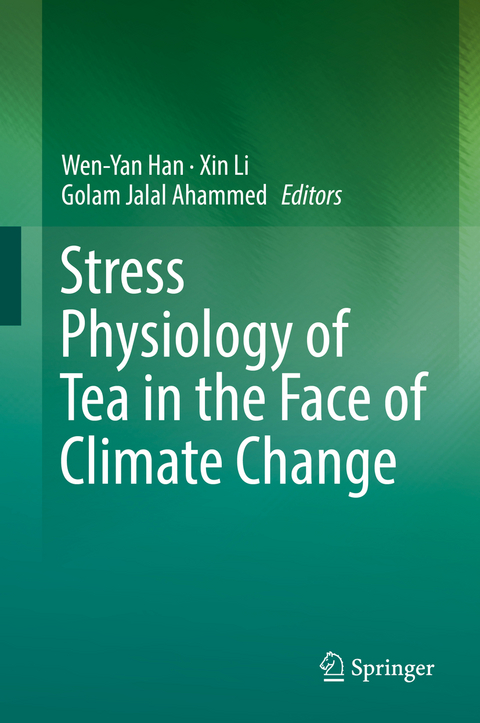
Stress Physiology of Tea in the Face of Climate Change (eBook)
XVIII, 361 Seiten
Springer Singapore (Verlag)
9789811321405 (ISBN)
?This book focuses on the existing knowledge regarding the effect of global climate change on tea plant physiology, biochemistry, and metabolism as well as economic and societal aspects of the tea industry. Specifically, this book synthesizes recent advances in the physiological and molecular mechanisms of the responses of tea plants to various abiotic and biotic stressors including high temperature, low temperature or freezing, drought, low light, UV radiation, elevated CO2, ozone, nutrient deficiency, insect herbivory, and pathogenic agents. This book also discusses challenges and potential management strategies for sustaining tea yield and quality in the face of climate change.
Dr. Wen-Yan Han is a Professor and Dr. Xin Li is an Associate Professor at the Tea Research Institute of the Chinese Academy of Agricultural Sciences (TRI, CAAS), Hangzhou, PR China. Dr. Golam Jalal Ahammed is an Associate Professor at the Department of Horticulture, College of Forestry, Henan University of Science and Technology, Luoyang, PR China.
Dr. Golam Jalal Ahammed is from Zhejiang University, Hangzhou, China.
Dr. Wen-Yan Han and Dr. Xin Li are from Tea Research Institute, Chinese Academy of Agricultural Sciences, Hangzhou, China.
?This book focuses on the existing knowledge regarding the effect of global climate change on tea plant physiology, biochemistry, and metabolism as well as economic and societal aspects of the tea industry. Specifically, this book synthesizes recent advances in the physiological and molecular mechanisms of the responses of tea plants to various abiotic and biotic stressors including high temperature, low temperature or freezing, drought, low light, UV radiation, elevated CO2, ozone, nutrient deficiency, insect herbivory, and pathogenic agents. This book also discusses challenges and potential management strategies for sustaining tea yield and quality in the face of climate change. Dr. Wen-Yan Han is a Professor and Dr. Xin Li is an Associate Professor at the Tea Research Institute of the Chinese Academy of Agricultural Sciences (TRI, CAAS), Hangzhou, PR China. Dr. Golam Jalal Ahammed is an Associate Professor at the Department of Horticulture, College of Forestry, Henan University of Science and Technology, Luoyang, PR China.
Dr. Golam Jalal Ahammed is from Zhejiang University, Hangzhou, China. Dr. Wen-Yan Han and Dr. Xin Li are from Tea Research Institute, Chinese Academy of Agricultural Sciences, Hangzhou, China.
Dedication 5
Foreword 6
Preface 8
Contents 10
Chapter 1: Global Climate Change, Ecological Stress, and Tea Production 18
1 Introduction 19
2 Global Climate Change Trends 20
3 Climate Change Effects on Agriculture and Tea Physiology 22
4 Socioeconomic Implications of Climate Change in Major Tea-Producing Areas Globally 33
5 Conclusion 35
References 36
Chapter 2: Understanding Response of Tea Plants to Heat Stress and the Mechanisms of Adaptation 41
1 Introduction 41
2 Identification of Heat Stress-Related Functional Genes from Tea Plant 42
3 Identification of Heat Stress-Related Transcription Factor Genes of Tea Plant 43
4 Reliable Reference Genes for Normalization of Expression Profiles of Genes Related Heat Stress in Tea Plant 44
5 Verification of Heat Stress-Related Genes of Tea Plant in Transgenic Plants 45
6 Transcriptome Analysis of Tea Plant 45
7 MiRNA Analysis of Tea Plant 46
8 Proteomic, Metabolomic, and Genomic Approaches of Heat Stress in Tea Plant 47
9 Future Perspectives 48
References 49
Chapter 3: Response and Adaptation Mechanisms of Tea Plant to Low-Temperature Stress 54
1 Introduction 54
2 Cold Acclimation: A Necessary Process to Increase Low-Temperature Tolerance 55
2.1 Freezing Tolerance Measurements and Physiological Changes During CA 57
2.2 Identification and Characterization of Low-Temperature-Responsive Genes 58
2.3 Major Signals and Pathways Involved in the Regulation of Low-Temperature Tolerance 60
3 Bud Dormancy: An Important Strategy for Surviving Freezing Cold During Winter 62
3.1 Physiological or Biochemical Changes in Overwintering Buds 63
3.2 Major Mechanisms Involved in the Regulation of Bud Dormancy 65
3.3 Key Genes and Transcription Factors Involved in the Regulation of Bud Dormancy 67
4 Secondary Metabolic Changes that Are Affected by Low Temperature 69
5 Challenges and Future Perspectives 70
References 71
Chapter 4: Response of Tea Plants to Drought Stress 77
1 Introduction 78
2 Morphological Responses 79
3 Physiological and Biochemical Responses 80
3.1 Water Relations 80
3.2 Photosynthesis 80
3.3 Photosynthetic Pigments 81
3.4 Nutrient Elements 82
3.5 Plant Growth Substances 83
3.6 Osmotic Adjustment 84
3.7 Carbohydrates 85
3.8 Oxidative Damage 85
3.9 Antioxidants 86
4 Molecular Responses 87
5 Conclusion 89
References 90
Chapter 5: Molecular and Physiological Adaptations of Tea Plant in Response to Low Light and UV Stress 96
1 Codifying the Sunlight: “Bright” Information for Tea Plant Metabolism 97
2 Shade in Camellia sinensis: Is It Beneficial? 99
2.1 Ecophysiological Adaptations 99
2.2 Anatomical and Ultrastructural Changes and Color Variation 103
2.3 Biochemical Responses 105
3 Ultraviolet-B Radiation in Camellia sinensis: Stressor or Enhancer? 115
4 Conclusions 118
References 119
Chapter 6: UV-B Radiation-Induced Changes in Tea Metabolites and Related Gene Expression 124
1 Introduction 125
2 Phenolic Compound Metabolism and Related Gene Expression 126
2.1 UV-B-Induced General Phenylpropanoid Pathway in Polyphenol Metabolism 126
2.2 UV-B-Induced Changes of Flavonols/Flavonol Glycosides and Related Gene Expression 128
2.3 UV-B-Induced Flavanols Metabolism and Related Gene Expression 129
2.4 UV-B-Induced Transcription Factors Involving in Flavonoid Biosynthesis 130
2.5 Phytohormone and Flavonoid Biosynthesis 131
3 UV-B-Induced Amino Acids Metabolism and Related Gene Expression 132
4 UV-B Induced Changes of Volatile Compounds and Related Gene Expression 134
4.1 UV-B-Induced Carotenoid-Derived Volatiles and Related Gene Expression 134
4.2 UV-B-Induced Terpene Volatiles and Related Gene Expression 135
4.3 UV-B-Induced Hydrolysis of Glycosidic-Bound Volatiles and Related Gene Expression 137
5 Conclusion and Perspectives 139
References 140
Chapter 7: Elevated Carbon Dioxide-Induced Perturbations in Metabolism of Tea Plants 147
1 Introduction 148
2 Effects of Elevated CO2 on Photosynthesis and Photosystems 149
2.1 Gas Exchange and CO2 Assimilation 149
2.2 Chlorophyll Content and Chlorophyll Fluorescence 152
3 Effects of Elevated CO2 on Respiration 152
4 Effects of Elevated CO2 on Primary and Secondary Metabolites in Tea Plants 153
4.1 Sugar and Saccharides 153
4.2 Amino Acids 154
4.3 Tea Polyphenol and Flavonoids 154
4.4 Caffeine 155
4.5 Theanine 157
5 Effects of Elevated CO2 on Nutrient and Element Contents 158
5.1 Elements and Nutritional Values 158
5.2 Carbon/Nitrogen Ratio (C:N) 158
6 Effect of Elevated CO2 on Biomass Production and Yield 159
7 Effect of Elevated CO2 on Defense and Stress Tolerance in Tea Plants 162
8 Conclusions and Future Perspectives 163
References 164
Chapter 8: Tea Plants and Air Pollutants 168
1 Introduction 169
2 Ozone 170
3 Fluorides 171
4 Sulfur Dioxide 175
5 Carbon Dioxide 177
6 Conclusive Remarks 179
References 179
Chapter 9: Nutrient Deficiency and Abundance in Tea Plants: Metabolism to Productivity 183
1 Introduction 183
1.1 Essential Nutrients and Their Role in Plants 184
1.2 Macronutrients, Micronutrients and Beneficial Elements 184
2 Nitrogen 184
2.1 Nitrogen in Plant and Soil 184
2.2 Nitrogen Nutrition in Tea 186
3 Phosphorus 188
3.1 Phosphorous in Plant and Soil 188
3.2 Phosphorous Nutrition in Tea 189
4 Sulphur 192
4.1 Sulphur in Plant and Soil 192
4.2 Sulphur Nutrition in Tea 193
5 Calcium 194
5.1 Calcium in Plant and Soil 194
5.2 Ca Nutrition in Tea 195
6 Magnesium 196
6.1 Magnesium in Plant and Soil 196
6.2 Magnesium Nutrition in Tea 197
7 Potassium 198
7.1 Potassium in Plant and Soil 198
7.2 Potassium Nutrition in Tea 199
8 Micronutrients 199
8.1 Iron 200
Iron in Plant and Soil 200
Iron Nutrition in Tea 200
8.2 Zinc 201
Zinc in Plant and Soil 201
Zn Nutrition in Tea 202
8.3 Manganese, Copper, Molybdenum and Nickel 202
Manganese in Plant and Soil 202
Copper in Plant and Soil 203
Molybdenum in Plant and Soil 204
Nickel in Plant and Soil 204
8.4 Chlorine and Boron 205
Chlorine in Plant and Soil 205
Boron in Plant and Soil 206
Boron Nutrition in Tea 207
Boron Nutrition and Stress Tolerance in Tea 208
9 Aluminium and Fluorine 208
9.1 Aluminium in Plant and Soil 208
9.2 Aluminium Functions in Tea 210
9.3 Fluorine Accumulation and Function in Tea 212
10 Effect of Nutrient Supply Level on the Quality of Tea 214
11 Environmental Consequences of Intensive Use of Fertilizers in Tea Production 216
11.1 Environmental Effects of N Fertilizers 216
11.2 Soil pH and Microbial Ecology of Soils 217
11.3 Effect of Fertilizer on Induction of Drought Stress 217
References 218
Chapter 10: Differential Changes in Tea Quality as Influenced by Insect Herbivory 226
1 Introduction 227
2 Chemistry of Tea Quality 228
2.1 Tea Volatiles 229
2.2 Tea Methylxanthines 230
2.3 Tea Polyphenols 230
2.4 Tea Amino Acids 231
3 Herbivore-Induced Changes in Tea Metabolites 233
3.1 Chewing Herbivores on Tea 234
3.2 Tea-Feeding Aphids 235
3.3 Tea Mosquito Bug 235
3.4 Cell-Rupture Feeding Tea Herbivores 236
4 Importance of Herbivore Density to Secondary Metabolite Induction 238
5 Effects of Climate Change on Insect Herbivory on Tea 241
6 Conclusion 242
References 244
Chapter 11: Biochemical, Physiological and Molecular Defence Mechanisms of Tea Plants Against Pathogenic Agents Under Changing Climate Conditions 250
1 Introduction 251
2 Characteristics of Tea 252
3 Pathogenic Agents in Tea Cultivation Areas and Biochemical, Physiological and Molecular Defence Mechanisms of Tea Plants 253
4 Effects of Climate Change in Tea-Growing Areas 265
5 What to Be Expected in Defence Responses of Tea Plants When Climate Changes Threaten the Crop Production of Tea-Cultivated Areas 266
6 Conclusions and Future Perspectives 270
References 271
Chapter 12: Plant Hormones as Mediators of Stress Response in Tea Plants 278
1 Introduction 279
2 Role of Hormones and Growth Regulators in Tea Plant Growth, Development, and Quality 280
3 Role of Hormones and Other Molecular Players in Various Abiotic Stresses 283
3.1 Drought Stress 284
3.2 Salt Stress 286
3.3 Temperature Stress 288
3.4 Other Abiotic Stresses 291
4 Conclusions and Future Perspectives 293
References 294
Chapter 13: Genomics Approaches for Biotic and Abiotic Stress Improvement in Tea 298
1 Introduction 299
2 Advances in Tea Genomics 300
3 Genomic Advances in Tea Plants in Response to Biotic Stress 305
3.1 Molecular Responses to Plant-Insect Interactions 307
3.2 Plant-Pathogen Interaction and the Mechanism of Defense 308
4 Abiotic Stress in Tea Plants and Contribution of Genomics to Gene Discovery 310
4.1 Temperature Stress and Winter Dormancy 311
4.2 Drought Stress 312
5 Conclusion 313
References 313
Chapter 14: Tea Antioxidants As Affected by Environmental Factors 322
1 Introduction 322
2 Tea Polyphenols 323
3 Antioxidant Properties of Tea: In Vitro and In Vivo Studies 326
4 Effects of Production and Processing 328
5 Environmental Factors 330
6 Concluding Remarks 336
References 336
Chapter 15: Toward the Implementation of Climate-Resilient Tea Systems: Agroecological, Physiological, and Molecular Innovations 341
1 Introduction 342
1.1 Climate Mitigation 342
1.2 Climate Adaptation 343
2 Agroecological Strategies for Climate Resilience 345
2.1 Good Agricultural Practices (GAPs) for Climate Mitigation and Adaptation 346
2.2 Agricultural Diversification 347
2.3 Soil Management 350
2.4 Water Management 351
2.5 Pest and Disease Management 352
2.6 Agroecological Strategies for Enhancing Insect Pollinators 353
3 Physiological and Molecular Strategies for Climate Resilience 353
3.1 Cultivation of Tea from Seed 353
3.2 Traditional Breeding Methods with Modern Science 354
3.3 Genetically Modified Crops 356
4 Technological, Monetary, and Certification Strategies for Climate Resilience 356
5 Overcoming Costs and Barriers to Adopting Climate-Resilient Tea Practices 357
5.1 Multi-sectoral Case Study in Kenya 358
6 Conclusion 359
References 360
Index 364
| Erscheint lt. Verlag | 23.11.2018 |
|---|---|
| Zusatzinfo | XVIII, 361 p. 36 illus., 19 illus. in color. |
| Verlagsort | Singapore |
| Sprache | englisch |
| Themenwelt | Naturwissenschaften ► Biologie ► Botanik |
| Naturwissenschaften ► Biologie ► Ökologie / Naturschutz | |
| Weitere Fachgebiete ► Land- / Forstwirtschaft / Fischerei | |
| Schlagworte | abiotic stress • biotic stress • climate change • Tea physiology • Tea quality |
| ISBN-13 | 9789811321405 / 9789811321405 |
| Informationen gemäß Produktsicherheitsverordnung (GPSR) | |
| Haben Sie eine Frage zum Produkt? |
 PDF (Wasserzeichen)
DRM: Digitales Wasserzeichen
Dieses eBook enthält ein digitales Wasserzeichen und ist damit für Sie personalisiert. Bei einer missbräuchlichen Weitergabe des eBooks an Dritte ist eine Rückverfolgung an die Quelle möglich.
Dateiformat: PDF (Portable Document Format)
Mit einem festen Seitenlayout eignet sich die PDF besonders für Fachbücher mit Spalten, Tabellen und Abbildungen. Eine PDF kann auf fast allen Geräten angezeigt werden, ist aber für kleine Displays (Smartphone, eReader) nur eingeschränkt geeignet.
Systemvoraussetzungen:
PC/Mac: Mit einem PC oder Mac können Sie dieses eBook lesen. Sie benötigen dafür einen PDF-Viewer - z.B. den Adobe Reader oder Adobe Digital Editions.
eReader: Dieses eBook kann mit (fast) allen eBook-Readern gelesen werden. Mit dem amazon-Kindle ist es aber nicht kompatibel.
Smartphone/Tablet: Egal ob Apple oder Android, dieses eBook können Sie lesen. Sie benötigen dafür einen PDF-Viewer - z.B. die kostenlose Adobe Digital Editions-App.
Buying eBooks from abroad
For tax law reasons we can sell eBooks just within Germany and Switzerland. Regrettably we cannot fulfill eBook-orders from other countries.
aus dem Bereich