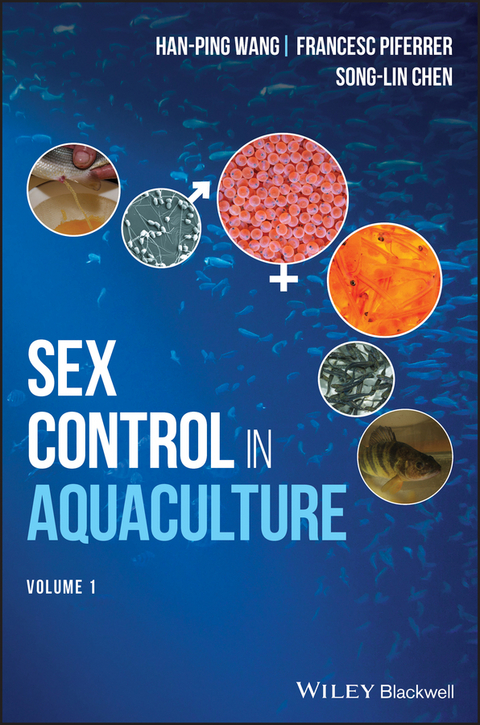
Sex Control in Aquaculture (eBook)
John Wiley & Sons (Verlag)
978-1-119-12727-7 (ISBN)
Awarded Bookauthority's 'Best Aquaculture Books of all Time'
A comprehensive resource that covers all the aspects of sex control in aquaculture written by internationally-acclaimed scientists
Comprehensive in scope, Sex Control in Aquaculture first explains the concepts and rationale for sex control in aquaculture, which serves different purposes. The most important are: to produce monosex stocks to rear only the fastest-growing sex in some species, to prevent precocious or uncontrolled reproduction in other species and to aid in broodstock management. The application of sex ratio manipulation for population control and invasive species management is also included. Next, this book provides detailed and updated information on the underlying genetic, epigenetic, endocrine and environmental mechanisms responsible for the establishment of the sexes, and explains chromosome set manipulation techniques, hybridization and the latest gene knockout approaches. Furthermore, the book offers detailed protocols and key summarizing information on how sex control is practiced worldwide in 35 major aquaculture species or groups, including fish and crustaceans, and puts the focus on its application in the aquaculture industry.
With contributions from an international panel of leading scientists, Sex Control in Aquaculture will appeal to a large audience: aquaculture/fisheries professionals and students, scientists or biologists working with basic aspects of fish/shrimp biology, growth and reproductive endocrinology, genetics, molecular biology, evolutionary biology, and R&D managers and administrators. This text explores sex control technologies and monosex production of commercially-farmed fish and crustacean species that are highly in demand for aquaculture, to improve feed utilization efficiency, reduce energy consumption for reproduction and eliminate a series of problems caused by mixed sex rearing. Thus, this book:
- Contains contributions from an international panel of leading scientists and professionals in the field
- Provides comprehensive coverage of both established and new technologies to control sex ratios that are becoming more necessary to increase productivity in aquaculture
- Includes detailed coverage of the most effective sex control techniques used in the world's most important commercially-farmed species
Sex Control in Aquaculture is the comprehensive resource for understanding the biological rationale, scientific principles and real-world practices in this exciting and expanding field.
About the Editors
HAN-PING WANG is Principal Scientist and Director of the Aquaculture Research Center, and Aquaculture Genetics and Breeding Laboratory, at The Ohio State University, Piketon, Ohio, USA
FRANCESC PIFERRER is Research Professor and head of the Group of Biology of Reproduction at the Institute of Marine Sciences, Spanish National Research Council, Barcelona, Spain
SONG-LIN CHEN is Professor and Director of the Lab for Aquaculture Biotechnology and Genomics at Yellow Sea Fisheries Research Institute, Chinese Academy of Fishery Sciences, Qingdao, China
Associate Editor
ZHI-GANG SHEN is Associate Professor at the College of Fisheries, Huazhong Agricultural University, Wuhan, China, and Aquaculture Genetics and Breeding Laboratory, The Ohio State University South Centers, Piketon, USA
Awarded Bookauthority's "e;Best Aquaculture Books of all Time"e;A comprehensive resource that covers all the aspects of sex control in aquaculture written by internationally-acclaimed scientists Comprehensive in scope, Sex Control in Aquaculture first explains the concepts and rationale for sex control in aquaculture, which serves different purposes. The most important are: to produce monosex stocks to rear only the fastest-growing sex in some species, to prevent precocious or uncontrolled reproduction in other species and to aid in broodstock management. The application of sex ratio manipulation for population control and invasive species management is also included. Next, this book provides detailed and updated information on the underlying genetic, epigenetic, endocrine and environmental mechanisms responsible for the establishment of the sexes, and explains chromosome set manipulation techniques, hybridization and the latest gene knockout approaches. Furthermore, the book offers detailed protocols and key summarizing information on how sex control is practiced worldwide in 35 major aquaculture species or groups, including fish and crustaceans, and puts the focus on its application in the aquaculture industry. With contributions from an international panel of leading scientists, Sex Control in Aquaculture will appeal to a large audience: aquaculture/fisheries professionals and students, scientists or biologists working with basic aspects of fish/shrimp biology, growth and reproductive endocrinology, genetics, molecular biology, evolutionary biology, and R&D managers and administrators. This text explores sex control technologies and monosex production of commercially-farmed fish and crustacean species that are highly in demand for aquaculture, to improve feed utilization efficiency, reduce energy consumption for reproduction and eliminate a series of problems caused by mixed sex rearing. Thus, this book: Contains contributions from an international panel of leading scientists and professionals in the field Provides comprehensive coverage of both established and new technologies to control sex ratios that are becoming more necessary to increase productivity in aquaculture Includes detailed coverage of the most effective sex control techniques used in the world's most important commercially-farmed species Sex Control in Aquaculture is the comprehensive resource for understanding the biological rationale, scientific principles and real-world practices in this exciting and expanding field.
About the Editors HAN-PING WANG is Principal Scientist and Director of the Aquaculture Research Center, and Aquaculture Genetics and Breeding Laboratory, at The Ohio State University, Piketon, Ohio, USA FRANCESC PIFERRER is Research Professor and head of the Group of Biology of Reproduction at the Institute of Marine Sciences, Spanish National Research Council, Barcelona, Spain SONG-LIN CHEN is Professor and Director of the Lab for Aquaculture Biotechnology and Genomics at Yellow Sea Fisheries Research Institute, Chinese Academy of Fishery Sciences, Qingdao, China Associate Editor ZHI-GANG SHEN is Associate Professor at the College of Fisheries, Huazhong Agricultural University, Wuhan, China, and Aquaculture Genetics and Breeding Laboratory, The Ohio State University South Centers, Piketon, USA
1
Sex Control in Aquaculture: Concept to Practice
Han‐Ping Wang1 and Zhi‐Gang Shen1,2
1 The Ohio State University South Centers, Piketon, Ohio, USA
2 College of Fisheries, Huazhong Agricultural University, Wuhan, China
1.1 Introduction
With over 30,000 recognized species, fish constitute the largest and most diverse taxa of vertebrates [1, 2] and display all kinds of reproductive strategies and sex determining (SD) mechanisms. These include genotypic sex determination (GSD), environmental sex determination (ESD), hermaphroditism, parthenogenesis, gynogenesis, and hybridogenesis [3, 4], as shown in Table 1.1.
Table 1.1 Summary of sex determination in fish.
| Sex determination or reproductive mode | Inheritance of sex | Sex‐determining mode or reproductive strategy | Time of sex determination | Female genotype(s) | Male genotype(s) | Morphology of sex chromosome | Example species | Reference |
| Genotypic sex determination | Sex chromosomal systems | Mono‐factorial system | At the point of fertilization and shortly later | XX | XY | Homomorphic | Tilapias | [51] |
| Heteromorphic | Rainbow trout | [184] |
| XX | XO | Heteromorphic | Triacanthus brevirostris | [185] |
| ZW | ZZ | Homomorphic | Tilapia mariae | [41] |
| Heteromorphic | Leporinus sp. | [186] |
| ZW | ZO | Heteromorphic | Colisa lalius | [187] |
| X1X1X2X2 | X1X2Y | Heteromorphic | Lutjanus quinquelineatus | [188] |
| XX | XY1Y2 | Heteromorphic | Hoplias malabaricus | [189] |
| XX | X1X2Y | Heteromorphic | Hoplias malabaricus | [190] |
| Z W1W2 | ZZ | Heteromorphic | Apareiodon affinis | [191] |
| Multifactorial system | XX, XW, WY | XY, YY | Homomorphic | Platyfish | [192] |
| Minor sex factors | Poly‐factorial system | N/A | N/A | N/A | zebrafish | [193] |
| Environment‐dependent sex | Environmental differences plus genetic factors | Temperature‐dependent SD | Thermo‐sensitive period | N/A | N/A | N/A | Pejerrey | [122] |
| determination | pH‐dependent SD | pH‐sensitive period | N/A | N/A | N/A | Apistogramma sp. | [194] |
| Hermaphrodite | Genetic factors | Proterandrous~ | N/A | N/A | N/A | N/A | Sparus aurata | [195] |
| Protogynous~ | N/A | N/A | N/A | N/A | Coris julis | [196] |
| Simultaneous~ | N/A | N/A | N/A | N/A | Serranus subligarius | [197] |
| Unisexuality | Genetic factors | Gynogenesis | At the point of fertilization and | XX | XY | Homomorphic | Carassius auratus gibelio | [198] |
| Hybridogenesis | shortly later | Not known | Not known | Not known | Poeciliopsis | [199] |
| Parthenogenesis | Not known | Not known | Not known | Poecilia formosa | [200] |
Note: sex determining mode assigned in the table only represents specific geographic population, not the species as a whole.
SD, sex determination; N/A, not applicable.
Table adapted from [64].
Of the 709 species with a recorded sexual system [5], SD mechanisms have only been extensively investigated in limited numbers – for example: tilapia (mainly of the genus Oreochromis); European sea bass (Dicentrarchus labrax); medaka (Oryzias latipes); tiger Pufferfish (Takifugu rubripes); rainbow trout (Oncorhynchus mykiss); pejerrey (Odontesthes bonariensis); Atlantic silverside (Menidia menidia); zebrafish (Danio rerio); Japanese flounder (Paralichthys olivaceus); and yellow catfish (Pelteobagrus fulvidraco). However, regardless of reproductive strategy, the sex ratio is determined by a sex determining mechanism, can be influenced during the process of sex differentiation, and is the vital demographic parameter that determines/influences population structure, reproductive potential, and economic value for a given species.
Besides the diversity, phenotypic sex of fish is characterized by plasticity/lability, changeability, and complexity. In short, sex determination in fish is much more complex than we ever thought, and having clear pictures of the related terminologies (Boxes 1.1 and 1.2) will help us understand the complexity of sex determination in fish and sex control in aquaculture.
Box 1.1 Glossary of reproductive strategies, sex determining mechanisms, sex differentiation, and sex control
- Gonochorists: individual organisms that contain only male or female sex organs throughout their lifetime.
- Hermaphrodites: individual organisms that contain both male and female sex organs.
- Sequential hermaphroditism: individual organisms that change sex at some point during their life.
- Unisexuality: a mode of reproduction whereby offspring are formed exclusively from maternal or paternal genetic information.
- Sex determination: the genetic or environmental process that establishes the sex of an organism.
- Sex differentiation: the process by which an undifferentiated gonad is transformed into an ovary or a testis. Specifically, it is the realization of the phenotypic sex.
- Genotypic sex determination: an individual’s sex is established by its genotype.
- Environmental‐dependent sex determination: sex is triggered by environmental cues, such as ambient temperature or pH during a sensitive period, usually in larval states.
- Temperature‐dependent sex determination (TSD): sex is determined by ambient temperature rather than genotype in early stages of development. TSD is the most popular type of ESD, which has received the most extensive attention.
- Genotypic sex determination plus temperature effects (GSD + TE): sex ratio is determined by genotype while affected by temperature.
- Polygenic sex determination (PSD): sex is dependent on the combined effects of multiple pro‐female and pro‐male factors (e.g., it is determined by multiple, independently segregating sex “switch” loci or alleles).
- Sex control: to change an individual or population’s sex ratio through one of several possible approaches, such as direct modification through sex‐reversal by hormone administration or gene knockout, or by indirect methods such as chromosome manipulation, hybridization, or a combination of several.
- Neomale: a genotypic female that develops into a phenotypic male (e.g., XX males in yellow perch (XX / XY)).
- Neofemale: a genotypic male that develops into a phenotypic female.
Box 1.2 Confusing terminologies
Several terms, such as sex determination and sex differentiation, as well as the differences between GSD and ESD (especially TSD), are very important and need to be clearly defined.
Sex determination and sex differentiation
Sex determination and sex differentiation are often misused, because the distinction between the two terms is difficult, since the criteria of sex differentiation (morphological/histological, cellular, molecular) are frequently used to state whether the phenotypic sex has been determined [4]. Sex determination indicates how and when the genotypic or environmental sex is determined, while sex differentiation describes the realization process of phenotypic male or female.
Sex determination usually happens prior to, or at the same time as sex differentiation, and influences sex differentiation in a...
| Erscheint lt. Verlag | 8.11.2018 |
|---|---|
| Mitarbeit |
Stellvertretende Herausgeber: Zhi-Gang Shen |
| Sprache | englisch |
| Themenwelt | Naturwissenschaften ► Biologie |
| Weitere Fachgebiete ► Land- / Forstwirtschaft / Fischerei | |
| Schlagworte | Aquaculture • Aquaculture, Fisheries & Fish Science • Aquakultur • Aquakultur, Fischereiwesen u. Fischforschung • A simplified classical fish sex differentiation cascade • Biowissenschaften • Endocrine regulation of fish sex differentiation • Environmental and consumer-friendly mono-sex production • Fische • Fische / Zucht u. Genetik • Fish Breeding & Genetics • Fish genetic sex determination • From genetic sex determination to environmental sex determination in fish • Large-scale mono-sex production • Life Sciences • Mechanisms for the emergence of new master sex-determining genes and gene regulatory networks • Molecular Biology • Molekularbiologie • Population-based identification of sex determining mechanism • Sex Control in Aquaculture: Concept to Practice • Sex control practices in fisheries • Sex Determination and Differentiation in Fish • Sex determination in fish • Sex differentiation as a threshold phenotype relying on fine regulations of a plastic regulatory gene network • Targets of sex-determining factors and molecular network involved in sex differentiation • When genetic and environmental sex determination blend |
| ISBN-10 | 1-119-12727-0 / 1119127270 |
| ISBN-13 | 978-1-119-12727-7 / 9781119127277 |
| Informationen gemäß Produktsicherheitsverordnung (GPSR) | |
| Haben Sie eine Frage zum Produkt? |
 EPUB (Adobe DRM)
Kopierschutz: Adobe-DRM
Adobe-DRM ist ein Kopierschutz, der das eBook vor Mißbrauch schützen soll. Dabei wird das eBook bereits beim Download auf Ihre persönliche Adobe-ID autorisiert. Lesen können Sie das eBook dann nur auf den Geräten, welche ebenfalls auf Ihre Adobe-ID registriert sind.
Details zum Adobe-DRM
Dateiformat: EPUB (Electronic Publication)
EPUB ist ein offener Standard für eBooks und eignet sich besonders zur Darstellung von Belletristik und Sachbüchern. Der Fließtext wird dynamisch an die Display- und Schriftgröße angepasst. Auch für mobile Lesegeräte ist EPUB daher gut geeignet.
Systemvoraussetzungen:
PC/Mac: Mit einem PC oder Mac können Sie dieses eBook lesen. Sie benötigen eine
eReader: Dieses eBook kann mit (fast) allen eBook-Readern gelesen werden. Mit dem amazon-Kindle ist es aber nicht kompatibel.
Smartphone/Tablet: Egal ob Apple oder Android, dieses eBook können Sie lesen. Sie benötigen eine
Geräteliste und zusätzliche Hinweise
Buying eBooks from abroad
For tax law reasons we can sell eBooks just within Germany and Switzerland. Regrettably we cannot fulfill eBook-orders from other countries.
aus dem Bereich