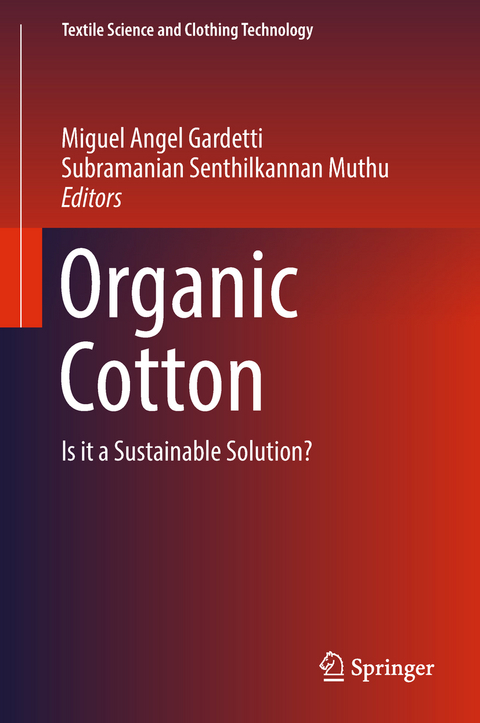
Organic Cotton (eBook)
X, 176 Seiten
Springer Singapore (Verlag)
978-981-10-8782-0 (ISBN)
This book highlights the traditional boundaries of the textile industry and discusses to what extent organic cotton is sustainable. It also examines the domestic and international influences of agricultural practices on cotton. Sustainability issues in the textile and fashion sectors require the influences that arise from beyond the boundaries of the conventional textile industry to be taken into account. These "e;external"e; influences-from (international or domestic) agricultural practices and energy policies to consumption patterns and levels of ecological notions of the society-have a significant impact on the sustainability of the textile and fashion sectors as a whole. Ecological and social concerns go far beyond individual companies and industries; therefore, in order to become more sustainable, the textile (and fashion) industry needs to address these concerns appropriately and connect with other disciplines, industries, communities, and international groups.
Dr. Miguel Angel Gardetti has been the head of the Center for Study of Corporate Sustainability (IESC) since its foundation in 2002, and he also holds the same position at the Center for Study of Sustainable Luxury. He is head professor in MBA and master’s programmes both in Argentina and abroad. He has provided training within frameworks of executive education and in house programmes to CEOs and corporate managers from both domestic and multinational companies in Argentina and Latin America. In the field of textiles, fashion and sustainability, he also developed several publications in the area of sustainable luxury as, for example, the special issue of the Journal of Corporate Citizenship on Textiles, Fashion and Sustainability and a book titled Sustainability in Fashion and Textiles; Values, Design, Production and Consumption. Miguel was a member of the United Nations Global Compact Promoting Group in Argentina and a member of its governance body—the Board of the Argentine Chapter of The Global Compact—for two consecutive terms. He was co-founder of the Global Compact Chair in Argentina, and he was also part of the task force that developed the ‘Management Responsible Education Principles’ of the United Nations Global Compact.Dr Subramanian Senthilkannan Muthu holds PhD in Textiles Sustainability and he has over 40 books to his credit along with 80 research publications. He is well known in the field of Textiles Sustainability due to his notable contributions to the society in terms of his academic and industrial experiences. He is an editor in chief of Textiles & Clothing Sustainability Journal.
Organic cotton and certifications.- Organic cotton and poverty.- Organic cotton and fair trade.- Organic cotton and environmental impacts.- Organic Cotton vs Recycled Cotton vs Sustainable Cotton.- Organic cotton and affordability.- Organic cotton: chemical free?.- Organic cotton and soil.- Organic cotton and greenwashing.- Organic cotton and developing countries.
| Erscheint lt. Verlag | 9.10.2018 |
|---|---|
| Reihe/Serie | Textile Science and Clothing Technology | Textile Science and Clothing Technology |
| Zusatzinfo | X, 176 p. 33 illus., 28 illus. in color. |
| Verlagsort | Singapore |
| Sprache | englisch |
| Themenwelt | Naturwissenschaften ► Biologie ► Ökologie / Naturschutz |
| Naturwissenschaften ► Chemie | |
| Technik ► Maschinenbau | |
| Technik ► Umwelttechnik / Biotechnologie | |
| Wirtschaft | |
| Weitere Fachgebiete ► Land- / Forstwirtschaft / Fischerei | |
| Schlagworte | Affordable cotton • Chemical free cotton • Cotton certifications • Cotton fair trade • Engineering Economics • Environmental impacts of cotton • Greenwashing cotton • Recycled cotton • Sustainable Cotton • textile engineering |
| ISBN-10 | 981-10-8782-2 / 9811087822 |
| ISBN-13 | 978-981-10-8782-0 / 9789811087820 |
| Informationen gemäß Produktsicherheitsverordnung (GPSR) | |
| Haben Sie eine Frage zum Produkt? |
 PDF (Wasserzeichen)
DRM: Digitales Wasserzeichen
Dieses eBook enthält ein digitales Wasserzeichen und ist damit für Sie personalisiert. Bei einer missbräuchlichen Weitergabe des eBooks an Dritte ist eine Rückverfolgung an die Quelle möglich.
Dateiformat: PDF (Portable Document Format)
Mit einem festen Seitenlayout eignet sich die PDF besonders für Fachbücher mit Spalten, Tabellen und Abbildungen. Eine PDF kann auf fast allen Geräten angezeigt werden, ist aber für kleine Displays (Smartphone, eReader) nur eingeschränkt geeignet.
Systemvoraussetzungen:
PC/Mac: Mit einem PC oder Mac können Sie dieses eBook lesen. Sie benötigen dafür einen PDF-Viewer - z.B. den Adobe Reader oder Adobe Digital Editions.
eReader: Dieses eBook kann mit (fast) allen eBook-Readern gelesen werden. Mit dem amazon-Kindle ist es aber nicht kompatibel.
Smartphone/Tablet: Egal ob Apple oder Android, dieses eBook können Sie lesen. Sie benötigen dafür einen PDF-Viewer - z.B. die kostenlose Adobe Digital Editions-App.
Buying eBooks from abroad
For tax law reasons we can sell eBooks just within Germany and Switzerland. Regrettably we cannot fulfill eBook-orders from other countries.
aus dem Bereich