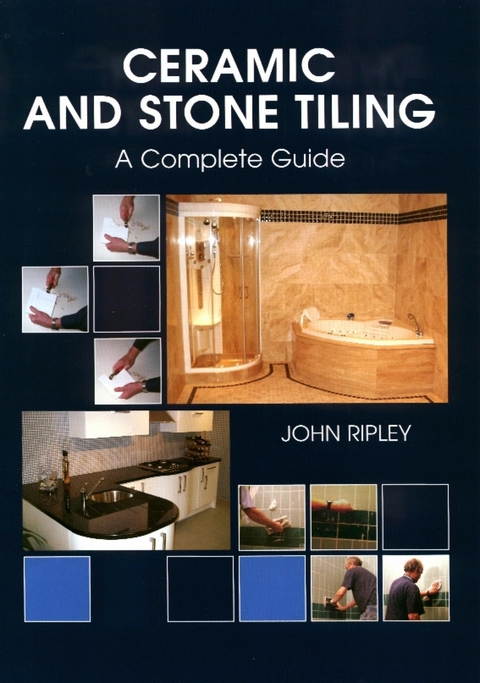
Ceramic and Stone Tiling (eBook)
144 Seiten
Crowood (Verlag)
978-1-84797-968-1 (ISBN)
ohn Ripley has been involved in the tiling business for his entire working life and over a period of fifty years gained experience in almost every aspect of the trade. He has represented the trade on the tiling committee of the British Standards Institute for many years and is the Chief Inspector for the National Federation of Terrazzo Marble and Mosaic specialists and a technical inspector for the Tile Assocation.
Introduction
The object of this book is to provide information that will enable a beginner to carry out tiling work to a satisfactory standard and to present the more competent do-it-yourself enthusiast with more detailed instructions than he or she might normally encounter. This book is definitely not intended to be a manual for the professional tiler. That would involve going into a depth of detail which is unnecessary for domestic work and which would probably bore anyone not directly involved in the trade.
There are many excellent books available that will provide enough information to enable you to carry out a competent tiling job for most domestic situations. Unfortunately, they rarely deal with the problems which we find ourselves facing in real life. This book contains plenty of information which will help you to avoid or overcome the difficulties that are most likely to crop up when doing actual tiling projects. Knowing how to do something is one thing. But knowing why it is done in that particular way enables you to understand the procedures involved in tiling and, hopefully, to foresee the problems that can arise.
Whilst it is not possible to give detailed instructions on how to overcome every difficulty, this book aims to give an insight into the processes involved and, in particular, what situations should be avoided. This, it is hoped, will provide sufficient information to assist you in making informed decisions on what needs to be done in most of the circumstances that are likely to arise in the average do-it-yourself project.
FUNCTION AND PURPOSE OF TILING
Why tile a surface in the first place? It is usually more expensive than paint or wallpaper, takes longer, is more difficult to do and the range of colours and patterns is little different from those available in other materials.
The reason is that tiles are very durable. They can resist knocks, abrasion and water, and can be used in situations where most other materials would quickly deteriorate. Ceramics are some of the most durable materials known to man and ceramic tiles can be counted on to last indefinitely without loosing the freshness of their appearance.
In both bathrooms and kitchens hygiene is important. Surfaces need to be cleaned regularly and thoroughly, often with abrasive chemical cleaners, without developing surface faults that could harbour bacteria. They also need to be hard and strong enough to withstand the day to day knocks which all such surfaces receive in commercial situations. Tiling can be the easiest way of providing a durable, easily cleaned surface, and commercially is often used just for these properties.
Tiles are most often used when a combination of durability and decoration is needed. Tile manufacturing techniques have evolved in a way that makes an enormous range of designs, textures and finishes available. Some of the technologies, such as stencilling and silk-screen printing, have been ‘borrowed’ from other trades. Others, like encaustic decoration and mosaic work, are unique to tiling and have evolved into high art forms in their own right. The range of tiles available today is huge and covers just about any imaginable situation from the point of view of beauty or practicality.
Lastly, but certainly not least, is the desirability factor. The expensive decorative forms of tiling have always presented an image of both prestige and opulence. It is only in the last fifty years or so that decorative tiles of any type have been affordable to most people. A century ago even the most basic form of tiling would have been beyond the means of the majority of the population. Modern computerized manufacturing methods, combined with new fixatives and fixing techniques, now make it possible for everyone to have the finishes that were once only available to the wealthiest in society.
BEFORE YOU START
Readers conversant with the building trade will probably notice that the technical terms used in this book do not necessarily coincide with the ones that they are used to. These do vary up and down the country and I have tried to use terms that are as descriptive of the situation as possible. Failing this, I have used the ones I was brought up with.
This book tries to tell the do-it-yourself tradesman not just how to tile, but the situations he or she should avoid. Readers are advised to read the whole book before starting work, because tiling is one of those trades where the processes constantly reflect back on earlier stages. You can create problems for yourself that you will not notice until a week later. Getting an idea of the whole process first will help to avoid those situations which every tiler gets into when first learning the trade.
Some of the processes described here are not strictly ‘to the book’. This is deliberate as it reflects what actually happens on sites, rather than the hypothetical position that can sometimes be impractical.
With floor tiling there is no certain division between paving and tiling as the terms cover fields that overlap. Likewise, there is no strict dividing line between semi-structural faience cladding and ordinary wall tiling. For the purposes of this book a tile will be considered as a hard, inflexible, mineral-based facing which has to be bonded to a base or backing to give it the structural strength it needs.
The right safety equipment is important.
HEALTH AND SAFETY
There is a great emphasis today on the safety aspects of building operations. The days have gone when the risks were usually mechanical and were restricted mainly to such things as hitting your thumb with a hammer or getting something in your eye. Materials today are more complex and potentially more dangerous: cement is faster reacting; adhesives and grouts are complex mixtures containing obscure resins; cutting equipment is often powered by electricity; and commercial power tools, originally intended for fully skilled tradesmen, can be hired by the general public. Safety should be the DIYer’s top priority. There is little point in starting a job if you are not going to keep yourself in a condition to finish it.
There are a few dangers which are specific to the trade. The glaze on the surface of glazed tiles is really a layer of glass and is just as sharp. Raw edges and splinters are produced when tiles are being cut; these should always be handled carefully and waste disposed of safely. Porcelain and other vitrified tiles have this property through the whole of their thickness. Always take care when handling cut tiles and avoid touching freshly cut edges on tiles if you can. Always wear gloves when clearing debris away.
Some of the products used in tiling can occasionally result in an allergic reaction if you are exposed to them for too long. Some people go all their working lives with no problems. Do not count on being one of the lucky ones. If the instructions for the product say you should wear protective clothing, then do so.
The most common accidents in the building trade are those involving falls. Always make sure that you have a secure footing, particularly when working in awkward corners or at a height. You will usually be using both hands for the job in hand, and will have none to spare for an emergency.
All power tools have the potential to be dangerous. In the building trade power tools are 110V. Those intended for domestic or DIY use are usually 240V, which places you potentially at more risk than the professional. Use circuit breakers and always keep it in mind that water and electricity do not mix.
Whilst tiling is not the most hazardous activity in the building industry, accidents are always waiting to happen and you can never relax your guard. It is not possible, in a book of this length, to cover every conceivable safety issue in detail. However, here are a few useful tips:
- Always expect that an accident will happen. Because if you don’t, it will. Accidents are only prevented by constantly taking precautions against them.
- Always read the instructions. They are not there just to decorate the bag or the box. When you have read them, do as they say.
- Work tidily. If it isn’t needed for the job in hand, get it out of the way. There isn’t a tiler alive who hasn’t knelt on a nail in a piece of lathe he has left lying about.
- Concentrate on the job in hand. Most accidents happen when you try to do two things at once, like thinking about tomorrow night’s date while using a bench saw that is powerful enough to throw you through a wall.
- If the job calls for protective clothing, use it. The gloves are not for keeping your hands warm and whilst goggles might not improve your eyesight, they might help you to keep it.
- Make sure that you have the right gear. If you are working 3m up a wall, a step stool with a few tile boxes on top is not the right gear.
- Keep some variety in the work, don’t do too much of anything at one time. This may not seem like a health and safety tip, but doing too much of the same thing makes you careless of safety. Apart from that, spending all day doing nothing but cutting with tile nippers will give you an insight into that most fashionable of disorders – Repetitive Strain Injury.
DESIGN CONSIDERATIONS
Tiling is different from other forms of decoration. It is much more permanent, and if you get it wrong you are usually going to have to live with it for a long time. Form, texture and colour are always going to be down to personal taste. However, within any trade there are situations which are known to cause problems. If you know what the problem is, then you can either avoid it or work around it. The following...
| Erscheint lt. Verlag | 30.11.2014 |
|---|---|
| Zusatzinfo | 117 colour photographs 43 diagrams |
| Verlagsort | London |
| Sprache | englisch |
| Themenwelt | Sachbuch/Ratgeber ► Freizeit / Hobby ► Hausbau / Einrichten / Renovieren |
| Sachbuch/Ratgeber ► Freizeit / Hobby ► Heimwerken / Do it yourself | |
| Sachbuch/Ratgeber ► Freizeit / Hobby ► Kreatives Gestalten | |
| Sachbuch/Ratgeber ► Gesundheit / Leben / Psychologie ► Lebenshilfe / Lebensführung | |
| Technik ► Bauwesen | |
| Weitere Fachgebiete ► Handwerk | |
| ISBN-10 | 1-84797-968-8 / 1847979688 |
| ISBN-13 | 978-1-84797-968-1 / 9781847979681 |
| Informationen gemäß Produktsicherheitsverordnung (GPSR) | |
| Haben Sie eine Frage zum Produkt? |
 EPUB (Wasserzeichen)
DRM: Digitales Wasserzeichen
Dieses eBook enthält ein digitales Wasserzeichen und ist damit für Sie personalisiert. Bei einer missbräuchlichen Weitergabe des eBooks an Dritte ist eine Rückverfolgung an die Quelle möglich.
Dateiformat: EPUB (Electronic Publication)
EPUB ist ein offener Standard für eBooks und eignet sich besonders zur Darstellung von Belletristik und Sachbüchern. Der Fließtext wird dynamisch an die Display- und Schriftgröße angepasst. Auch für mobile Lesegeräte ist EPUB daher gut geeignet.
Systemvoraussetzungen:
PC/Mac: Mit einem PC oder Mac können Sie dieses eBook lesen. Sie benötigen dafür die kostenlose Software Adobe Digital Editions.
eReader: Dieses eBook kann mit (fast) allen eBook-Readern gelesen werden. Mit dem amazon-Kindle ist es aber nicht kompatibel.
Smartphone/Tablet: Egal ob Apple oder Android, dieses eBook können Sie lesen. Sie benötigen dafür eine kostenlose App.
Geräteliste und zusätzliche Hinweise
Buying eBooks from abroad
For tax law reasons we can sell eBooks just within Germany and Switzerland. Regrettably we cannot fulfill eBook-orders from other countries.
aus dem Bereich