Green Composites (eBook)
VIII, 90 Seiten
Springer Singapore (Verlag)
978-981-13-1969-3 (ISBN)
Dr Subramanian Senthilkannan Muthu holds a PhD in Textiles Sustainability and has over 60 books to his credit, along with 80 research publications. He is well known in the field of Textiles Sustainability due to his notable contributions in both academic and industrial contexts. He is currently working as Head of Sustainability for SgT Group & API, based in Hong Kong.
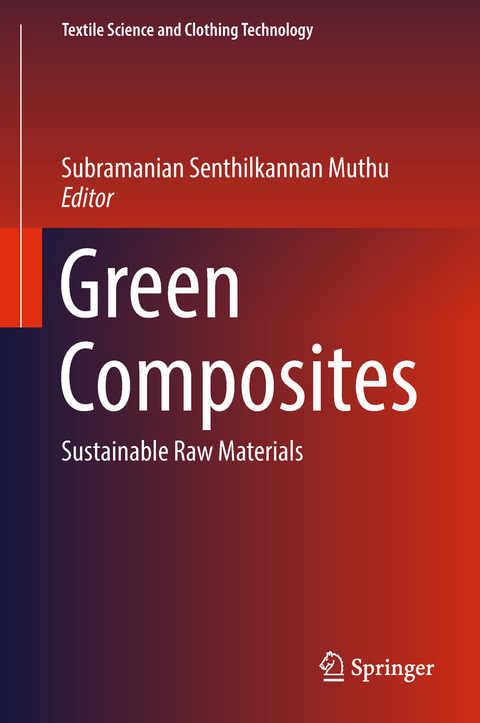
This book highlights the production of green composites from various sustainable raw materials. We now live in an environmentally conscious era, in which sustainable raw materials (renewable, biodegradable, recycled), sustainable processing sequences, the production of recyclable and biodegradable products, and avoiding the depletion of renewable resources are key considerations with regarding to producing any product. The textile sector is no exception. Accordingly, this book addresses these aspects in connection with textiles, and discusses how they can be actively practiced.
Dr Subramanian Senthilkannan Muthu holds a PhD in Textiles Sustainability and has over 60 books to his credit, along with 80 research publications. He is well known in the field of Textiles Sustainability due to his notable contributions in both academic and industrial contexts. He is currently working as Head of Sustainability for SgT Group & API, based in Hong Kong.
Contents 7
1 Production of Green Composites from Various Sustainable Raw Materials 9
Abstract 9
1 Properties of Sustainable Raw Materials as Reinforcing Materials 11
2 Composites 13
2.1 Sustainable Fibres Used in Composite 14
2.2 Necessity of Matrix and Its Role in Preparation of Fibre-Reinforced Polymer Composite 15
2.2.1 Resin Matrix 15
2.2.2 Thermoset Benefits 15
2.2.3 Thermoplastic Benefits 15
2.2.4 Polyester Resins 16
2.2.5 Vinyl Ester Resins 16
2.2.6 Epoxy Resins 17
3 Surface Modification of Bast Fibres for Composite Materials 17
3.1 Surface Modification Methods of Natural Fibres 18
3.2 Physical Methods 18
3.3 Chemical Methods 18
3.3.1 Alkali Treatment 19
3.3.2 Graft Copolymerization 19
3.3.3 Grafting of Cellulose 20
3.3.4 Other Chemical Treatments 21
4 Application of Sustainable Raw Materials as Green Composite 21
4.1 Sustainable Green Composites from Natural Oil-Based Resins 22
4.2 Sustainable Green Composites from Soy Protein-Based Resin 23
4.3 Sustainable Green Composites from Polylactic Acid-Based Resin 24
4.4 Sustainable Green Composites from Starch-Based Materials 25
5 Some Novel Sustainable Lignocellulosic Fibres Used as Reinforcing Materials 25
5.1 Fibres from Agave angustifolia Plant 25
5.2 Fibres from Abelmoschus manihot Plant 26
5.3 Fibres from Sansevieria roxburghiana Plant 26
5.4 Fibres from Pandanus odorifer Plant 27
6 Challenges in Sustainable Composites 29
7 Conclusions 29
References 30
2 Production of Sustainable Green Concrete Composites Comprising Industrial Waste Carpet Fibres 33
Abstract 33
1 Introduction 34
1.1 General Appraisal 34
1.2 Background 35
2 Waste Carpet Fibres 36
2.1 Types and Sources of Waste Carpet 37
2.2 Carpet Fibre Recycling Technology 38
3 Concrete Composites Incorporating Waste Carpet Fibres 41
3.1 Fresh Properties 41
3.1.1 Density 41
3.1.2 Air Content 41
3.1.3 Slump 42
3.1.4 Vebe Time 44
3.2 Hardened Properties 45
3.2.1 Compressive Strength 45
3.2.2 Splitting Tensile Strength 46
3.2.3 Flexural Strength 48
3.2.4 Impact Resistance 49
3.2.5 Water Absorption 52
3.2.6 Chloride Penetration 53
3.3 Microstructural Analysis 54
4 Applications 57
5 Conclusions 57
References 58
3 Environmentally Benign and Sustainable Green Composites: Current Developments and Challenges 61
Abstract 61
1 Introduction 62
2 Composites 63
2.1 Matrix Materials 64
2.1.1 Polymer Matrix 64
Thermoset Resin Matrices 64
Thermoplastic Resin Matrices 65
2.1.2 Metal Matrix 65
2.1.3 Ceramic Matrix 66
2.2 Reinforcing Materials 67
2.2.1 Fibre-Reinforced Composites 67
2.2.2 Particulate-Reinforced Composites 68
2.2.3 Structural Composites 69
2.3 Advantages and Limitations of Composites 69
3 Effect of Composites and Their Materials on the Environment 71
3.1 Impact of Different Composite Materials on the Environment 71
3.1.1 Impact of Polymers 71
3.1.2 Impact of Metals 72
3.2 Impact of Composites 73
3.2.1 Non-Degradable Composites 73
3.2.2 Partially Degradable Composites 73
3.2.3 Biodegradable Composites 74
4 Environmentally Harmless Green Composites 74
4.1 Green Composite Reinforcements and Matrix 74
4.1.1 Natural Fibres 74
Plant Fibres 76
Animal Fibres 77
Fibres from Waste 78
4.1.2 Biodegradable Polymers 78
Polylactic Acids (PLA) 80
Polyhydroxyalkanoates (PHA) 82
Starch 83
Cellulose 84
4.2 Processing Aspects of Green Composites 85
4.2.1 Filament Winding 86
4.2.2 Contact Moulding 87
4.2.3 Resin Transfer Moulding (RTM) 87
4.2.4 Injection Moulding 88
4.2.5 Autoclave Bonding 88
4.3 Thermoplastic and Thermosetting Green Composites 89
4.4 Attributes of Green Composites 91
4.4.1 Mechanical Properties 91
4.4.2 Varying Properties of Fibres 92
4.4.3 Renewability 92
4.4.4 Low Embodied Energy 92
4.4.5 Biodegradability 92
4.4.6 Low Cost 93
4.4.7 High Water Absorption 93
4.4.8 Poor Durability 93
4.4.9 Non-Toxicity 94
4.4.10 Biocompatibility and Bioactivity 94
4.4.11 High-Temperature Degradation 94
5 Conclusion and Future Prospects 94
References 95
| Erscheint lt. Verlag | 20.8.2018 |
|---|---|
| Reihe/Serie | Textile Science and Clothing Technology | Textile Science and Clothing Technology |
| Zusatzinfo | VIII, 90 p. 28 illus., 21 illus. in color. |
| Verlagsort | Singapore |
| Sprache | englisch |
| Themenwelt | Naturwissenschaften ► Biologie ► Ökologie / Naturschutz |
| Naturwissenschaften ► Chemie | |
| Naturwissenschaften ► Geowissenschaften | |
| Technik ► Maschinenbau | |
| Technik ► Umwelttechnik / Biotechnologie | |
| Wirtschaft ► Betriebswirtschaft / Management ► Unternehmensführung / Management | |
| Weitere Fachgebiete ► Land- / Forstwirtschaft / Fischerei | |
| Schlagworte | Biodegradable Composites • Engineering Economics • Fiber Reinforced Composites (FRC) • Glass Reinforced Plastics (GRP) • Polymer Matrix Composites (PMC) • Recycled Composites • Renewable Composites • Sustainable Green Composites • textile engineering |
| ISBN-10 | 981-13-1969-3 / 9811319693 |
| ISBN-13 | 978-981-13-1969-3 / 9789811319693 |
| Informationen gemäß Produktsicherheitsverordnung (GPSR) | |
| Haben Sie eine Frage zum Produkt? |
 PDF (Wasserzeichen)
DRM: Digitales Wasserzeichen
Dieses eBook enthält ein digitales Wasserzeichen und ist damit für Sie personalisiert. Bei einer missbräuchlichen Weitergabe des eBooks an Dritte ist eine Rückverfolgung an die Quelle möglich.
Dateiformat: PDF (Portable Document Format)
Mit einem festen Seitenlayout eignet sich die PDF besonders für Fachbücher mit Spalten, Tabellen und Abbildungen. Eine PDF kann auf fast allen Geräten angezeigt werden, ist aber für kleine Displays (Smartphone, eReader) nur eingeschränkt geeignet.
Systemvoraussetzungen:
PC/Mac: Mit einem PC oder Mac können Sie dieses eBook lesen. Sie benötigen dafür einen PDF-Viewer - z.B. den Adobe Reader oder Adobe Digital Editions.
eReader: Dieses eBook kann mit (fast) allen eBook-Readern gelesen werden. Mit dem amazon-Kindle ist es aber nicht kompatibel.
Smartphone/Tablet: Egal ob Apple oder Android, dieses eBook können Sie lesen. Sie benötigen dafür einen PDF-Viewer - z.B. die kostenlose Adobe Digital Editions-App.
Buying eBooks from abroad
For tax law reasons we can sell eBooks just within Germany and Switzerland. Regrettably we cannot fulfill eBook-orders from other countries.
aus dem Bereich