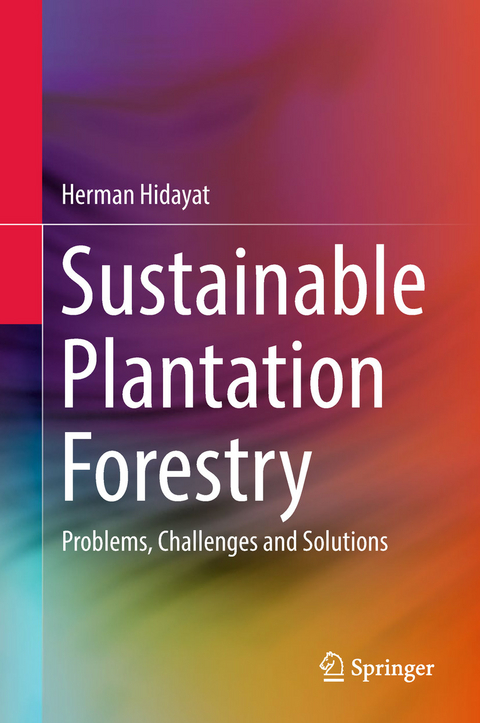
Sustainable Plantation Forestry (eBook)
XI, 315 Seiten
Springer Singapore (Verlag)
978-981-10-7653-4 (ISBN)
This book discusses sustainable forest management from the perspectives of sociology, anthropology, politics, economics and policy. It examines the roles of governments, private sectors, NGOs, academics and local communities in implementing sustainable plantation forestry, which aims to supply timber for the forestry industry while at the same time reducing global warming. The book also explores the debates on sustainable forest management practices in several countries, and examines the effects of political ecology on plantation forestry as well as the impact of climate change and conservation programs. By analyzing a number of interrelated issues, it offers a valuable resource for all governments, private companies, practitioners, NGOs, academics and students studying forest management and political ecology from a social sciences perspective.
Herman Hidayat, Ph.D, is an expert researcher in social forestry. He obtained his professorship in December 2014 at the Indonesian Institute of Sciences. He completed his doctoral degree in The University of Tokyo, Graduate School of Agricultural and Life Sciences, Department of Forest Sciences, Laboratory of Forest Policy (2005). He carried out his post-doctoral research under the JSPS Fellowship program from November 2008-November 2010 in the Center for Southeast Asian Studies, Kyoto University. His research interest is in sustainable plantation forestry in ASEAN and its sociological effects on stakeholders. He publishes extensively on forest policy, land conflict, political ecology and national parks in Indonesia, Southeast Asia, Japan and France. Over the last 20 years, he has published over 45 articles, 80 popular writings and 2 books on forestry issues, with most of his articles being published in international journals. He has also been actively involved as a Visiting Fellow in research institutes in Japan and France such as Kyushu University - Research Center for Comparative Education and Culture, Fukuoka (April 1991-March 1992), Institute of Developing Economies - Japan External Trade Organization, Chiba (September 2006-February 2007), Kyoto University - Center for Southeast Asian Studies (November 2008-December 2010), Fondation Maison des Sciences de I'homme, Paris (October-November 2011), a Visiting Professor at Kagoshima University - Research Center for the Pacific Islands (November 2012-March 2013) and a Visiting Fellow at Kahin Center Research Center, Cornell University (August-October 2014). He was also one of fifteen participants who attended a training program on 'Building Capacity for Sustainable Forest Governance in Indonesia and Australia' (January-February 2017) under the sponsorship of the Australia Awards Fellowships Program and Centre for Environmental Law, Macquarie University, Sydney. Currently, he serves as a reviewer with the Journal of Forest Science, Kangwon National University, Chunchon, South Korea, Social Economic of Forestry Journal, Research Center for Social Economic Forestry, Ministry of Forestry and Society and Natural Resources Journal, The International Association for Society and Natural Resources.
This book discusses sustainable forest management from the perspectives of sociology, anthropology, politics, economics and policy. It examines the roles of governments, private sectors, NGOs, academics and local communities in implementing sustainable plantation forestry, which aims to supply timber for the forestry industry while at the same time reducing global warming. The book also explores the debates on sustainable forest management practices in several countries, and examines the effects of political ecology on plantation forestry as well as the impact of climate change and conservation programs. By analyzing a number of interrelated issues, it offers a valuable resource for all governments, private companies, practitioners, NGOs, academics and students studying forest management and political ecology from a social sciences perspective.
Herman Hidayat, Ph.D, is an expert researcher in social forestry. He obtained his professorship in December 2014 at the Indonesian Institute of Sciences. He completed his doctoral degree in The University of Tokyo, Graduate School of Agricultural and Life Sciences, Department of Forest Sciences, Laboratory of Forest Policy (2005). He carried out his post-doctoral research under the JSPS Fellowship program from November 2008-November 2010 in the Center for Southeast Asian Studies, Kyoto University. His research interest is in sustainable plantation forestry in ASEAN and its sociological effects on stakeholders. He publishes extensively on forest policy, land conflict, political ecology and national parks in Indonesia, Southeast Asia, Japan and France. Over the last 20 years, he has published over 45 articles, 80 popular writings and 2 books on forestry issues, with most of his articles being published in international journals. He has also been actively involved as a Visiting Fellow in research institutes in Japan and France such as Kyushu University - Research Center for Comparative Education and Culture, Fukuoka (April 1991-March 1992), Institute of Developing Economies - Japan External Trade Organization, Chiba (September 2006-February 2007), Kyoto University - Center for Southeast Asian Studies (November 2008-December 2010), Fondation Maison des Sciences de I’homme, Paris (October-November 2011), a Visiting Professor at Kagoshima University - Research Center for the Pacific Islands (November 2012-March 2013) and a Visiting Fellow at Kahin Center Research Center, Cornell University (August-October 2014). He was also one of fifteen participants who attended a training program on "Building Capacity for Sustainable Forest Governance in Indonesia and Australia" (January-February 2017) under the sponsorship of the Australia Awards Fellowships Program and Centre for Environmental Law, Macquarie University, Sydney. Currently, he serves as a reviewer with the Journal of Forest Science, Kangwon National University, Chunchon, South Korea, Social Economic of Forestry Journal, Research Center for Social Economic Forestry, Ministry of Forestry and Society and Natural Resources Journal, The International Association for Society and Natural Resources.
List of Tables.- List of Figures.- Foreword by Prof. David Sonnenfeld.- Section I.- Introduction.- Chapter 1. Sustainable Forest Management Review - An Introduction.- Section II.- Asia.- Chapter 2. Japan.- Chapter 3. Indonesia, Philippines, Thailand and Vietnam.- Section III.- Europe.- Chapter 4. France.- Section IV. America.- Chapter 5. New York State.- Index.
| Erscheint lt. Verlag | 15.3.2018 |
|---|---|
| Zusatzinfo | XI, 315 p. 82 illus. |
| Verlagsort | Singapore |
| Sprache | englisch |
| Themenwelt | Naturwissenschaften ► Biologie ► Ökologie / Naturschutz |
| Naturwissenschaften ► Geowissenschaften | |
| Sozialwissenschaften ► Politik / Verwaltung ► Staat / Verwaltung | |
| Sozialwissenschaften ► Soziologie | |
| Wirtschaft ► Volkswirtschaftslehre | |
| Weitere Fachgebiete ► Land- / Forstwirtschaft / Fischerei | |
| Schlagworte | Community Resource Management • Development of Pulp and Paper Industry • environmental anthropology • Environmental Sociology • forest resource management • Pollitical Ecology • Role of Government in Sustaining Environment • Sustainable forest management • Sustainable Plantation Forestry in Asia • Sustainable Plantation Forestry in France • Sustainable Plantation Forestry in United States |
| ISBN-10 | 981-10-7653-7 / 9811076537 |
| ISBN-13 | 978-981-10-7653-4 / 9789811076534 |
| Informationen gemäß Produktsicherheitsverordnung (GPSR) | |
| Haben Sie eine Frage zum Produkt? |
 PDF (Wasserzeichen)
DRM: Digitales Wasserzeichen
Dieses eBook enthält ein digitales Wasserzeichen und ist damit für Sie personalisiert. Bei einer missbräuchlichen Weitergabe des eBooks an Dritte ist eine Rückverfolgung an die Quelle möglich.
Dateiformat: PDF (Portable Document Format)
Mit einem festen Seitenlayout eignet sich die PDF besonders für Fachbücher mit Spalten, Tabellen und Abbildungen. Eine PDF kann auf fast allen Geräten angezeigt werden, ist aber für kleine Displays (Smartphone, eReader) nur eingeschränkt geeignet.
Systemvoraussetzungen:
PC/Mac: Mit einem PC oder Mac können Sie dieses eBook lesen. Sie benötigen dafür einen PDF-Viewer - z.B. den Adobe Reader oder Adobe Digital Editions.
eReader: Dieses eBook kann mit (fast) allen eBook-Readern gelesen werden. Mit dem amazon-Kindle ist es aber nicht kompatibel.
Smartphone/Tablet: Egal ob Apple oder Android, dieses eBook können Sie lesen. Sie benötigen dafür einen PDF-Viewer - z.B. die kostenlose Adobe Digital Editions-App.
Buying eBooks from abroad
For tax law reasons we can sell eBooks just within Germany and Switzerland. Regrettably we cannot fulfill eBook-orders from other countries.
aus dem Bereich