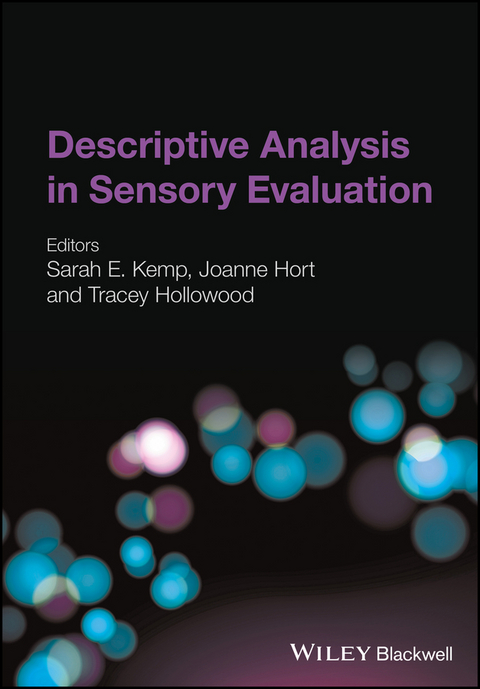
Descriptive Analysis in Sensory Evaluation (eBook)
John Wiley & Sons (Verlag)
978-1-118-99166-4 (ISBN)
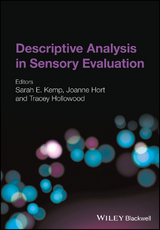
A comprehensive review of the techniques and applications of descriptive analysis
Sensory evaluation is a scientific discipline used to evoke, measure, analyse and interpret responses to products perceived through the senses of sight, smell, touch, taste and hearing. It is used to reveal insights into the ways in which sensory properties drive consumer acceptance and behaviour, and to design products that best deliver what the consumer wants.
Descriptive analysis is one of the most sophisticated, flexible and widely used tools in the field of sensory analysis. It enables objective description of the nature and magnitude of sensory characteristics for use in consumer-driven product design, manufacture and communication.
Descriptive Analysis in Sensory Evaluation provides a comprehensive overview of a wide range of traditional and recently-developed descriptive techniques, including history, theory, practical considerations, statistical analysis, applications, case studies and future directions. This important reference, written by academic and industrial sensory scientist, traces the evolution of descriptive analysis, and addresses general considerations, including panel set-up, training, monitoring and performance; psychological factors relevant to assessment; and statistical analysis.
Descriptive Analysis in Sensory Evaluation is a valuable resource for sensory professionals working in academia and industry, including sensory scientists, practitioners, trainers and students, and industry-based researchers in quality assurance, research and development, and marketing.
About the Editors
Sarah E. Kemp, Consultant and formerly Head of Global Sensory and Consumer Guidance, Cadbury Schweppes, UK.
Joanne Hort, Professor, Massey Institute of Food Science and Technology, Massey University, New Zealand.
Tracey Hollowood, Managing Director, Sensory Dimensions Ltd, Nottingham, UK.
A comprehensive review of the techniques and applications of descriptive analysis Sensory evaluation is a scientific discipline used to evoke, measure, analyse and interpret responses to products perceived through the senses of sight, smell, touch, taste and hearing. It is used to reveal insights into the ways in which sensory properties drive consumer acceptance and behaviour, and to design products that best deliver what the consumer wants. Descriptive analysis is one of the most sophisticated, flexible and widely used tools in the field of sensory analysis. It enables objective description of the nature and magnitude of sensory characteristics for use in consumer-driven product design, manufacture and communication. Descriptive Analysis in Sensory Evaluation provides a comprehensive overview of a wide range of traditional and recently-developed descriptive techniques, including history, theory, practical considerations, statistical analysis, applications, case studies and future directions. This important reference, written by academic and industrial sensory scientist, traces the evolution of descriptive analysis, and addresses general considerations, including panel set-up, training, monitoring and performance; psychological factors relevant to assessment; and statistical analysis. Descriptive Analysis in Sensory Evaluation is a valuable resource for sensory professionals working in academia and industry, including sensory scientists, practitioners, trainers and students, and industry-based researchers in quality assurance, research and development, and marketing.
About the Editors Sarah E. Kemp, Consultant and formerly Head of Global Sensory and Consumer Guidance, Cadbury Schweppes, UK. Joanne Hort, Professor, Massey Institute of Food Science and Technology, Massey University, New Zealand. Tracey Hollowood, Managing Director, Sensory Dimensions Ltd, Nottingham, UK.
Editor Biographies ix
List of Contributors xi
Preface to the Series xv
Preface xix
Section 1: Introduction
1 Introduction to Descriptive Analysis 3
Sarah E. Kemp, May Ng, Tracey Hollowood and Joanne Hort
2 General Considerations 41
Sylvie Issanchou
3 Setting Up and Training a Descriptive Analysis Panel 81
Margaret A. Everitt
4 Panel Quality Management: Performance, Monitoring and Proficiency 113
Carol Raithatha and Lauren Rogers
5 Statistical Analysis of Descriptive Data 165
Anne Hasted
Section 2: Techniques
6 Consensus Methods for Descriptive Analysis 213
Edgar Chambers IV
7 Original Flavor and Texture Profile and Modified/Derivative Profile Descriptive Methods 237
Alejandra M. Muñoz and Patricia A. Keane
8 Quantitative Descriptive Analysis 287
Joel L. Sidel, Rebecca N. Bleibaum and K.W. Clara Tao
9 Spectrum(TM) Method 319
Clare Dus, Lee Stapleton, Amy Trail, Annlyse Retiveau Krogmann and Gail Vance Civille
10 Quantitative Flavour Profiling 355
Sophie Davodeau and Christel Adam
11 A ¯5daptive Profile Method ® 389
Alejandra M. Muñoz
12 Ranking and Rank-Rating 447
Graham Cleaver
13 Free Choice Profiling 493
Pieter H. Punter
14 Flash Profile Method 513
Wender L.P. Bredie, Jing Liu, Christian Dehlholm and Hildegarde Heymann
15 Projective Mapping & Sorting Tasks 535
Dominique Valentin, Sylvie Chollet, Michael Nestrud and Hervé Abdi
16 Polarized Sensory Positioning 561
Gastón Ares, Lucía Antúnez, Luis de Saldamando and Ana Giménez
17 Check-All-That-Apply and Free Choice Description 579
Dominic Buck and Sarah E. Kemp
Section 3: Applications
18 Application of Descriptive Sensory Analysis to Food and Drink Products 611
Cindy Beeren
19 Application of Descriptive Analysis to Non-Food Products 647
Anne Churchill and Ruth Greenaway
Section 4: Summary
20 Comparison of Descriptive Analysis Methods 681
Alejandra M. Muñoz, Sarah E. Kemp, Tracey Hollowood and Joanne Hort
Index 711
CHAPTER 1
Introduction to Descriptive Analysis
Sarah E. Kemp, May Ng, Tracey Hollowood and Joanne Hort
1.1 Introduction
Descriptive analysis is a method used to objectively describe the nature and magnitude of sensory characteristics. It was a pioneering development for its day, and represented a major step forward that gave sensory evaluation a scientific footing through the ability to produce objective, statistically reliable and statistically analysable data. Today, it remains a cornerstone method in sensory analysis.
A wide range of descriptive analysis techniques have been developed since its inception. Traditional descriptive techniques, such as profiling‐based methods and quantitative descriptive analysis, involve a panel of trained assessors objectively measuring the quality and strength of the sensory attributes of samples. More recently, faster descriptive techniques, such as sorting, projective mapping and polarized sensory positioning, involve untrained consumers grouping samples based on holistic similarities and differences in sensory characteristics. Over the years, descriptive analysis has proved itself to be flexible and customizable, which has contributed to its usefulness and hence its longevity.
As descriptive analysis enables objective, comprehensive and informative sensory data to be obtained, it acts as a versatile source of product information in industry, government and research settings. Descriptive analysis was first applied to foods and beverages, but is now applied to a broad range of products including home, personal care, cars, environmental odours, plants, etc. It is used throughout the product lifecycle, including market mapping, product development, value optimization, and quality control and assurance. Descriptive analysis is particularly useful in product design, when sensory data are linked to consumer hedonic data and physico‐chemical data produced using instrumental measures. This allows product developers and marketing professionals to understand and identify sensory drivers of product liking in order to design products with optimal liking. Sensory descriptive information can also be linked to other types of consumer data to enhance brand elements, emotional benefits, functional benefits and marketing communication.
There are many general texts and reviews on descriptive analysis and the reader is directed to the following: ASTM (1992), Gacula (1997), Murray et al. (2001), Meilgaard et al. (2006), Kemp et al. (2009), Lawless and Heymann (2010a,b), Varela and Ares (2012, 2014), Stone et al. (2012) and Delarue et al. (2014).
1.2 Development of Descriptive Analysis
1.2.1 Evolution
Descriptive analysis grew from the need to assess products in a reliable fashion. Originally, product sensory quality relied on assessment by experts, such as brewers, wine tasters, tea tasters and cheese makers, who judged quality on key product attributes and made recommendations on how ingredients and process variables affected production and the finished product, which might often have a very fixed, invariable specification over a long period of time. The expert, sometimes called the ‘golden tongue’, was often a single person, who had product experience or had been trained by other experts. Businesses relied heavily on a few key individuals, which could be problematic if they left, particularly if they were the prime expert on the unique sensory characteristics of a company’s product. Attributes were often important to the manufacturing process, rather than the consumer, and might comprise defects or complex terms that were difficult to understand. Attributes were often assessed using grading on quality scales that might be idiosyncratic to a company, an industry or a country. Indeed, experts could also be idiosyncratic and subjective in their judgements. Data often comprised a single value, which could not be interrogated statistically, making it difficult to compare scores in a meaningful way. In many cases, only the expert could interpret differences in scores between products.
As the market became more complex and fast‐paced, with increasing numbers of ingredients, processing technologies, products, competition and consumer choice, the need arose for a more robust system for assessing product quality. The introduction of descriptive analysis moved away from a single expert to a trained panel of assessors, removing the reliance on a single person and making the data more reliable. Controls were introduced, such as experimentally verified scales, physical sensory references rather than descriptive words, consistent assessment methodology and thorough training. As sensory evaluation became recognized as a scientific discipline, good experimental design as used in other scientific areas was introduced, such as elimination of variability and bias, and use of experimental design and replication. This enabled the production of robust, objective data that could be analysed statistically. In a similar fashion, food production had moved from a craft to a science, and data produced from descriptive analysis now became available for food scientists and technologists to use in conjunction with physico‐chemical instrumental measures to understand food quality in a science‐based, rigorous manner.
The market continued to grow, and became increasingly international and global. Companies began to manufacture greater volumes, often at many national and international sites, and the rigorous nature of descriptive analysis now made it easier to compare data across studies and across panels, for example, to check that product quality was consistent across manufacturing sites. At this point, descriptive analysis was a key tool for quality assurance and control, and the sensory department was essentially providing a service based on routine testing. Traditional methodologies continued to be honed. In the US, several dominant descriptive analysis methods emerged driven by sensory agencies. In Europe, where the market for sensory agencies was more fragmented, the trend was towards customizing descriptive methodology to suit the needs of individual companies.
With globalization, the marketplace has evolved to be highly competitive. Consumers have become increasingly sophisticated and demanding, with a wide range of choices. To gain a competitive advantage, it is important to deliver consumers’ needs, wants and desires. Product push has given way to consumer pull, and it is now consumers who are the ultimate judges of product nature and quality (Kemp 2013). The applications of descriptive analysis have evolved to become a key tool for use in product design and development, in order to interpret and deliver consumers’ sensory requirements. New product development can be guided to create products based on consumer likes and dislikes. Descriptive data are now routinely combined with consumer data to determine sensory attributes that drive consumer liking, aided by the advances in technology outlined below that have enabled sophisticated, rapid statistical modelling and analysis. Physico‐chemical and process data can also be combined in these models to enable manipulation of product characteristics to optimize consumer liking. Sensory attributes of key importance to the consumer can be comprehensively understood, and are now routinely used in quality control and assessment.
As the marketplace has become complex and sophisticated, so has the means of marketing products. There are many ways in which product sensory characteristics play a role in marketing, as described in section 1.4.3, including sensory pleasantness leading to repeat purchase, as an essential brand characteristic, as a functional benefit or indicator of a functional benefit, and as part of the brand/product experience, which is increasingly highlighting emotional aspects. Statistical modelling using descriptive data has been able to illuminate and design sensory characteristics linked to brand elements, functional benefits and emotional benefits. Hence, descriptive analysis is now an important tool for marketing and can be used across the product life cycle. As a result, the sensory department itself has now evolved to become a full partner to marketing and technical functions, rather than a service provider in the quality department.
As factors related to the commercial environment have influenced the evolution of descriptive analysis, and indeed sensory evaluation in general, so have advances in technology. Methods of data collection have changed considerably. In the early days, all data had to be collected using pen and paper, and then transcribed into raw data tables by hand. The chance of error was higher and data entry was usually double checked, further slowing progress. Preparing paper questionnaires was time‐consuming, and could be complex given the experimental design. Transcribing data from a continuous line scale involved measuring the distance from the end of the scale to the assessment mark with a ruler, which was a daunting task made exponentially larger by the number of attributes, samples, assessors and replicates. The size and complexity of descriptive analysis studies were limited, as was the statistical analysis that was feasible.
The introduction of computers in the 1980s considerably speeded up operations. Initially, computers were expensive and one computer might be used in a conjunction with an optical reader to carry out data input and analysis. As computers became faster and cheaper, the process of descriptive analysis became increasingly more automated. Computers were introduced into sensory...
| Erscheint lt. Verlag | 25.1.2018 |
|---|---|
| Sprache | englisch |
| Themenwelt | Naturwissenschaften ► Biologie |
| Naturwissenschaften ► Chemie | |
| Sozialwissenschaften ► Soziologie | |
| Technik ► Lebensmitteltechnologie | |
| Wirtschaft ► Volkswirtschaftslehre ► Mikroökonomie | |
| Weitere Fachgebiete ► Land- / Forstwirtschaft / Fischerei | |
| Schlagworte | Analysis • Applications • Behaviour • Best • Comprehensive • consumer • descriptive • Discipline • Drive • Evaluation • Food Science & Technology • Insights • Interpret • Lebensmittelforschung u. -technologie • Lebensmittelsensorik • Products • Review • Scientific • Senses • sensory • sensory properties • Sensory Science • sight • sophisticated • techniques • Ways |
| ISBN-10 | 1-118-99166-4 / 1118991664 |
| ISBN-13 | 978-1-118-99166-4 / 9781118991664 |
| Informationen gemäß Produktsicherheitsverordnung (GPSR) | |
| Haben Sie eine Frage zum Produkt? |
 EPUB (Adobe DRM)
Kopierschutz: Adobe-DRM
Adobe-DRM ist ein Kopierschutz, der das eBook vor Mißbrauch schützen soll. Dabei wird das eBook bereits beim Download auf Ihre persönliche Adobe-ID autorisiert. Lesen können Sie das eBook dann nur auf den Geräten, welche ebenfalls auf Ihre Adobe-ID registriert sind.
Details zum Adobe-DRM
Dateiformat: EPUB (Electronic Publication)
EPUB ist ein offener Standard für eBooks und eignet sich besonders zur Darstellung von Belletristik und Sachbüchern. Der Fließtext wird dynamisch an die Display- und Schriftgröße angepasst. Auch für mobile Lesegeräte ist EPUB daher gut geeignet.
Systemvoraussetzungen:
PC/Mac: Mit einem PC oder Mac können Sie dieses eBook lesen. Sie benötigen eine
eReader: Dieses eBook kann mit (fast) allen eBook-Readern gelesen werden. Mit dem amazon-Kindle ist es aber nicht kompatibel.
Smartphone/Tablet: Egal ob Apple oder Android, dieses eBook können Sie lesen. Sie benötigen eine
Geräteliste und zusätzliche Hinweise
Buying eBooks from abroad
For tax law reasons we can sell eBooks just within Germany and Switzerland. Regrettably we cannot fulfill eBook-orders from other countries.
aus dem Bereich