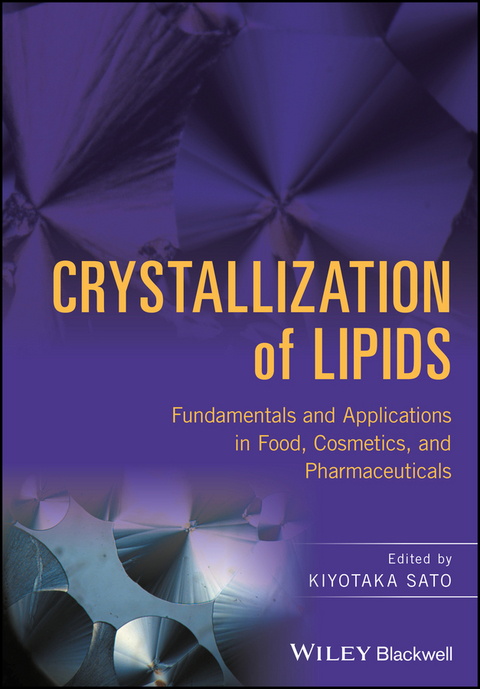
Crystallization of Lipids (eBook)
John Wiley & Sons (Verlag)
978-1-118-59389-9 (ISBN)
An authoritative reference that contains the most up-to-date information knowledge, approaches, and applications of lipid crystals
Crystallization of Lipids is a comprehensive resource that offers the most current and emerging knowledge, techniques and applications of lipid crystals. With contributions from noted experts in the field, the text covers the basic research of polymorphic structures, molecular interactions, nucleation and crystal growth and crystal network formation of lipid crystals which comprise main functional materials employed in food, cosmetic and pharmaceutical industry. The authors highlight trans-fat alternative and saturated-fat reduction technology to lipid crystallization. These two issues are the most significant challenges in the edible-application technology of lipids, and a key solution is lipid crystallization.
The text focuses on the crystallization processes of lipids under various external influences of thermal fluctuation, ultrasound irradiation, shear, emulsification and additives. Designed to be practical, the book's information can be applied to realistic applications of lipids to foods, cosmetic and pharmaceuticals. This authoritative and up-to-date guide:
- Highlights cutting-edge research tools designed to help analyse lipid crystallization with the most current and the conventional techniques
- Offers a thorough review of the information, techniques and applications of lipid crystals
- Includes contributions from noted experts in the field of lipid crystals
- Presents cutting-edge information on the topics of trans-fat alterative and saturated-fat reduction technology
Written for research and development technologists as well as academics, this important resource contains research on lipid crystals which comprise the main functional materials employed in food, cosmetic and pharmaceutical industry.
About the Editor
KIYOTAKA SATO is Professor Emeritus, Hiroshima University, Japan.
An authoritative reference that contains the most up-to-date information knowledge, approaches, and applications of lipid crystals Crystallization of Lipids is a comprehensive resource that offers the most current and emerging knowledge, techniques and applications of lipid crystals. With contributions from noted experts in the field, the text covers the basic research of polymorphic structures, molecular interactions, nucleation and crystal growth and crystal network formation of lipid crystals which comprise main functional materials employed in food, cosmetic and pharmaceutical industry. The authors highlight trans-fat alternative and saturated-fat reduction technology to lipid crystallization. These two issues are the most significant challenges in the edible-application technology of lipids, and a key solution is lipid crystallization. The text focuses on the crystallization processes of lipids under various external influences of thermal fluctuation, ultrasound irradiation, shear, emulsification and additives. Designed to be practical, the book s information can be applied to realistic applications of lipids to foods, cosmetic and pharmaceuticals. This authoritative and up-to-date guide: Highlights cutting-edge research tools designed to help analyse lipid crystallization with the most current and the conventional techniques Offers a thorough review of the information, techniques and applications of lipid crystals Includes contributions from noted experts in the field of lipid crystals Presents cutting-edge information on the topics of trans-fat alterative and saturated-fat reduction technology Written for research and development technologists as well as academics, this important resource contains research on lipid crystals which comprise the main functional materials employed in food, cosmetic and pharmaceutical industry.
About the Editor KIYOTAKA SATO is Professor Emeritus, Hiroshima University, Japan.
1
Introduction: Relationships of Structures, Properties, and Functionality
Kiyotaka Sato
1.1 Introduction
This chapter presents a comprehensive sketch of the lipid species and functionality of lipid crystals present in various end products by outlining different stages of crystallization. In doing so, topics will be highlighted that will be elaborated further in chapters of this book. At the end of this chapter, a particular effort is made to relate trans‐fat alternative and saturated‐fat reduction technology to lipid crystallization because these two issues are the most significant problems in the edible‐application technology of lipids and one of the key solutions is lipid crystallization.
1.2 Lipid Species
Lipids are a class of compounds that contain long‐chain aliphatic hydrocarbons and their derivatives (O’Keefe 2008). There is a wide variety of lipid materials such as hydrocarbons, fatty acids, acylglycerols, sterols and sterol esters, waxes, phospholipids, plasmalogens, sphingolipids, and so on. Typical lipids whose crystallization properties have critical implications in food and other industries include hydrocarbons, fatty acids, alcohols, waxes, and acylglycerols. Because the lipid species of natural lipids of vegetable or animal resources vary from one to another, the understanding of the crystallization, melting, and physical properties must be based on the effects of major and minor lipid components included in every lipid material.
In this section, we take a brief look at the chemical structures of these typical lipid molecules.
1.2.1 Hydrocarbons
Hydrocarbons comprise a group of the simplest lipid molecules and are composed of hydrogen and carbon atoms. A typical molecular shape of hydrocarbons containing all saturated carbon–carbon bonds is expressed as CH3‐(CH2)n‐2‐CH3, in which n is the number of carbon atoms. Hereafter, we use nc as the number of carbon atoms in the all‐hydrocarbon chains. In nature, even‐numbered and odd‐numbered hydrocarbons occur, depending on whether nc is even or odd.
Molecular interactions operating among the hydrocarbon molecules are van der Waals forces, and these comprise the major molecular interactions among lipid molecules when they contain hydrocarbon chains as hydrophobic moieties. When the number of carbon atoms exceeds four, structural isomers occur (e.g., straight chains or branched chains). The straight‐chain hydrocarbons are called n‐alkanes as illustrated for n‐octadecane with nc=18 (Fig. 1.1a).
Fig. 1.1 Typical lipid molecules. (a) n‐Octadecane, (b) stearic acid, (c) oleic acid, (d) elaidic acid, and (e) triacylglycerol. In (a)–(d), carbon atoms are shown except for COOH groups for fatty acids. In (e), R is fatty acid moiety.
1.2.2 Fatty Acids
Fatty acids are formed by replacing one end of –CH3 in n‐hydrocarbons with a carboxyl group (–COOH). In contrast, dicarboxilic acids are formed when both end groups of –CH3 in n‐hydrocarbons are replaced with –COOH. There are saturated and unsaturated fatty acids, depending on whether double bonds are included and stereoisomers of cis or trans unsaturated fatty acids occur.
In nature, a wide variety of fatty acids is present, differing in nc, the number of double bonds having cis or trans conformations or the positions of the double bonds at the hydrocarbon chains. Similarly to hydrocarbons, even‐ and odd‐numbered fatty acids occur. The principal fatty acids abundantly occurring in nature are summarized in Table 1.1. Although standard (IUPAC) systematic names are given to fatty acids, the common names and abbreviations presented in the table will be used throughout this book.
Table 1.1 Systematic, common, and shorthand names of principal fatty acids.
| Systematic | Common | Shorthand | Abbreviation |
| Saturated |
| Octanoic | Caprylic | 8:0 | Ca |
| Decanoic | Capric | 10:0 | C |
| Dodecanoic | Lauric | 12:0 | L |
| Tetradecanoic | Myristic | 14:0 | M |
| Hexadecanoic | Palmitic | 16:0 | P or PA |
| Heptadecanoic | Margaric | 17:0 | Ma |
| Octadecanoic | Stearic | 18:0 | S or SA |
| Nonadecanoic | Nonadecanoic | 19:00 | No |
| Eicosanoic | Arachidic | 20:0 | A |
| Docosanoic | Behenic | 22:0 | B |
| Unsaturated |
| c‐9‐Hexadecenoic | Palmitoleic | 16:1, Δ9‐ω7 | POA |
| c‐9‐Octadecenoic | Oleic | 18:1, Δ9‐ω9 | O or OA |
| c‐12‐Octadecenoic | Petroselinic | 18:1, Δ6‐ω12 | PSA |
| t‐9‐Octadecenoic | Elaidic | 18:1, Δ9‐ω9 | E |
| c‐11‐Octadecenoic | Asclepic | 18:1, Δ11‐ω7 | APA |
| 12‐hydroxy, c‐9‐Cctadecenoic | Ricinoleic | 18:1, Δ9‐ω9 | R |
| t‐11‐Octadecenoic | Vaccenic | 18:1, Δ11‐ω7 | V |
| c‐9, c‐12‐Octadecadienoic | Linoleic | 18:2‐ω6, 9 | Li |
| c‐9, c‐12‐ c‐15‐Octadecatrienoic | α‐Linolenic | 18:3‐ω3, 6, 9 | ALA |
| c‐6, c‐9‐ c‐12‐Octadecatrienoic | γ‐Linolenic | 18:3‐ω6, 9, 12 | GLA |
| c‐11‐Eicosanoic | Gondoic | 20:1, Δ11‐ω9 | GOA |
| c‐5, c‐8, c‐11, c‐14, c‐17‐Eicosapentanoic | Eicosapentanoic | 20:5, ω3, 6, 9, 12, 15 | EPA |
| c‐13‐Docosenoic | Erucic | 22:1, Δ13‐ω9 | Er |
| c‐4, c‐7, c‐10, c‐13, c‐16, c‐19‐Docosahexanoic | DHA | 22:6, ω3, 6, 9, 12, 15, 18 | DHA |
As typical fatty acids having nc=18, stearic acid is a saturated fatty acid, oleic acid is a mono‐unsaturated fatty acid having a cis double bond at the 9–10 carbon atoms, and elaidic acid is a mono‐unsaturated fatty acid having a trans double bond at the 9–10 carbon atoms, as seen in Fig. 1.1(b, c, and d). The melting temperatures (Tm) of the three fatty acids in their most stable polymorphic forms are 69° C (stearic acid), 44° C (elaidic acid), and 16.1° C (oleic acid). This typically represents the relationships between Tm and the molecular shapes of the fatty acids in the following aspects.
- At a fixed number of nc, Tm decreases with increasing numbers of double bonds, and the conformation of the double bonds changes from trans to cis.
- As for saturated fatty acids, Tm increases with increasing nc, although the values of Tm for fatty acids with an odd‐numbered nc is a bit lower than those with an even‐numbered nc–1. For example, Tm of margaric acid nc=17 (palmitic acid, nc=16) is 61° C (63° C). This is ascribed to the instability of molecular packing at the lamellar interfaces, where CH3‐CH3 end groups are stacked against each other, of odd‐numbered fatty acids compared to that of even‐numbered fatty acids.
These relationships apply to other lipids containing fatty acid chains as their hydrophobic moieties.
The –COOH group is hydrophilic (water soluble), and the hydrocarbon chains are hydrophobic (oil soluble). Therefore, the hydrophobicity or hydrophilicity of a fatty acid molecule as a whole depends on nc. Fatty acids with nc ≤6 become water soluble, whereas they are sparingly water soluble when nc exceeds 6. Molecules having a hydrophobic moiety in one part and a hydrophilic moiety in another part are called amphiphilic, as revealed in other lipids: alcohols, mono‐ and di‐acylglycerols, phospholipids, emulsifiers, and so on.
1.2.3 Alcohols and Waxes
Alcohols are formed by replacing one –CH3 end...
| Erscheint lt. Verlag | 24.1.2018 |
|---|---|
| Sprache | englisch |
| Themenwelt | Naturwissenschaften ► Biologie |
| Technik ► Lebensmitteltechnologie | |
| Weitere Fachgebiete ► Land- / Forstwirtschaft / Fischerei | |
| Schlagworte | Conformation of hydrocarbon chains • Cosmetics and Pharmaceuticals • crystal growth • crystallization • Crystallization of Lipids • Crystal molecular structures • emulsifier • Emulsion • Fats • Food chemistry • Food Processing, Production & Manufacture • Food Science & Technology • Formation processes of lipid crystals • Framework for Engineering Calculation • functionality of lipid crystals • Fundamentals and Applications in Food • Governing Principles for Phase Boundaries • Herstellung u. Verarbeitung von Lebensmitteln • Kiyotaka Sato • Kristallisation • Lebensmittelchemie • Lebensmittelforschung u. -technologie • Lipide • Lipids • Molecular interactions and mixing phase behavior of lipid crystals • Monoacylglycerols and diacylglycerols • nucleation • Oils & Fats • Öle u. Fette • organogel • Phase Behavior of Co-Crystallizing Components • Physical states and functionality of lipid products • Polymorphic behavior • Polymorphism • Polymorphism of lipid crystals • properties of lipid crystals • saturated fatty acids • Structures of lipid crystals • Thermal behavior of polymorphic transformations • Thermodynamic Considerations • Trans-fat alternative and saturated-fat reduction technology • triacylglycerol • unsaturated fatty acids |
| ISBN-10 | 1-118-59389-8 / 1118593898 |
| ISBN-13 | 978-1-118-59389-9 / 9781118593899 |
| Informationen gemäß Produktsicherheitsverordnung (GPSR) | |
| Haben Sie eine Frage zum Produkt? |
 EPUB (Adobe DRM)
Kopierschutz: Adobe-DRM
Adobe-DRM ist ein Kopierschutz, der das eBook vor Mißbrauch schützen soll. Dabei wird das eBook bereits beim Download auf Ihre persönliche Adobe-ID autorisiert. Lesen können Sie das eBook dann nur auf den Geräten, welche ebenfalls auf Ihre Adobe-ID registriert sind.
Details zum Adobe-DRM
Dateiformat: EPUB (Electronic Publication)
EPUB ist ein offener Standard für eBooks und eignet sich besonders zur Darstellung von Belletristik und Sachbüchern. Der Fließtext wird dynamisch an die Display- und Schriftgröße angepasst. Auch für mobile Lesegeräte ist EPUB daher gut geeignet.
Systemvoraussetzungen:
PC/Mac: Mit einem PC oder Mac können Sie dieses eBook lesen. Sie benötigen eine
eReader: Dieses eBook kann mit (fast) allen eBook-Readern gelesen werden. Mit dem amazon-Kindle ist es aber nicht kompatibel.
Smartphone/Tablet: Egal ob Apple oder Android, dieses eBook können Sie lesen. Sie benötigen eine
Geräteliste und zusätzliche Hinweise
Buying eBooks from abroad
For tax law reasons we can sell eBooks just within Germany and Switzerland. Regrettably we cannot fulfill eBook-orders from other countries.
aus dem Bereich