Food Safety (eBook)
John Wiley & Sons (Verlag)
978-1-119-13368-1 (ISBN)
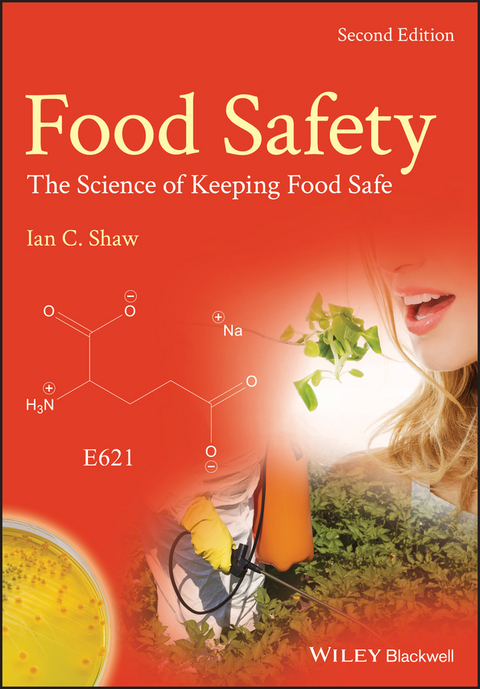
Food safety is a multi-faceted subject, using microbiology, chemistry, standards and regulations, and risk management to address issues involving bacterial pathogens, chemical contaminants, natural toxicants, additive safety, allergens, and more.
This revised edition has been updated with the latest information on food safety. It addresses all the topics pertinent to a full understanding of keeping the food we eat safe. Each chapter of Food Safety: The Science of Keeping Food Safe, Second Edition proceeds from introductory concepts and builds towards a sophisticated treatment of the topic, allowing the reader to take what knowledge is required for understanding food safety at a wide range of levels. Illustrated with photographs and examples throughout, this new edition also boasts 4 new chapters covering radioactivity in food; food terrorism; food authenticity; and food supplements.
• This second edition has been revised and updated throughout to include the latest topics in this fast-moving field
• Includes 4 brand new chapters on radioactivity in food, food terrorism, food authenticity, and food supplements
• The most readable and user-friendly food safety book for students, scientists, regulators, and general readers
Food Safety is the ideal starting point for students and non-specialists seeking to learn about food safety issues, and an enjoyable and stylish read for those who already have an academic or professional background in the area.
IAN C. SHAW is Professor of Toxicology at the University of Canterbury, Christchurch, New Zealand. His CV includes academic positions in biochemistry, toxicology, and applied biology, as well as experience as a clinical scientist and a member of various international government advisory bodies on food safety.
Food safety is a multi-faceted subject, using microbiology, chemistry, standards and regulations, and risk management to address issues involving bacterial pathogens, chemical contaminants, natural toxicants, additive safety, allergens, and more. This revised edition has been updated with the latest information on food safety. It addresses all the topics pertinent to a full understanding of keeping the food we eat safe. Each chapter of Food Safety: The Science of Keeping Food Safe, Second Edition proceeds from introductory concepts and builds towards a sophisticated treatment of the topic, allowing the reader to take what knowledge is required for understanding food safety at a wide range of levels. Illustrated with photographs and examples throughout, this new edition also boasts 4 new chapters covering radioactivity in food; food terrorism; food authenticity; and food supplements. This second edition has been revised and updated throughout to include the latest topics in this fast-moving field Includes 4 brand new chapters on radioactivity in food, food terrorism, food authenticity, and food supplements The most readable and user-friendly food safety book for students, scientists, regulators, and general readers Food Safety is the ideal starting point for students and non-specialists seeking to learn about food safety issues, and an enjoyable and stylish read for those who already have an academic or professional background in the area.
IAN C. SHAW is Professor of Toxicology at the University of Canterbury, Christchurch, New Zealand. His CV includes academic positions in biochemistry, toxicology, and applied biology, as well as experience as a clinical scientist and a member of various international government advisory bodies on food safety.
Chapter 1
Introduction
Introduction
Food safety is a relatively recent ‘invention’. It was introduced in the developed world to increase confidence in food. In our modern world it simply is not acceptable to have food that might make us ill. Sadly even now a good proportion of the world's people are very much more concerned about getting food and stemming their unrelenting hunger than they are about whether they might get a stomach upset as a result of eating the food. We must always remember these horrifying facts when we study food safety. Food safety and the legislation emanating from it are for the relatively rich countries that have the luxury of having sufficient food to allow them to make rules about what is safe to eat.
A brief history of food safety
Prehistoric times
The risk of eating in prehistoric times was very much more an issue of the dangers of catching the beast to eat than the ill effects suffered after eating it. To survive, cavemen had to eat and their animal instincts dominated their behaviour with respect to food. These instincts, no doubt, made them avoid food they had learned made them sick, but their overriding instinct was ‘eat to live’. Some foods, however, might have been so toxic that they threatened the early man's survival. Behaviour that minimised consumption of toxic food would have been selected in because individuals that succumbed to toxins in their food simply did not survive. This is the raw material of Darwinian evolution and could be considered a very early manifestation of food safety issues! Whether this happened or not thousands of years ago is impossible to know, but we do know that modern‐day animals avoid toxic plants in their diet. This might be because some of the toxins (e.g. alkaloids) have a bitter taste that warns the would‐be consumer of the risk. Prehistoric man probably behaved in exactly this way which is why he was able to survive in such a harsh environment in which every day posed new and unknown food challenges.
This is hardly prehistoric food safety policy, but it illustrates our inborn survival instinct that extends to the food we eat. We have an innate desire not to eat something that will make us ill. This has not changed over the millennia.
Evolution of cellular protection mechanisms
It is important to remember too that our metabolic systems (and avoidance strategies) evolved during the tens of thousands of years of prehistoric times. Metabolism of toxins from food in order to reduce their toxicity and so make the food ‘good’ developed over millions of years. There are highly complex metabolic systems ‘designed’ to detoxify ingested toxins that evolved long before man, but the enzyme systems from the primitive cells in which they evolved were selected into the human genome through the evolutionary process and were inevitably expressed by the earliest hominids. These detoxification systems gave man an advantage because he could eat food that contained chemicals which if not detoxified would make the food too toxic to eat. These enzyme systems are now very well understood; they include the cytochromes P450 mixed function oxidases (termed Phase I metabolism) and the conjugating enzymes (termed Phase II metabolism) (Figure 1.1).
Figure 1.1 Phase I and II metabolism for a simple compound, benzene, showing how the molecule is detoxified, made water soluble and excreted (e.g. in urine).
There are many food toxins that are detoxified by these systems, so making the food safe to eat (this will be discussed further in Chapters 7 and 8); for example, parsnips contain bergapten, a photosensitising toxin that also causes cancer (see Chapter 8, Furocoumarins in parsnips, parsley and celery); bergapten is detoxified by Phase I and II metabolism (Figure 1.2) thus making parsnips safe to eat. These metabolic processes are the cell's internal food safety mechanisms and broaden the range of foods we can eat without suffering the ill effects that some of their components would cause.
Figure 1.2 A proposed metabolic pathway for bergapten.
There are significant differences in the susceptibility of different animal species to toxic chemicals; these are due to the evolutionary selective pressures under which the particular species developed. This means that safe foods for some species might be highly toxic to others. For example, the toxin in the swan plant (Asclepias fruticosa), labriformidin, is very toxic to birds but harmless to the monarch butterfly (Danaus plexippus) (see Chapter 8, Why produce natural toxins?).
The monarch butterfly uses this differential toxicity as a means of protection. Its caterpillar eats swan plant leaves and incorporates labriformidin into its body; this makes it toxic and unpalatable to predatory birds. This interesting means of survival is by no means unique amongst animals. Indeed, some plants that are eaten by animals are very toxic to humans. For example, it would only take a few leaves of hemlock (Conium maculatum) to kill a person, but the skylark (Alauda arvensis) is unaffected by its toxin (Figure 1.3). Indeed, there have been cases of human poisoning in Italy following consumption of skylarks which (strange as it may seem) are a delicacy in that country. The toxin in hemlock is coniine (Figure 1.3) – it is very toxic; about 200 mg would be fatal to a human. Hemlock was the poison used to execute Socrates in 399 BC for speaking his mind in the restrictive environment of ancient Greece.
Figure 1.3 Socrates (469–399 BC), coniine, the poison from hemlock used to execute him, and the skylark (Alauda arvensis) which is unaffected by coniine.
(Pictures from http://en.wikipedia.org/wiki/File:Socrates_Louvre.jpg, © Sting; http://en.wikipedia.org/wiki/File:Alauda_arvensis_2.jpg, © Daniel Pettersson; photograph of hemlock taken by the author.)
Tudor England (1485–1603)
In the 1500s I doubt whether many people thought about illness being linked to what they had eaten, but I imagine food‐borne illness was prevalent in that rather unhygienic society. In fact spices were introduced into Tudor England to mask the putrid taste of some foods particularly meat – this is a ‘head in the sand’ approach where masking the bad taste was thought to take away the bad effects. Whether the Tudors thought that masking the taste of putrefying meat stopped them getting ill I cannot know, but they certainly thought that masking the terrible smells of putrid plague‐ridden London prevented them catching fatal diseases like the Plague. The gentry used, amongst other things, oranges stuck with cloves, and ornate necklaces with receptacles for sweet‐smelling spices and resins (pomanders – derived from the French pomme d'ambre meaning apple of amber; ambergris, a sweet‐smelling substance produced by sperm whales was often used to scent pomanders) to waft in front of them to take away the evil smells as they walked the streets. This is hardly food safety legislation, but it might just be the beginning of people connecting off‐food with illness – a key step in making food safe.
The times of King George III of England (1760–1820)
The Georgian era was a time of great social division. The rich ate well, if not exuberantly, and the poor just about found enough food to keep them alive. The idea that bad smells were associated with disease prevailed as did the naïve thought that if the smell was masked, putrid food was good to eat. Susannah Carter, an American cookery author, described a ‘method of destroying the putrid smell which meat acquires during Hot Weather’ in her book The Frugal Housewife, or, Complete Woman Cook, published in New York in 1803. Some people must have been very ill after eating food prepared under this rather naïve food safety philosophy; i.e. bad smell means high risk and hiding the smell minimises the risk. I wonder if they connected their stomach upset with the food they had eaten? Probably not because such illness would be the norm in the 1700s and people probably simply took it for granted.
The 1800s – Pasteur's Germ Theory, Lister's antiseptics and the first refrigerators
In the mid 1800s in Europe there was a significant improvement in the understanding of disease and, in particular, public health. This was the time that the connection between microorganisms and disease was beginning to be understood. Louis Pasteur (1822–1895; Figure 1.4) proposed the Germ Theory of Disease while he was working at the University of Strasbourg in France in the 1860s. He later extended his understanding of ‘germs’ to propose that heating contaminated broths to a high temperature for a short time would kill the ‘germs’. This is the basis of one of today's most important methods of assuring safe food – pasteurisation.
Figure 1.4 Louis Pasteur (1822–1895).
(Picture from http://en.wikipedia.org/wiki/File:Louis_Pasteur.jpg.)
Disinfectants
Joseph Lister (1827–1912)...
| Erscheint lt. Verlag | 9.1.2018 |
|---|---|
| Sprache | englisch |
| Themenwelt | Naturwissenschaften ► Biologie |
| Technik ► Lebensmitteltechnologie | |
| Weitere Fachgebiete ► Land- / Forstwirtschaft / Fischerei | |
| Schlagworte | allergens • Bacteria • Contaminants • food authenticity • foodborne illness • Food Legislation • Food Quality Assurance • Food Safety • Food Science & Technology • Lebensmittelforschung u. -technologie • Lebensmittel-Gesetzgebung • Lebensmittel / Qualitätskontrolle • Microbiology • Microbiology, Food Safety & Security • Mikrobiologie u. Nahrungsmittelsicherheit • Regulations • Risk Management |
| ISBN-10 | 1-119-13368-8 / 1119133688 |
| ISBN-13 | 978-1-119-13368-1 / 9781119133681 |
| Informationen gemäß Produktsicherheitsverordnung (GPSR) | |
| Haben Sie eine Frage zum Produkt? |
 EPUB (Adobe DRM)
Kopierschutz: Adobe-DRM
Adobe-DRM ist ein Kopierschutz, der das eBook vor Mißbrauch schützen soll. Dabei wird das eBook bereits beim Download auf Ihre persönliche Adobe-ID autorisiert. Lesen können Sie das eBook dann nur auf den Geräten, welche ebenfalls auf Ihre Adobe-ID registriert sind.
Details zum Adobe-DRM
Dateiformat: EPUB (Electronic Publication)
EPUB ist ein offener Standard für eBooks und eignet sich besonders zur Darstellung von Belletristik und Sachbüchern. Der Fließtext wird dynamisch an die Display- und Schriftgröße angepasst. Auch für mobile Lesegeräte ist EPUB daher gut geeignet.
Systemvoraussetzungen:
PC/Mac: Mit einem PC oder Mac können Sie dieses eBook lesen. Sie benötigen eine
eReader: Dieses eBook kann mit (fast) allen eBook-Readern gelesen werden. Mit dem amazon-Kindle ist es aber nicht kompatibel.
Smartphone/Tablet: Egal ob Apple oder Android, dieses eBook können Sie lesen. Sie benötigen eine
Geräteliste und zusätzliche Hinweise
Buying eBooks from abroad
For tax law reasons we can sell eBooks just within Germany and Switzerland. Regrettably we cannot fulfill eBook-orders from other countries.
aus dem Bereich