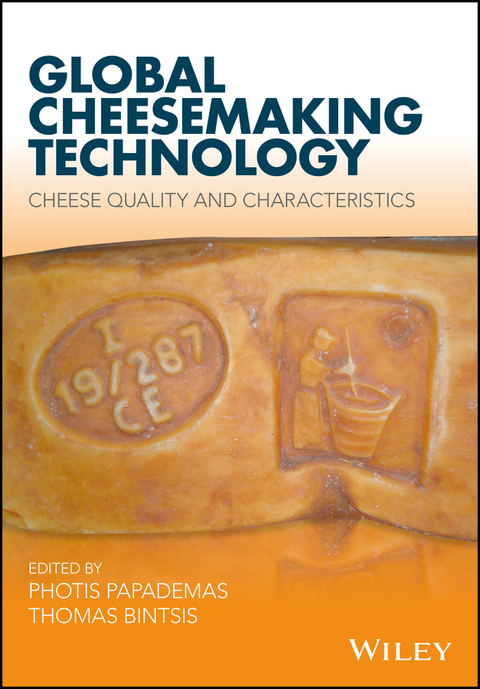
Global Cheesemaking Technology (eBook)
John Wiley & Sons (Verlag)
978-1-119-04618-9 (ISBN)
Global Cheesemaking Technology: Cheese Quality and Characteristics reviews cheesemaking practices, and describes cheeses and the processes from which they are manufactured. In addition, the book examines new areas to stimulate further research in addition to the already established knowledge on the scientific principles on cheesemaking.
Part I provides an account on the history of cheese, factors influencing the physicochemical properties, flavour development and sensory characteristics, microbial ecology and cheese safety, traceability and authentication of cheeses with protected labels, and traditional wooden equipment used for cheesemaking, while an overview of the cheesemaking process is also presented.
Part II describes 100 global cheeses from 17 countries, divided into 13 categories. The cheeses described are well-known types produced in large quantities worldwide, together with some important locally produced, in order to stimulate scientific interest in these cheese varieties. Each category is presented in a separate chapter with relevant research on each cheese and extensive referencing to facilitate further reading.
About the Editors
PHOTIS PAPADEMAS is Assistant Professor of Dairy Science and Technology at the Department of Agricultural Sciences, Biotechnology and Food Science, Cyprus University of Technology, Cyprus.
THOMAS BINTSIS is a consultant to the dairy industry and auditor of food safety management systems, and was formerly an adjunct lecturer at the Technological Education Institute of West Macedonia, Greece.
Global Cheesemaking Technology: Cheese Quality and Characteristics reviews cheesemaking practices, and describes cheeses and the processes from which they are manufactured. In addition, the book examines new areas to stimulate further research in addition to the already established knowledge on the scientific principles on cheesemaking. Part I provides an account on the history of cheese, factors influencing the physicochemical properties, flavour development and sensory characteristics, microbial ecology and cheese safety, traceability and authentication of cheeses with protected labels, and traditional wooden equipment used for cheesemaking, while an overview of the cheesemaking process is also presented. Part II describes 100 global cheeses from 17 countries, divided into 13 categories. The cheeses described are well-known types produced in large quantities worldwide, together with some important locally produced, in order to stimulate scientific interest in these cheese varieties. Each category is presented in a separate chapter with relevant research on each cheese and extensive referencing to facilitate further reading.
About the Editors PHOTIS PAPADEMAS is Assistant Professor of Dairy Science and Technology at the Department of Agricultural Sciences, Biotechnology and Food Science, Cyprus University of Technology, Cyprus. THOMAS BINTSIS is a consultant to the dairy industry and auditor of food safety management systems, and was formerly an adjunct lecturer at the Technological Education Institute of West Macedonia, Greece.
Chapter 1
The History of Cheese
Paul S. Kindstedt
Department of Nutrition and Food Sciences,, University of Vermont, US
1.1 Introduction
The International Dairy Federation estimated that global cheese production in 2015 totalled approximately 23 million tonnes (IDF, 2016). This production was spread across six continents and included cheese made mainly from cow (20.7 million tonnes) milk. The remainder is composed of cheese from other species (buffalo, goat and sheep) as well as home-made and farmstead cheeses which do not appear in national statistics. How did this come about? More specifically, where, when and why did cheesemaking begin, how did it spread and evolve, and how did cheese attain such diversity, widespread distribution and prominence in our time? Although our understanding of the history of cheese remains very incomplete, various pieces of this vast puzzle can be fitted together to form a narrative that provides context for global cheesemaking in the twenty-first century.
1.2 Origins of Cheese
Until recently, the origins of cheese have remained mostly shrouded in the impenetrable fog of ancient prehistory. During the past two decades, however, groundbreaking advances in widely ranging fields of research and scholarship have yielded new insights into humanity's earliest experiences with cheese. Indeed, the convergence of multiple trains of research has pushed the likely beginnings of cheesemaking back to the Neolithic, perhaps nearly all the way back to the very origins of livestock domestication and dairying, which provided the context for the emergence of cheese.
Sheep and goats were first domesticated in the upper Euphrates and Tigris River valleys of Southwest Asia, as inferred from the study of archaeological skeletal remains. Advances in techniques to recover, evaluate and statistically analyse skeletal and dental remains for vital diagnostic characteristics such as size, sex and age of the animal at death, along with advances in interpretive frameworks based on ethnographic modelling of management strategies used by semi-nomadic shepherds in Southwest Asia today, have led to breakthroughs in the ability to detect the emergence, and track the spread, of livestock domestication (Vigne, 2011; Vigne & Helmer, 2007). Archaeozoological data clearly demonstrate the occurrence of drastic changes in the slaughtering profiles of sheep and goats, considered indicative of the onset of domestication, around the middle of the 9th millennium BC (Helmer, Gourichon & Vila, 2007; Vigne, 2011; Vigne et al., 2011). Similarly, cattle were also domesticated in the Middle Euphrates basin slightly later, again based on archaeozoological analyses (Vigne, 2011). Furthermore, mitochondrial genetic studies of modern sheep, goats and cattle, along with analyses of mitochondrial DNA extracted from Neolithic skeletal remains, also support the conclusion that the earliest domestication of these livestock occurred in the Fertile Crescent region of Southwest Asia (Bollongino et al., 2012; Bonfiglio et al., 2012; Conolly et al., 2012; Edwards et al., 2007; Hiendleder et al., 2002; Meadows et al., 2007; Naderi et al., 2008). Thus, a considerable body of evidence indicates that goat, sheep and cattle domestication occurred for the first time in the same general region of the upper Fertile Crescent, aptly dubbed the ‘cradle of agriculture’, where the initial domestication of key founder grain crops such as wheat, barley, lentil, pea and chickpea also took place several centuries earlier (Weiss & Zohary, 2011).
It has been widely (though not universally) presumed that domesticated livestock in Southwest Asia were initially raised for their meat, hides and other products resulting from the animals' slaughter, and that the milking of goats, sheep and cattle did not commence until much later, for example, around the 4th millennium bc during the so-called ‘secondary products revolution’ (Sherratt, 1981, 1983). However, current archaeozoological and archaeochemical findings reveal that dairying was practised much earlier. For example, analyses of dental remains testify to the occurrence of sheep and goat slaughtering profiles, as early as the late 9th millennium bc, that are consistent with milk production (Helmer, Gourichon & Vila, 2007). Dairying practices appear to have then spread rapidly beyond their initial areas of origin, such that by the 8th millennium bc, Neolithic migrants from the northern Levantine mainland had transported domestic sheep and goats to Cyprus, where the animals were raised partly for milk production, as inferred from the early culling profiles observed there (Vigne, 2008; Vigne et al., 2011). Around the same period, archaeozoological remains of domestic cattle in the Northern Levant show similar evidence of culling strategies indicative of milking (Vigne & Helmer, 2007), which eventually spread to central and western Anatolia by the 7th millennium bc (Çakirlar, 2012; Evershed et al., 2008). Thus, ample indirect archaeozoological evidence points to dairying being practised almost from the beginning of the Neolithic when livestock were first domesticated. Indeed, it is not unreasonable to postulate that the harvesting of milk for human consumption may have been among the original reasons that inspired Neolithic farmers to domesticate ruminant livestock in the first place (Vigne, 2008; Vigne & Helmer, 2007).
The first direct evidence for dairying in the archaeological record, however, had to wait until the dawn of pottery making, during the 7th millennium bc. Recent advances in analytical techniques to recover lipid residues preserved within the fabric of ancient unglazed pottery sherds, and to identify the lipid sources based on stable carbon isotope (C12 and C13) content, have enabled archaeochemists to reconstruct the contents of many ancient Neolithic pots at the time of their use (Dudd & Evershed, 1998; Mottram et al., 1999). Using this approach, Evershed et al. (2008) demonstrated definitively, and Thissen et al. (2010) corroborated, that milk production occurred as early as the 7th millennium bc in western Anatolia.
This same analytical approach has also made it possible to track the ancient practice of milk production through time and space by analysing pottery remains left behind by migrating Neolithic farmers. For example, a growing body of evidence in the field of archaeoclimatology strongly suggests that a substantial rise in sea level, followed by a major episode of climatic cooling, occurred during the late 7th millennium bc, which in turn precipitated social collapse among Neolithic farmers in Southwest Asia and triggered large-scale migrations out of Southwest Asia into Europe and elsewhere (Clare et al., 2008; Pross et al., 2009; Turney & Brown, 2007; Weninger et al., 2006). Among the evidence for Neolithic migration from Anatolia to Europe around this time are the analyses of potsherds recovered from the Balkan Peninsula that chronicle the spread of dairying as migrating Neolithic farmers transported their pottery-making technology and dairy subsistence strategy with them (Evershed et al., 2008). From there, Neolithic farmers continued their migration into Central, Eastern and Southern Europe by the 6th millennium BC (Craig et al., 2005; Salque et al., 2012; Spangenberg, Jacomet, & Schibler, 2006), the British Isles by the 5th millennium bc (Copley et al., 2003; Copley et al., 2005a, 2005b), and the Western Baltic region, Scandinavia and Finland by the 5th/4th millennium bc (Craig et al., 2011; Cramp et al., 2014; Isaksson & Hallgren, 2012), leaving behind a trail of potsherds containing milk fat residues. Similar analyses have also confirmed the occurrence of dairying as early as the 5th millennium bc in Northern Africa (Dunne et al., 2012), and the 2nd millennium bc in the steppe zone of Central Asia (Outram et al., 2012). Thus, it appears that Neolithic farmers meticulously conserved dairying as a component of their subsistence strategy, even as they migrated vast distances, sometimes under conditions of great environmental stress.
The presence of milk fat residues in ancient potsherds does not necessarily indicate the occurrence of cheesemaking, only that the original pot contained milk in some form at the time of use. However, results from model studies of unglazed potsherds that were exposed to milk products and then buried to simulate conditions of archaeological pottery strongly suggest that the presence of milk fat residues in ancient potsherds constitutes telltale signs of concentrated dairy products such as butter and cheese. For example, unglazed potsherds that were deliberately exposed to liquid full fat milk only absorbed minute levels of milk fat within the pottery fabric, which rapidly degraded to undetectable levels upon burial of the sherds, probably due to microbial breakdown (Copley et al., 2005a; Dudd & Evershed, 1998). Therefore, it seems unlikely that ancient pots that contained only liquid raw milk at the time of use would have retained permanent measurable milk fat residues embedded within the pottery fabric. In contrast, model potsherds that were deliberately dosed with butter and then buried absorbed milk fat into the pottery fabric at 70 times the level observed for liquid milk, and the embedded milk fat underwent much less degradation during burial for up to one year, resulting in the abundant persistence of measurable milk fat residues (Copley et al., 2005a). It is evident, therefore, that concentrated dairy products such as butter and cheese, which contain high levels of milk fat and low levels of water and lactose, are much more likely than liquid milk to transfer abundant milk...
| Erscheint lt. Verlag | 16.11.2017 |
|---|---|
| Sprache | englisch |
| Themenwelt | Naturwissenschaften ► Biologie |
| Technik ► Lebensmitteltechnologie | |
| Weitere Fachgebiete ► Land- / Forstwirtschaft / Fischerei | |
| Schlagworte | Calcium equilibrium in bovine milk • Calcium equilibrium in cheese • Changes in the calcium equilibrium of cheese during ripening • Cheese in antiquity • Cheese in the Middle Ages and Renaissance • Cheese in the Modern Era • Colloidal calcium phosphate • Dairy Food • Food Processing, Production & Manufacture • Food Science & Technology • Food Types • Forms of calcium in milk • Global Cheesemaking Technology Cheese Quality and Characteristics • Herstellung u. Verarbeitung von Lebensmitteln • influence of calcium on physicochemical properties of cheese • Käse • Lebensmittel • Lebensmittelforschung u. -technologie • Manipulation of calcium equilibrium in cheese • Mechanisms of calcium equilibrium changes during cheese ripening • Methods of calcium equilibrium determination in cheese • Milcherzeugnis • Milchprodukte • Modification of calcium equilibrium in bovine milk • Origins of Cheese • Photis Papademas • The influence of Ca equilibrium on cheese microstructure • The influence of calcium on cheese rheology and functionality • Thomas Bintsis |
| ISBN-10 | 1-119-04618-1 / 1119046181 |
| ISBN-13 | 978-1-119-04618-9 / 9781119046189 |
| Informationen gemäß Produktsicherheitsverordnung (GPSR) | |
| Haben Sie eine Frage zum Produkt? |
 EPUB (Adobe DRM)
Kopierschutz: Adobe-DRM
Adobe-DRM ist ein Kopierschutz, der das eBook vor Mißbrauch schützen soll. Dabei wird das eBook bereits beim Download auf Ihre persönliche Adobe-ID autorisiert. Lesen können Sie das eBook dann nur auf den Geräten, welche ebenfalls auf Ihre Adobe-ID registriert sind.
Details zum Adobe-DRM
Dateiformat: EPUB (Electronic Publication)
EPUB ist ein offener Standard für eBooks und eignet sich besonders zur Darstellung von Belletristik und Sachbüchern. Der Fließtext wird dynamisch an die Display- und Schriftgröße angepasst. Auch für mobile Lesegeräte ist EPUB daher gut geeignet.
Systemvoraussetzungen:
PC/Mac: Mit einem PC oder Mac können Sie dieses eBook lesen. Sie benötigen eine
eReader: Dieses eBook kann mit (fast) allen eBook-Readern gelesen werden. Mit dem amazon-Kindle ist es aber nicht kompatibel.
Smartphone/Tablet: Egal ob Apple oder Android, dieses eBook können Sie lesen. Sie benötigen eine
Geräteliste und zusätzliche Hinweise
Buying eBooks from abroad
For tax law reasons we can sell eBooks just within Germany and Switzerland. Regrettably we cannot fulfill eBook-orders from other countries.
aus dem Bereich