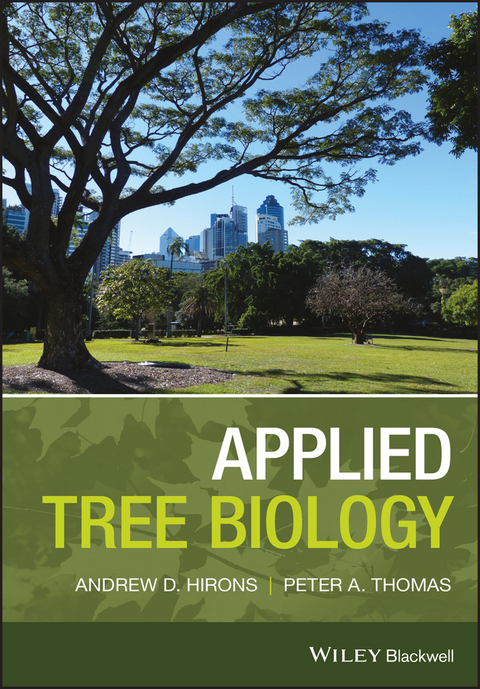
Applied Tree Biology (eBook)
John Wiley & Sons (Verlag)
978-1-118-29637-0 (ISBN)

Many arborists learn tree work practices without fully understanding the biological and physiological principles behind them. However, outcomes for the health and longevity of trees are greatly improved when an arborist understands the science behind the care of tree root systems and crowns. In Applied Tree Biology, Drs. Hirons and Thomas draw upon their decades of experience in the laboratory, classroom, and the field - as well as the expertise of distinguished contributors to this volume - to provide those responsible for tree care with the scientific information that informs best practices for planting, pruning, soil decompaction, irrigation, and much more.
- Takes a multidisciplinary approach, integrating knowledge from plant biology, physiology, arboriculture, ecology, and more
- Provides a systematic presentation of fundamental tree biology and the scientific principles informing high quality tree care
- Presents accessible scientific information and best practices that help promote the health and longevity of trees
- Reflects the authors' decades of experience as tree biology researchers and educators, as well as their years of professional experience across the globe
Applied Tree Biology is an indispensable source of practical, succinct information on tree biology, physiology, and ecology for professionals and interested amateurs involved with the care of trees. Arborists, foresters, and horticulturists at all stages of their careers will find this text particularly useful.
ANDREW D. HIRONS is a Senior Lecturer in Arboriculture at University Centre Myerscough, UK. He has international experience as a climbing arborist and a plant health care practitioner. As well as lecturing on a range of arboricultural courses he is also actively involved in research. His current research activity is motivated by the need to create resilience in our urban forests, and is focused on using plant traits to inform species selection for urban environments.
PETER A. THOMAS is a Reader in Plant Ecology at Keele University, UK. He has more than 30 years of experience in ecological aspects of trees and forests in the UK, Europe, North & Central America, Africa, Russia, Asia and Australasia.
Many arborists learn tree work practices without fully understanding the biological and physiological principles behind them. However, outcomes for the health and longevity of trees are greatly improved when an arborist understands the science behind the care of tree root systems and crowns. In Applied Tree Biology, Drs. Hirons and Thomas draw upon their decades of experience in the laboratory, classroom, and the field as well as the expertise of distinguished contributors to this volume to provide those responsible for tree care with the scientific information that informs best practices for planting, pruning, soil decompaction, irrigation, and much more. Takes a multidisciplinary approach, integrating knowledge from plant biology, physiology, arboriculture, ecology, and more Provides a systematic presentation of fundamental tree biology and the scientific principles informing high quality tree care Presents accessible scientific information and best practices that help promote the health and longevity of trees Reflects the authors decades of experience as tree biology researchers and educators, as well as their years of professional experience across the globe Applied Tree Biology is an indispensable source of practical, succinct information on tree biology, physiology, and ecology for professionals and interested amateurs involved with the care of trees. Arborists, foresters, and horticulturists at all stages of their careers will find this text particularly useful.
ANDREW D. HIRONS is a Senior Lecturer in Arboriculture at University Centre Myerscough, UK. He has international experience as a climbing arborist and a plant health care practitioner. As well as lecturing on a range of arboricultural courses he is also actively involved in research. His current research activity is motivated by the need to create resilience in our urban forests, and is focused on using plant traits to inform species selection for urban environments. PETER A. THOMAS is a Reader in Plant Ecology at Keele University, UK. He has more than 30 years of experience in ecological aspects of trees and forests in the UK, Europe, North & Central America, Africa, Russia, Asia and Australasia.
"Overall this is very well written and beautifully presented book on applied tree biology that completely meets its declared objectives and is an excellent resource for all those engaged in the care and management of amenity trees, parks and other urban landscapes. It also fills an important and neglected niche in the scientific literature and so it is highly recommended reading for all interested in the management of trees - especially urban trees." - Prof RRB Leakey, Forest Trees and Livelihood, March 2018
"This is an ambitious book that bridges the gap between basic plant biology and practical arboriculture. Books have attempted this before but not in such a comprehensive way. Arborists, in common with other professions, sometimes too easily accept and follow practices based on unquestioning assumption rather than evidence. This book will help ground modern arboriculture in sound science."- The Plantsman, June 2018
1
Introduction
Value of Trees Globally
The three trillion trees around the world (Crowther et al. 2015) are hugely important to us and to the well‐being of our planet (Figure 1.1). Their value is usually described in terms of ecosystem services – what trees and forests can do to help us humans. A detailed list of ecosystem services provided by trees and forests would fill this book (the UK National Ecosystem Assessment 2011 provides a very good summary) so, by way of illustration, here are just three major services.
Figure 1.1 Forests are globally important to mankind for storing carbon, helping to determine weather patterns and providing a habitat for a vast range of life. This scene is of the temperate forest in Robert H. Treman State Park, New York.
One of the major services is storing carbon. Forests hold around 45% of the carbon stored on land (i.e. not including the reserves held in oceans) which amounts to 2780 Gt of carbon (Giga has nine zeros; i.e. billions). This is about 3.3 times the amount already in the atmosphere (829 Gt). Carbon dioxide in the atmosphere has increased from 280 ppm in pre‐industrial times to 404 ppm at the time of writing, an increase of 42%. If all the world’s trees died and decomposed to release their carbon into the atmosphere, the atmospheric level of carbon dioxide would rise to 1700 ppm (>600% pre‐industrial) with catastrophic effects on our world (UNEP 2008), so global carbon storage in trees and forests is a hugely important service.
Forests also help to determine weather patterns. This is partly by forests evaporating large amounts of water, producing clouds that release rain downwind. Furthermore, it has recently been discovered that a chemical released by trees, pinene (one of the monoterpenes), can help ‘seed’ clouds by acting as nuclei for water to condense around, and so help clouds to form and rain to fall (Kirby et al. 2016). It seems plausible that other volatile organic compounds (VOCs) emitted by trees have a similar effect. Trees and forests are also beneficial by acting as sponges, slowing the journey of rainfall to the ground and helping to improve soil structure, both of which encourage water to sink into the soil rather than run off the surface. This delays water discharge to streams and rivers, helping to reduce flooding and soil erosion.
Most of the world’s biodiversity is held in forests. Tropical forests, which cover 7% of land surface, hold more than 60% of the world’s species of terrestrial animals and plants (Bradshaw et al. 2009), and all the world’s forests hold more than 80% of species (Balvanera et al. 2014).
Value of Urban Trees
On a smaller scale, urban trees and woodlands also have an important role in our well‐being, but for slightly different reasons. Fundamentally, urban trees make our towns and cities better places to live. Quite apart from making urban areas look more appealing, trees can provide a sense of place and time. They help provide outdoor recreation opportunities and make the urban environment more pleasant. Economic benefits of urban trees include higher property values; reduced energy costs of buildings; and reduced expenditure on air pollution removal and storm water infrastructure (Roy et al. 2012; Mullaney et al. 2015). There are also many environmental benefits, the most important of which are summarised in Expert Box 1.1.
With more than half of the world’s population now living in cities, one of the most important contributions that trees and green spaces make is to our health. There is a growing body of information that shows that exposure to trees and green spaces improves wellness and our sociability (Wolf and Robbins 2015). Studies have also shown that the positive health impact of trees is independent of access to green space in general. For example, in Sacramento, California, higher tree cover within 250 m of home was associated with better general health, partially mediated by lower levels of obesity and better neighbourhood social cohesion (Ulmer et al. 2016). There is also a body of information that shows that psychological benefits of trees can affect the physiology of our bodies by reducing pulse rate and levels of cortisol, a major stress hormone (Ochiai et al. 2015). This works even when looking at pictures of trees. There is also a physiological response because chemicals released by some trees affect us directly. For example, Ikei et al. (2015) found that oil from the Hinoki cypress Chamaecyparis obtusa, widely used in fragrances in soap, toothpaste and cosmetics in Japan, positively affects brain activity and induces a feeling of ‘comfortableness’. This is the basis for shinrin‐yoku (forest‐air breathing or forest bathing), a popular form of relaxation in Japan, walking through wooded areas or standing beneath a tree and slowly breathing (Figure 1.2). The same monoterpenes that cause cloud formation are known to reduce tension and mental stress, reducing aggression and depression and increasing feelings of well‐being. Even a short lunchtime walk of 1.8 km through green areas can improve sleep patterns that night (Gladwell et al. 2016). Moreover, the physiological effects stay with us. A study by Li (2010) found that a 3‐day forest visit had positive effects on the immune system up to 30 days later.
Figure 1.2 A sign encouraging people to breathe in the air in a forest in northern Honshu Island, Japan. This shinrin‐yoku (forest‐air breathing) is a popular form of relaxation in Japan.
The loss of trees from urban environments has also been demonstrated to have negative outcomes for human health. Over 100 million ash Fraxinus spp. trees have been lost in the north‐eastern USA since 2002 as a result of the emerald ash borer (EAB), an invasive beetle. This huge loss of trees has been linked to increased human mortality as a result of higher levels of cardiovascular and respiratory diseases (Donovan et al. 2013). Social costs, such as an increase in crime, have also been associated with the loss of trees caused by EAB (Kondo et al. 2017). Consequently, there is a growing body of evidence that the presence of trees in and around our urban environments provides major public health and societal benefits.
However, in some cases, the much‐championed value of urban trees is perhaps not all that is claimed. Examples of this include oxygen production and carbon sequestration (the locking‐up of carbon). It is true that trees produce an abundance of oxygen. For example, urban forests in the USA have been estimated to produce enough oxygen (61 Mt of it) annually to keep two‐thirds of the US population breathing (Nowak et al. 2007). However, given the enormous reserves of oxygen in the atmosphere, this is a fairly minor benefit of urban trees. Another benefit of urban trees that is often over‐played is their role in mitigating carbon emissions. Roland Ennos, Expert Box 1.1, points out that Greater London’s 8.4 million trees are estimated to store 2.4 million tonnes of carbon (t C) and sequester about 77 200 t C each year (Rogers et al. 2015). This amounts to about 3% of the city’s annual carbon emissions or, to put it another way, enough to cover the city’s emissions for about 12 days. London’s trees sequester only about 0.2% of annual carbon emissions. This is not to disparage carbon sequestration in urban trees, but just to put it into perspective; urban trees are very valuable to us but planting them will not be a solution for climate change or even offset the carbon emissions of our towns and cities to any great extent. In this regard, conservation of the world’s forests is of much greater significance.
Although trees are overwhelmingly beneficial for our landscapes and for us, they can also create problems, particularly if they are inappropriately planted, the wrong species is selected for the site or the site is poorly designed with respect to tree development. Trees can get too big for their location; they can conflict with buildings, utilities and sightlines. At certain times of year, pollen from trees can contribute to discomfort amongst those with hay‐fever; litter from flowers, fruit and leaves can create slip hazards or block drains. Tree roots sometimes cause damage to pavements, making them uneven, and they may exacerbate damage to pipes by exploiting them as a source of water and nutrition. Occasionally, in dry years, certain species growing on shrinkable clay soils can extract enough water to cause subsidence damage to built structures. Trees may also pose a risk to persons or property if they are structurally unstable or develop extensive decay. But should these potential problems prevent us keeping and planting urban trees? Emphatically not.
Even though many of the problems associated with trees in urban landscapes can be linked to poor planning, design and workmanship, the tree is invariably blamed. Despite the evidence for the benefits of trees, widespread loss of trees from our urban environments is often reported. In the USA it has been estimated that four million urban trees are lost per year (Nowak and Greenfield 2012) and a similar trend can be seen across Europe. More insidiously, even where the total number of trees is not appreciably declining, the size of the tree is changing. In the UK, the...
| Erscheint lt. Verlag | 7.11.2017 |
|---|---|
| Sprache | englisch |
| Themenwelt | Naturwissenschaften ► Biologie ► Botanik |
| Naturwissenschaften ► Biologie ► Ökologie / Naturschutz | |
| Weitere Fachgebiete ► Land- / Forstwirtschaft / Fischerei | |
| Schlagworte | Agriculture • Apical dominance • arboriculture • arboriculture art and science • arboriculture best practices • arboriculture biology • arboriculture ecology • arboriculture physiology • arboriculture practices • arboriculture science • Arboriculture techniques • arborist • best tree pruning techniques • biomechanical principles of trees and tree growth • Biowissenschaften • Botanik • epicormic branching • epicormic shoots • epicormic sprouting • forestry • Forstwirtschaft • how trees grow • keeping trees healthy • Landwirtschaft • leaf biology • leaf physiology • Life Sciences • Ökologie • Ökologie / Pflanzen • plant biology for arborists • plant biology of trees • plant ecology • plant ecology for arborists • plant ecology of trees • plant physiology for arborists • plant physiology of trees • plant science • targeted pruning of different types of trees • tree bark biology • tree biology • Tree ecology • tree longevity secrets • tree management • Tree physiology • tree root system biology • tree root system physiology • tree root systems explained |
| ISBN-10 | 1-118-29637-0 / 1118296370 |
| ISBN-13 | 978-1-118-29637-0 / 9781118296370 |
| Informationen gemäß Produktsicherheitsverordnung (GPSR) | |
| Haben Sie eine Frage zum Produkt? |
 EPUB (Adobe DRM)
Kopierschutz: Adobe-DRM
Adobe-DRM ist ein Kopierschutz, der das eBook vor Mißbrauch schützen soll. Dabei wird das eBook bereits beim Download auf Ihre persönliche Adobe-ID autorisiert. Lesen können Sie das eBook dann nur auf den Geräten, welche ebenfalls auf Ihre Adobe-ID registriert sind.
Details zum Adobe-DRM
Dateiformat: EPUB (Electronic Publication)
EPUB ist ein offener Standard für eBooks und eignet sich besonders zur Darstellung von Belletristik und Sachbüchern. Der Fließtext wird dynamisch an die Display- und Schriftgröße angepasst. Auch für mobile Lesegeräte ist EPUB daher gut geeignet.
Systemvoraussetzungen:
PC/Mac: Mit einem PC oder Mac können Sie dieses eBook lesen. Sie benötigen eine
eReader: Dieses eBook kann mit (fast) allen eBook-Readern gelesen werden. Mit dem amazon-Kindle ist es aber nicht kompatibel.
Smartphone/Tablet: Egal ob Apple oder Android, dieses eBook können Sie lesen. Sie benötigen eine
Geräteliste und zusätzliche Hinweise
Buying eBooks from abroad
For tax law reasons we can sell eBooks just within Germany and Switzerland. Regrettably we cannot fulfill eBook-orders from other countries.
aus dem Bereich