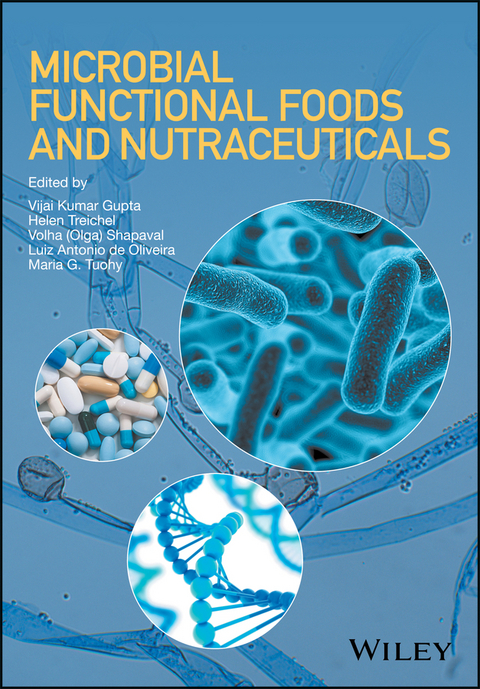
Microbial Functional Foods and Nutraceuticals (eBook)
John Wiley & Sons (Verlag)
978-1-119-04899-2 (ISBN)
Showcases the recent advances in microbial functional food applications across food science, microbiology, biotechnology, and chemical engineering
Microbial technology plays a key role in the improvement of biotechnology, cosmeceuticals, and biopharmaceutical applications. It has turned into a subject of expanding significance because new microbes and their related biomolecules are distinguished for their biological activity and health benefits. Encompassing both biotechnology and chemical engineering, Microbial Functional Foods and Nutraceuticals brings together microbiology, bacteria, and food processing/mechanization, which have applications for a variety of audiences. Pharmaceuticals, diagnostics, and medical device development all employ microbial food technology.
The book addresses the recent advances in microbial functional foods and associated applications, providing an important reference work for graduates and researchers. It also provides up-to-date information on novel nutraceutical compounds and their mechanisms of action-catering to the needs of researchers and academics in food science and technology, microbiology, chemical engineering, and other disciplines who are dealing with microbial functional foods and related areas.
Microbial Functional Foods and Nutraceuticals is:
- Ground-breaking: Includes the latest developments and research in the area of microbial functional foods and nutraceuticals
- Multidisciplinary: Applicable across food science and technology, microbiology, biotechnology, chemical engineering, and other important research fields
- Practical and academic: An important area of both academic research and new product development in the food and pharmaceutical industries
Microbial Functional Foods and Nutraceuticals is an ideal resource of information for biologists, microbiologists, bioengineers, biochemists, biotechnologists, food technologists, enzymologists, and nutritionists.
About the Editors
Vijai Kumar Gupta, Tallinn University of Technology, Tallinn, Estonia.
Helen Treichel, Universidade Federal da Fronteira Sul (UFFS), Brazil.
Volha (Olga) Shapaval, Norwegian University of Life Sciences, Aas, Norway.
Luiz Antonio de Oliveira, Instituto Nacional de Pesquisas da Amaz??nia in Manaus, Brazil.
Maria G. Tuohy, National University of Ireland Galway, Galway, Ireland.
Showcases the recent advances in microbial functional food applications across food science, microbiology, biotechnology, and chemical engineering Microbial technology plays a key role in the improvement of biotechnology, cosmeceuticals, and biopharmaceutical applications. It has turned into a subject of expanding significance because new microbes and their related biomolecules are distinguished for their biological activity and health benefits. Encompassing both biotechnology and chemical engineering, Microbial Functional Foods and Nutraceuticals brings together microbiology, bacteria, and food processing/mechanization, which have applications for a variety of audiences. Pharmaceuticals, diagnostics, and medical device development all employ microbial food technology. The book addresses the recent advances in microbial functional foods and associated applications, providing an important reference work for graduates and researchers. It also provides up-to-date information on novel nutraceutical compounds and their mechanisms of action catering to the needs of researchers and academics in food science and technology, microbiology, chemical engineering, and other disciplines who are dealing with microbial functional foods and related areas. Microbial Functional Foods and Nutraceuticals is: Ground-breaking: Includes the latest developments and research in the area of microbial functional foods and nutraceuticals Multidisciplinary: Applicable across food science and technology, microbiology, biotechnology, chemical engineering, and other important research fields Practical and academic: An important area of both academic research and new product development in the food and pharmaceutical industries Microbial Functional Foods and Nutraceuticals is an ideal resource of information for biologists, microbiologists, bioengineers, biochemists, biotechnologists, food technologists, enzymologists, and nutritionists.
About the Editors Vijai Kumar Gupta, Tallinn University of Technology, Tallinn, Estonia. Helen Treichel, Universidade Federal da Fronteira Sul (UFFS), Brazil. Volha (Olga) Shapaval, Norwegian University of Life Sciences, Aas, Norway. Luiz Antonio de Oliveira, Instituto Nacional de Pesquisas da Amaz??nia in Manaus, Brazil. Maria G. Tuohy, National University of Ireland Galway, Galway, Ireland.
List of Contributors vii
1 Microalgae as a Sustainable Source of Nutraceuticals 1
Md Nazmul Islam, Faisal Alsenani, and Peer M. Schenk
2 Functional Foods from Cyanobacteria: An Emerging Source for Functional Food Products of Pharmaceutical Importance 21
Neha Panjiar, Shashank Mishra, Ajar Nath Yadav, and Priyanka Verma
3 Seaweed Carotenoid, Fucoxanthin, as Functional Food 39
Nissreen Abu-Ghannam and Emer Shannon
4 Functional Foods from Mushroom 65
Vinay Basavegowda Raghavendra, Chandrasekar Venkitasamy, Zhongli Pan, and Chandra Nayak
5 Microbial Production of Organic Acids 93
Ram Naraian and Simpal Kumari
6 Microbes as a Source for the Production of Food Ingredients 123
Charu Gupta and Dhan Prakash
7 Microbial Xanthan, Levan, Gellan, and Curdlan as Food Additives 149
Ozlem Ates and Ebru Toksoy Oner
8 Microbial Fibrinolytic Enzyme Production and Applications 175
Essam Kotb
9 Microbial Products Maintain Female Homeostasis 215
Sarika Amdekar, Mayuri Khare, Vivek Kumar Shrivastava, Avnish Kumar, and Vinod Singh
10 Production of High-Quality Probiotics by Fermentation 235
Marimuthu Anandharaj, Rizwana Parveen Rani, and Manas R. Swain
11 Probiotics and Their Health Benefits 267
Michelle Fleet and Pattanathu K.S.M. Rahman
12 Nutritional Potential of Auricularia auricula-judae and Termitomyces umkowaan - The Wild Edible Mushrooms of South-Western India 281
Namera C. Karun, Kandikere R. Sridhar, and Cheviri N. Ambarish
Index 303
1
Microalgae as a Sustainable Source of Nutraceuticals
Md Nazmul Islam, Faisal Alsenani, and Peer M. Schenk*
Algae Biotechnology Laboratory, School of Agriculture and Food Sciences, University of Queensland, Brisbane, Queensland, Australia
*Corresponding author e‐mail: p.schenk@uq.edu.au
Introduction
Nutraceutical is a broad term which describes any food product with increased health benefits and which exceeds the usual health benefits of normal foods (Borowitzka 2013). Many bioactive constituents of food have been commercialized in the form of pharmaceutical products (pills, capsules, solutions, gels, liquors, powders, granules, etc.) which contribute to enhanced human health. However, these products cannot be categorized solely as “food” or “pharmaceutical” and a new hybrid term between nutrients and pharmaceuticals, “nutraceuticals,” has been introduced (Palthur et al. 2010).
A generally accepted term for nutraceuticals is “food supplements.” Another closely related term is “functional foods,” defined as “products derived from natural sources which can also be fortified, whose consumption is likely to benefit human health” (Burja et al. 2008). However, it is a widely held view that there appears to be a boundary between nutraceuticals and functional foods. For example, when a bioactive compound is added in a food formulation, i.e., 200 mg of carotenoids dissolved in 1 L of juice, this may result in a new potential functional food, whereas the same amount of carotenoids encapsulated in a tablet or capsule is considered a nutraceutical (Espin et al. 2007). Additionally, nutraceuticals can either be whole food products (e.g., Spirulina in tablet form) or dietary supplements where the nutraceutical compound(s) may be concentrated to provide the claimed health benefits (e.g., astaxanthin extracted from Haematococcus microalgae is available in the market).
Therefore, the emphasis on searching for nutraceuticals that contribute to improved human health has increased worldwide. Microalgae have become a popular target in the research community and biotechnology industry based on findings that many microalgal strains are very good sources of various nutraceuticals, such as vitamins, carotenoids, polyunsaturated fatty acids (PUFAs), phytosterols, etc. (Hudek et al. 2014). Moreover, the use of microalgal biomass has attracted attention because they grow fast regardless of the land’s suitability for farming. In principle, microalgae cultivation can be carried out independent of freshwater supply and does not compete with arable land or biodiverse landscapes. In fact, many microalgae with health benefits are marine or brackish water algae (Lim et al. 2012). Microalgae are therefore considered an ideal source for the sustainable production of physiologically active compounds (Abdelaziz et al. 2013; Hudek et al. 2014). Many of them have a surprising capability of enduring adverse environmental conditions by means of their secondary metabolites, and some of these conditions lead to high accumulation of these compounds (e.g., Dunaliella salina produces high levels of β‐carotene under highly saline conditions; Borowitzka 2013).
Prior studies have noted the health benefits of algal nutraceuticals which include improved immunity, neurological development, increased health of different organs including bones, teeth, intestine, etc. Algal nutraceuticals were also found to be effective in fighting obesity and cholesterol, and decrease blood pressure and maintain optimum heart condition. Several studies also documented some antiviral and anticancer properties (Venugopal 2008). In this chapter, we will provide a brief overview of the different nutraceutical compounds currently reported to be available in microalgae.
Microalgae‐Derived Nutraceuticals
Pigments
Stengel and his team (2011) pointed out a few of the major categories of microalgal pigments which are closed tetrapyrroles such as chlorophylls a and b (chlorins), porphyrins (chlorophyll c), open chain tetrapyrroles (phycobilin pigments), and carotenoids (polyisoprenoids; carotenes and xanthophylls). Among them, the most targeted pigment groups are carotenoids and phycobilins which are already widely used by industry (Stengel et al. 2011).
Generally, carotenoids are powerful antioxidants and provide photoprotection to cells. Most of them have a 40‐carbon polyene chain as their molecular backbone (del Campo et al. 2007; Guedes et al. 2011a). A recent study by our group showed that when induced by external stimuli, various microalgae can produce significant amounts of carotenoids. Among a few hundred Australian microalgal strains, 12 rapidly growing strains were screened for carotenoid profiles and D. salina, Tetraselmis suecica, Isochrysis galbana, and Pavlova salina were found to be good sources of various carotenoids at 4.68–6.88 mg/g dry weight (DW) even without external stimuli (Ahmed et al. 2014).
A considerable amount of work has been done worldwide to screen microalgae for carotenoid production. For example, lutein is dominant in Muriellopsis sp., Scenedesmus almeriensis, and Chlorella sp. (Blanco et al. 2007; Borowitzka 2013; del Campo et al. 2001; Fernandez‐Sevilla et al. 2010); astaxanthin, canthaxanthin and lutein are abundant in Chlorella zofingiensis; canthaxanthin in Scenedesmus komareckii; aplanospores in D. salina; echinenone in Botryococcus braunii; and fucoxanthin in Phaeodactylum tricornutum (Table 1.1). However, apart from β‐carotene and astaxanthin, large‐scale production for these microalgae‐synthesized carotenoids is still in consideration due to the high costs of downstream processing for extraction and purification (Borowitzka 2013). Furthermore, the cyanobacterium Synechocoocccus and the microalga Nannochloropsis gaditana present a good source of β‐carotene, zeaxanthin, violaxanthin, vaucheriaxanthin, and chlorophyll a (Macías‐Sánchez et al. 2007).
Table 1.1 Selected microalgae‐derived bioactive compounds: their sources and function.
| Bioactive compounds | Microalga source | Function | References |
| Pigments | Lutein | Muriellopsis sp. Scenedesmus almeriensis Chlorella sp. | Prevention of cancer, protection from macular degeneration and cognitive impairment | Guedes et al. 2011a,c Borowitzka 2013 |
| Astaxanthin | Chlorella zofigiensis Dunaliella salina Haematococcus pluvialis | Antioxidant and anti‐inflammatory properties, effective against cancer, protein degradation, Parkinson’s disease, reduced vision, rheumatoid arthritis | Hudek et al. 2014, Ibanez and Cifuentes 2013, Borowitzka 2013 |
| β‐carotene | Nannochloropsis gaditana Dunaliella salina Haematococcus pluvialis | Prevention of breast cancer and macular degeneration | Macías‐Sánchez et al. 2007, Stengel et al. 2011, Guedes et al. 2011a |
| PUFAs | EPA | Phaeodactylum tricornutum Nannochloropsis sp. Monodus subterraneus | Neural development, prevention of cardiovascular disease, lessen and protect against COPD, asthma, rheumatoid arthritis, atherosclerosis, Crohn’s disease and cystic fibrosis. Facilitate child and infant development | Stengel et al. 2011, Janssen and Kiliaan 2014, Guedes et al. 2011b, Borowitzka 2013 |
| DHA | Crypthecodinium cohnii Pavlova salina Isochrysis galbana |
| Linolenic acid | Dunaliella salina Spirulina platensis |
| Proteins | Phycobiliproteins, hormone‐like bioactive peptides, 2‐20, and essential amino acids, etc. | Haematococcus pluvialis Chlamydomonas reinhardtii Chlorella sp. Spirulina sp. Scenedesmus sp. Dunaliella sp. Oscillatoria sp. Chlamydomonas sp. | Anticancer, immunomodulating, hepatoprotective, anti‐inflammatory, antioxidant, antimicrobial properties, protection of DNA Production of recombinant proteins, e.g., for type 1 diabetes detection, etc. | Himaya et al. 2012, Stengel et al. 2011, Dewapriya and Kim 2014, Gong et al. 2011, Mayfield et al. 2007, Agyei and Danquah 2011, Sheih et al. 2009 |
| Vitamins | Cobalamin (vitamin B12) | Dunaliella tertiolecta Chlorella sp. Spirulina sp. | Antioxidant activities, role in body function, immunity, digestive system, etc. | Fabregas and Herrero 1990, Watanabe et al. 2002,Durmaz et al. 2007 |
| Tocopherols (vitamin E) | Dunaliella tertiolecta Porphyridium cruentum |
| Thiamin (vitamin B1) | Tetraselmis suecica |
| Nicotinic acid (vitamin B3) | Tetraselmis suecica |
| Ascorbic acid (vitamin C) | Tetraselmis... |
| Erscheint lt. Verlag | 30.10.2017 |
|---|---|
| Sprache | englisch |
| Themenwelt | Naturwissenschaften ► Biologie |
| Technik ► Lebensmitteltechnologie | |
| Weitere Fachgebiete ► Land- / Forstwirtschaft / Fischerei | |
| Schlagworte | Bioactive Compounds • biochemistry • Bioengineering • biopharmaceuticals • Bioprocesses • Biotechnology • chemical engineering for food • Cosmeceuticals • Enzymology • Ernährungslehre • Food Biochemistry • food biotechnology • food microbes • Food Processing • food science • Food Science & Technology • Food Technology • Functional Food, Nutraceuticals • functional food processing • Functional Foods • Functional Foods & Nutraceuticals • Gesundheits- u. Sozialwesen • Health & Social Care • Lebensmittel / Biotechnologie • Lebensmittelforschung u. -technologie • microbes • microbial food • microbial food technology • microbial functional foods • Microbial Functional Foods and Nutraceuticals • Microbial technology • Microbiology • nutraceutical compound mechanisms of action • nutraceutical compounds • Nutraceuticals • Nutrition • Nutritional Research |
| ISBN-10 | 1-119-04899-0 / 1119048990 |
| ISBN-13 | 978-1-119-04899-2 / 9781119048992 |
| Informationen gemäß Produktsicherheitsverordnung (GPSR) | |
| Haben Sie eine Frage zum Produkt? |
 EPUB (Adobe DRM)
Kopierschutz: Adobe-DRM
Adobe-DRM ist ein Kopierschutz, der das eBook vor Mißbrauch schützen soll. Dabei wird das eBook bereits beim Download auf Ihre persönliche Adobe-ID autorisiert. Lesen können Sie das eBook dann nur auf den Geräten, welche ebenfalls auf Ihre Adobe-ID registriert sind.
Details zum Adobe-DRM
Dateiformat: EPUB (Electronic Publication)
EPUB ist ein offener Standard für eBooks und eignet sich besonders zur Darstellung von Belletristik und Sachbüchern. Der Fließtext wird dynamisch an die Display- und Schriftgröße angepasst. Auch für mobile Lesegeräte ist EPUB daher gut geeignet.
Systemvoraussetzungen:
PC/Mac: Mit einem PC oder Mac können Sie dieses eBook lesen. Sie benötigen eine
eReader: Dieses eBook kann mit (fast) allen eBook-Readern gelesen werden. Mit dem amazon-Kindle ist es aber nicht kompatibel.
Smartphone/Tablet: Egal ob Apple oder Android, dieses eBook können Sie lesen. Sie benötigen eine
Geräteliste und zusätzliche Hinweise
Buying eBooks from abroad
For tax law reasons we can sell eBooks just within Germany and Switzerland. Regrettably we cannot fulfill eBook-orders from other countries.
aus dem Bereich