


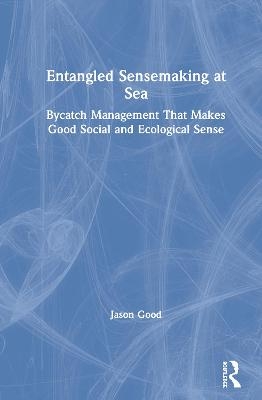
Entangled Sensemaking at Sea
Bycatch Management That Makes Good Social and Ecological Sense
Seiten
2020
Greenleaf Publishing (Verlag)
978-1-78353-811-9 (ISBN)
Greenleaf Publishing (Verlag)
978-1-78353-811-9 (ISBN)
Sustainable commercial fishing, species protection and bycatch are contentious topics. This book presents a framework for understanding frontline organizing processes in commercial fishing. It enables industry managers, regulators, and society more broadly to better understand, influence, and respond to sustainability issues.
Sustainable commercial fishing, species conservation, and bycatch are contentious topics. Great emphasis has been placed on the sustainable sourcing of particular species that we buy at the store and order in restaurants, but how can we trust that the fish on our plates, from a system-wide perspective, have been appropriately sourced? Even in what are commonly considered to be the best-managed fisheries in the world (i.e., Alaskan fisheries), thousands of tons of fish are wasted each year in the interest of providing certain species in certain ways to certain people, at certain prices. Are the management practices and regulations that we think are helping actually having the desired outcomes in terms of the effective use of natural resources?
This book presents a framework that can enhance our understanding, research, and regulation of frontline organizing processes in commercial fisheries, which may be generalized to other resource extraction industries. It enables readers to better grasp and respond to the need to develop practices and regulations that involve effective use of all natural resources, rather than just a chosen few. The book is especially important to researchers and practitioners active in the fishing industry, and natural resource managers and regulators interested in understanding and improving their management systems. It is also highly relevant to organization and management researchers interested in coupled human and natural systems, ecological sensemaking, the role of quantum mechanics in organizational phenomena, sociomateriality, and sustainability.
The book uses the real-world case of an Alaskan fishing fleet to explore how the commercial fishing industry (which includes businesses, management agencies, regulatory bodies, and markets, among others) entangles itself with natural phenomena in order to extract resources from them. After gaining a better understanding of these processes can we see how they can be improved, especially through changes to regulatory management systems, in order to foster not only more sustainable, but also less wasteful (these two goals are not necessarily interdependent in today's regulatory management systems), natural resource extraction and use. Such an understanding requires exploring how regulations, natural phenomena, human sensemaking processes, and market forces entangle at sea to materialize the fish that make their way to our plates - as well as those that, importantly, do not.
Sustainable commercial fishing, species conservation, and bycatch are contentious topics. Great emphasis has been placed on the sustainable sourcing of particular species that we buy at the store and order in restaurants, but how can we trust that the fish on our plates, from a system-wide perspective, have been appropriately sourced? Even in what are commonly considered to be the best-managed fisheries in the world (i.e., Alaskan fisheries), thousands of tons of fish are wasted each year in the interest of providing certain species in certain ways to certain people, at certain prices. Are the management practices and regulations that we think are helping actually having the desired outcomes in terms of the effective use of natural resources?
This book presents a framework that can enhance our understanding, research, and regulation of frontline organizing processes in commercial fisheries, which may be generalized to other resource extraction industries. It enables readers to better grasp and respond to the need to develop practices and regulations that involve effective use of all natural resources, rather than just a chosen few. The book is especially important to researchers and practitioners active in the fishing industry, and natural resource managers and regulators interested in understanding and improving their management systems. It is also highly relevant to organization and management researchers interested in coupled human and natural systems, ecological sensemaking, the role of quantum mechanics in organizational phenomena, sociomateriality, and sustainability.
The book uses the real-world case of an Alaskan fishing fleet to explore how the commercial fishing industry (which includes businesses, management agencies, regulatory bodies, and markets, among others) entangles itself with natural phenomena in order to extract resources from them. After gaining a better understanding of these processes can we see how they can be improved, especially through changes to regulatory management systems, in order to foster not only more sustainable, but also less wasteful (these two goals are not necessarily interdependent in today's regulatory management systems), natural resource extraction and use. Such an understanding requires exploring how regulations, natural phenomena, human sensemaking processes, and market forces entangle at sea to materialize the fish that make their way to our plates - as well as those that, importantly, do not.
Jason Good holds a master’s and PhD in Natural Resources and Environment from the University of Michigan, USA. Prior to his graduate work he was a fisheries scientist, working primarily in Alaskan waters. His research focuses on business sustainability, circular economy, and coupled organizational and natural systems.
Chapter One: Introduction
Chapter Two: Context and Methodology
Chapter Three: (Non)Rational Decision-Making at Sea
Chapter Four: Ecological Sensemaking at Sea
Chapter Five: The Propositional Nature of Ecological Sensemaking
Chapter Six: The Entangled Nature of Ecological Sensemaking
Chapter Seven When Lightning Strikes: Making Posthumanisic Ecological Sense of Chinook Salmon Bycatch
References
| Erscheinungsdatum | 30.06.2020 |
|---|---|
| Zusatzinfo | 20 Halftones, black and white; 20 Illustrations, black and white |
| Verlagsort | Saltaire |
| Sprache | englisch |
| Maße | 156 x 234 mm |
| Gewicht | 453 g |
| Themenwelt | Technik ► Umwelttechnik / Biotechnologie |
| Wirtschaft ► Betriebswirtschaft / Management ► Marketing / Vertrieb | |
| Wirtschaft ► Betriebswirtschaft / Management ► Unternehmensführung / Management | |
| Weitere Fachgebiete ► Land- / Forstwirtschaft / Fischerei | |
| ISBN-10 | 1-78353-811-2 / 1783538112 |
| ISBN-13 | 978-1-78353-811-9 / 9781783538119 |
| Zustand | Neuware |
| Informationen gemäß Produktsicherheitsverordnung (GPSR) | |
| Haben Sie eine Frage zum Produkt? |
Mehr entdecken
aus dem Bereich


aus dem Bereich
Grundlagen marktorientierter Unternehmensführung : Konzepte, …
Buch (2024)
Springer Gabler (Verlag)
CHF 69,95
Wie Sie mit starken Geschichten Ihre Kunden überzeugen
Buch | Softcover (2025)
Vahlen (Verlag)
CHF 31,95
Aufgaben, Werkzeuge und Erfolgsfaktoren
Buch | Softcover (2023)
Vahlen (Verlag)
CHF 30,65


