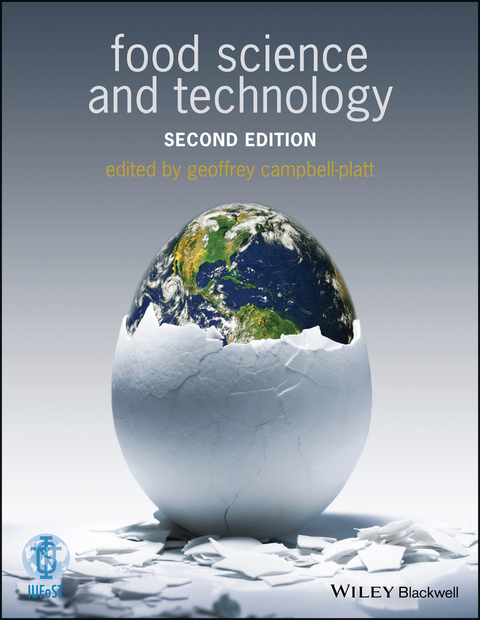
Food Science and Technology (eBook)
John Wiley & Sons (Verlag)
978-1-118-84623-0 (ISBN)
Food Science and Technology, Second Edition is a comprehensive text and reference book designed to cover all the essential elements of food science and technology, including all core aspects of major food science and technology degree programs being taught worldwide. The book is supported by the International Union of Food Science and Technology and comprises 21 chapters, carefully written in a user-friendly style by 30 eminent industry experts, teachers, and researchers from across the world. All authors are recognized experts in their respective fields, and together represent some of the world's leading universities and international food science and technology organizations.
All chapters in this second edition have been fully revised and updated to include all-new examples and pedagogical features (including discussion questions, seminar tasks, web links, and glossary terms). The book is designed with more color to help enhance the content on each page and includes more photos and illustrations to bring the topics to life.
- Coverage of all the core modules of food science and technology degree programs internationally
- Crucial information for professionals in the food industry worldwide
- Chapters written by subject experts, all of whom are internationally respected in their fields
- A must-have textbook for libraries in universities, food science and technology research institutes, and food companies globally
- Additional interactive resources on the book's companion website, including multiple choice questions, web links, further reading, and exercises
Food Science and Technology, 2nd Edition is an indispensable guide for food science and technology degree programs at the undergraduate and postgraduate level and for university libraries and food research facilities.
About the Editor
Geoffrey Campbell-Platt is Professor Emeritus of Food Technology at the University of Reading, UK, and Former President of the International Union of Food Science and Technology (IUFoST). He is also a Fellow of the International Academy of Food Science and Technology (IAFoST).
About the Editor Geoffrey Campbell-Platt is Professor Emeritus of Food Technology at the University of Reading, UK, and Former President of the International Union of Food Science and Technology (IUFoST). He is also a Fellow of the International Academy of Food Science and Technology (IAFoST).
Contributors vii
About the Companion Website ix
1 Introduction 1
Geoffrey Campbell-Platt
2 Food Chemistry 5
Richard A. Frazier
3 Food Analysis 31
Heinz-Dieter Isengard, Gertrud Morlock and Dietmar Breithaupt
4 Food Biochemistry 75
Brian C. Bryksa and Rickey Y. Yada
5 Food Biotechnology 105
Cherl-Ho Lee and Hyun-Jin Park
6 Food Microbiology 137
Tim Aldsworth, Christine E.R. Dodd and Will Waites
7 Numerical Procedures 193
R. Paul Singh
8 Food Physics 211
Keshavan Niranjan, Darío Iker Téllez-Medina and Gustavo Fidel Gutiérrez-López
9 Food Processing 227
Yugang Shi, Jianshe Chen and Andrew Rosenthal
10 Food Engineering 271
R. Paul Singh
11 Food Packaging 303
Gordon L. Robertson
12 Nutrition 325
C. Jeya Henry and Lis Ahlström
13 Sensory Evaluation 351
Herbert Stone and Rebecca N. Bleibaum
14 Statistical Analysis 375
Herbert Stone and Rebecca N. Bleibaum
15 Quality Assurance and Legislation 391
David Jukes
16 Regulatory Toxicology 437
Gerald C. Moy
17 Food Business Management: Principles and Practice 453
Michael Bourlakis, David B. Grant and Paul Weightman
18 Food Marketing 473
Takahide Yamaguchi
19 Product Development 487
Ray Winger
20 Information Technology 503
Jeremy D. Selman
21 Communication and Transferable Skills 519
Jeremy D. Selman
Index 535
CHAPTER 1
Introduction
Geoffrey Campbell-Platt
Department of Food and Nutritional Sciences,University of Reading, Reading, UK
- 1.1 Food Science and Technology Course Elements
- 1.2 Evolution of the Book
- 1.3 Food Safety Assurance
- 1.4 The International Union of Food Science and Technology
- 1.5 The Book
Food science and technology is the understanding and application of science to satisfy the needs of society for sustainable food quality, safety and security.
At several universities worldwide, degree programmes in food science and technology have been developed in the past half-century. This followed the lead of the University of Strathclyde (then the Royal College of Science and Technology), in Glasgow, Scotland, under the leadership of the first Professor of Food Science, who also became President of the International Union of Food Science and Technology (IUFoST), the late John Hawthorn.
The aim of these courses has been to provide food science and technology graduates with the ability, through multidisciplinary studies, to understand and integrate the scientific disciplines relevant to food. They would be able to extend their knowledge and understanding of food through a scientific approach, and be able to apply and communicate that knowledge to meet the needs of society, industry and the consumer for sustainable food quality, safety and security of supply.
1.1 Food Science and Technology Course Elements
Students studying food science and technology in higher education need to have undertaken courses in the basic scientific disciplines of chemistry, biology, mathematics, statistics and physics. These are developed in food science and technology degree programmes through course elements in food chemistry, food analysis, food biochemistry, food biotechnology, food microbiology, numerical procedures, and food physics. These are all covered by chapters in this book, followed by chapters covering food processing, food engineering, and packaging. Further courses are required in nutrition, sensory evaluation, statistical techniques, and quality assurance and legislation. Regulatory toxicology and food safety are addressed, as is food business management. Other course elements in food marketing, and product development are included, together with chapters on information technology, and communication and transferable skills.
Food science and technology is a science-based course, requiring good grounding in science and the use of laboratory and pilot-plant facilities, to reinforce the theoretical knowledge acquired. As well as gaining practical laboratory and observation skills, students need to learn how to write up laboratory experiments and to develop important reporting and interpretation skills. Universities therefore require up-to-date facilities for chemical, microbiological laboratory exercises, and processing pilot-plant facilities for teaching the principles of unit processing and engineering operations, as well as sufficient well-qualified staff to teach the range of disciplines covered in this book.
1.2 Evolution of the Book
Food Science and Technology, second edition, has evolved from a working group of the Committee of University Professors of Food Science and Technology (CUPFST), in the United Kingdom, who sought to agree a framework of common course elements for the various food science and technology courses established in the UK. Newer universities advised that each course element should be based on outcomes, which should be achieved on successful completion, and it is these outcome-headings that have largely been used as subject headings in each chapter. This approach is popular internationally, as well as being used by professional institutes such as the Institute of Food Science and Technology (IFST) in the UK, and the book has evolved in consultation with the recommended Education Standards for Food Science of the Institute of Food Technologists (IFT) in the United States.
The IFT recognizes food science as the discipline in which engineering, biological and physical sciences are used to study the nature of foods, the causes of deterioration, the principles underlying food processing, and the improvement of foods for the consuming public. Food technology is recognized as the application of food science to the selection, preservation, processing, packaging, distribution and use of safe, nutritious and wholesome food. In short, it could be said that the food scientist analyses and takes apart food materials, whereas the food technologist puts all that knowledge into use in producing safe, desired food products. In practice, as recognized throughout the world, the terms are often used interchangeably, and practising food scientists and technologists have to both understand the nature of food materials and produce safe, nutritious food products.
It is understood, and desirable, that the various food science and technology courses offered will vary, reflecting particular research interests and expertise, in different institutions, and students will want to develop their own interests through specific module choices or individual research projects. However, the purpose of establishing the core competencies, reflected in the chapters of this book, is to recognize what a food science or food technology graduate can be expected to achieve as a minimum, so that employers and regulators know what to expect of a qualified graduate, who could then expect, after suitable relevant experience, to become a member of a professional body, such as IFT or IFST, or a Certified Food Scientist or Chartered Scientist.
This book also provides a useful framework for the delivery of food science and technology courses that meet the criteria for international IUFoST recognition.
1.3 Food Safety Assurance
In our increasingly interdependent globalized world, food safety is an implied term in the “food purchasing or food service” consumer contract, which often appears to be addressed publicly only when something goes wrong. In fact, food control agencies and food retailers require processors and manufacturers to apply Hazard Analysis Critical Control Points (HACCP) to all their processes. This, combined with good practices, such as Good Manufacturing Practice (GMP) and traceability, build quality and safety assurance into the food chain, which is inherently better with the very large number of food items produced and eaten frequently, and when individual item or destructive testing can only give a limited picture of the total production. Both HACCP and GMP require good teamwork by all involved in food processing, and it is the multidisciplinary-trained food scientist or technologist who usually is called upon to lead and guide these operations.
In our modern world where food ethics are to the fore, in terms of sustainable, environmentally friendly production practices, fair trade, packaging recycling and climate change concerns, food scientists and technologists have an increasing requirement to keep abreast of these issues and the science that can be applied to help address them. To be successful, food scientists need good interpersonal, communication and presentation skills, which may be learned through example, mentoring and practice in as many different situations as possible; in the future, these skills promise to be in even greater demand, as scientists engage with increasingly demanding members of the public.
1.4 The International Union of Food Science and Technology
The International Union of Food Science and Technology (IUFoST) is the international body representing some 75 member countries, and some 300 000 food scientists and technologists worldwide, focusing particularly on food safety, education and food security. IUFoST organizes World Congresses of Food Science and Technology in different locations around the world, normally every 2 years, at which the latest research and ideas are shared, and the opportunity is provided for young food scientists to present papers and posters and to interact with established world experts. Higher education in food science and technology has been of great interest for several years, with many developing countries looking for guidance in establishing courses in the subject, or to align them more closely with others, to help graduates move more successfully between countries and regions. IUFoST is also helping the development of distance education, where people are in employment and not able to attend normal university courses. IUFoST therefore sees the publication of this book as an important part of its contribution to helping internationally in sharing knowledge and good practice.
IUFoST has also established the International Academy of Food Science and Technology (IAFoST), to which eminent food scientists can be elected by peer review, and designated as Fellows of IAFoST. The Fellows have acted as lead authors and advisers in the expanding range of authoritative Scientific Information Bulletins published by IUFoST, through its Scientific Council, which help summarize key food issues to a wider audience.
1.5 The Book
In writing this book, we have been honoured to have the 20 chapters written by some 30 eminent authors, from some 10 different countries. All authors are experts in their respective fields, and together represent several of the world's leading universities in food science and technology, as well as leading international organizations. We are...
| Erscheint lt. Verlag | 26.9.2017 |
|---|---|
| Sprache | englisch |
| Themenwelt | Naturwissenschaften ► Biologie |
| Naturwissenschaften ► Chemie | |
| Technik ► Lebensmitteltechnologie | |
| Weitere Fachgebiete ► Land- / Forstwirtschaft / Fischerei | |
| Schlagworte | Biology • food biology • Food chemistry • food engineering • Food Microbiology • Food preservation • Food Processing, Production & Manufacture • Food Product Development • food quality control • food research • food science • Food Science & Technology • Food Science and Technology • food science institutions • Food Technology • Herstellung u. Verarbeitung von Lebensmitteln • Human Consumption • International Union of Food Science and Technology (IUFoST) • Lebensmittel • Lebensmittelforschung u. -technologie • Lebensmitteltechnik • Library Association's McColvin Medal • <p>food • Microbiology, Food Safety & Security • Mikrobiologie • Mikrobiologie u. Nahrungsmittelsicherheit • The International Academy of Food Science</p> • the nature of foods |
| ISBN-10 | 1-118-84623-0 / 1118846230 |
| ISBN-13 | 978-1-118-84623-0 / 9781118846230 |
| Informationen gemäß Produktsicherheitsverordnung (GPSR) | |
| Haben Sie eine Frage zum Produkt? |
 EPUB (Adobe DRM)
Kopierschutz: Adobe-DRM
Adobe-DRM ist ein Kopierschutz, der das eBook vor Mißbrauch schützen soll. Dabei wird das eBook bereits beim Download auf Ihre persönliche Adobe-ID autorisiert. Lesen können Sie das eBook dann nur auf den Geräten, welche ebenfalls auf Ihre Adobe-ID registriert sind.
Details zum Adobe-DRM
Dateiformat: EPUB (Electronic Publication)
EPUB ist ein offener Standard für eBooks und eignet sich besonders zur Darstellung von Belletristik und Sachbüchern. Der Fließtext wird dynamisch an die Display- und Schriftgröße angepasst. Auch für mobile Lesegeräte ist EPUB daher gut geeignet.
Systemvoraussetzungen:
PC/Mac: Mit einem PC oder Mac können Sie dieses eBook lesen. Sie benötigen eine
eReader: Dieses eBook kann mit (fast) allen eBook-Readern gelesen werden. Mit dem amazon-Kindle ist es aber nicht kompatibel.
Smartphone/Tablet: Egal ob Apple oder Android, dieses eBook können Sie lesen. Sie benötigen eine
Geräteliste und zusätzliche Hinweise
Buying eBooks from abroad
For tax law reasons we can sell eBooks just within Germany and Switzerland. Regrettably we cannot fulfill eBook-orders from other countries.
aus dem Bereich