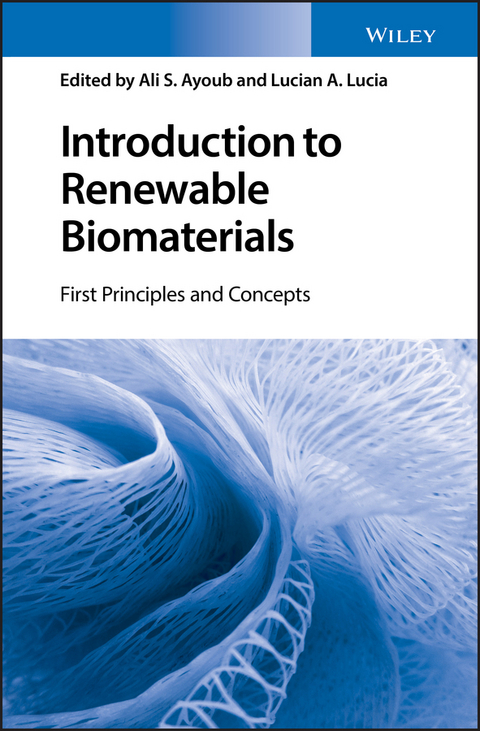
Introduction to Renewable Biomaterials (eBook)
John Wiley & Sons (Verlag)
978-1-118-69859-4 (ISBN)
Covers the entire evolutionary spectrum of biomass, from its genetic modification and harvesting, to conversion technologies, life cycle analysis, and its value to the current global economy
This original textbook introduces readers to biomass-a renewable resource derived from forest, agriculture, and organic-based materials-which has attracted significant attention as a sustainable alternative to petrochemicals for large-scale production of fuels, materials, and chemicals. The current renaissance in the manipulation and uses of biomass has been so abrupt and focused, that very few educational textbooks actually cover these topics to any great extent. That's why this interdisciplinary text is a welcome resource for those seeking a better understanding of this new discipline. It combines the underpinning science of biomass with technology applications and sustainability considerations to provide a broad focus to its readers.
Introduction to Renewable Biomaterials: First Principles and Concepts consists of eight chapters on the following topics: fundamental biochemical & biotechnological principles; principles and methodologies controlling plant growth and silviculture; fundamental science and engineering considerations; critical considerations and strategies for harvesting; first principles of pretreatment; conversion technologies; characterization methods and techniques; and life cycle analysis. Each chapter includes a glossary of terms, two to three problem sets, and boxes to highlight novel discoveries and instruments. Chapters also offer questions for further consideration and suggestions for further reading.
- Developed from a successful USDA funded course, run by a partnership of three US universities: BioSUCEED - BioProducts Sustainability, a University Cooperative Center for Excellence in Education
- Covers the entire evolutionary spectrum of biomass, from genetic modification to life cycle analysis
- Presents the key chemistry, biology, technology, and sustainability aspects of biomaterials
- Edited by a highly regarded academic team, with extensive research and teaching experience in the field
Introduction to Renewable Biomaterials: First Principles and Concepts is an ideal text for advanced academics and industry professionals involved with biomass and renewable resources, bioenergy, biorefining, biotechnology, materials science, sustainable chemistry, chemical engineering, crop science and technology, agriculture.
About the Editors
Ali S. Ayoub, PhD is an internationally recognized expert in the biopolymer science and engineering field and has successfully developed groundbreaking inventions in areas relevant to polymeric materials and the biorefinery concept. He is a senior scientist in the chemical industry, as well as an adjunct professor and associate graduate faculty member at North Carolina State University. He is associated with the United States Department of Interior and symposiums related to natural polymers within the American Chemical Society.
Lucian A. Lucia, PhD is an Associate Professor in Forest Biomaterials and Chemistry, North Carolina State University and an honorary Professor of Green Chemistry at Qilu University of Technology (China). He was the Principle Investigator for the acclaimed BioSUCCEED educational/research framework (BioProducts Sustainability, a University Cooperative Center for Excellence in Education). He has been elected Fellow to a number of prestigious organizations and is co-Founder and co-Editor of the international journal BioResources.
Covers the entire evolutionary spectrum of biomass, from its genetic modification and harvesting, to conversion technologies, life cycle analysis, and its value to the current global economy This original textbook introduces readers to biomass a renewable resource derived from forest, agriculture, and organic-based materials which has attracted significant attention as a sustainable alternative to petrochemicals for large-scale production of fuels, materials, and chemicals. The current renaissance in the manipulation and uses of biomass has been so abrupt and focused, that very few educational textbooks actually cover these topics to any great extent. That s why this interdisciplinary text is a welcome resource for those seeking a better understanding of this new discipline. It combines the underpinning science of biomass with technology applications and sustainability considerations to provide a broad focus to its readers. Introduction to Renewable Biomaterials: First Principles and Concepts consists of eight chapters on the following topics: fundamental biochemical & biotechnological principles; principles and methodologies controlling plant growth and silviculture; fundamental science and engineering considerations; critical considerations and strategies for harvesting; first principles of pretreatment; conversion technologies; characterization methods and techniques; and life cycle analysis. Each chapter includes a glossary of terms, two to three problem sets, and boxes to highlight novel discoveries and instruments. Chapters also offer questions for further consideration and suggestions for further reading. Developed from a successful USDA funded course, run by a partnership of three US universities: BioSUCEED - BioProducts Sustainability, a University Cooperative Center for Excellence in Education Covers the entire evolutionary spectrum of biomass, from genetic modification to life cycle analysis Presents the key chemistry, biology, technology, and sustainability aspects of biomaterials Edited by a highly regarded academic team, with extensive research and teaching experience in the field Introduction to Renewable Biomaterials: First Principles and Concepts is an ideal text for advanced academics and industry professionals involved with biomass and renewable resources, bioenergy, biorefining, biotechnology, materials science, sustainable chemistry, chemical engineering, crop science and technology, agriculture.
About the Editors Ali S. Ayoub, PhD is an internationally recognized expert in the biopolymer science and engineering field and has successfully developed groundbreaking inventions in areas relevant to polymeric materials and the biorefinery concept. He is a senior scientist in the chemical industry, as well as an adjunct professor and associate graduate faculty member at North Carolina State University. He is associated with the United States Department of Interior and symposiums related to natural polymers within the American Chemical Society. Lucian A. Lucia, PhD is an Associate Professor in Forest Biomaterials and Chemistry, North Carolina State University and an honorary Professor of Green Chemistry at Qilu University of Technology (China). He was the Principle Investigator for the acclaimed BioSUCCEED educational/research framework (BioProducts Sustainability, a University Cooperative Center for Excellence in Education). He has been elected Fellow to a number of prestigious organizations and is co-Founder and co-Editor of the international journal BioResources.
Cover 1
Title Page 5
Copyright 6
Contents 7
List of Contributors 15
Preface 17
Chapter 1 Fundamental Biochemical and Biotechnological Principles of Biomass Growth and Use 19
1.1 Learning Objectives 19
1.2 Comparison of Fossil-Based versus Bio-Based Raw Materials 20
1.2.1 The Nature of Fossil Raw Materials 20
1.2.2 Industrial Use 21
1.2.2.1 Energy 21
1.2.2.2 Chemicals 22
1.2.3 Expectancy of Resources 26
1.2.4 Green House Gas (GHG) Emission 26
1.2.5 Regional Pillars of Competitiveness 27
1.2.6 Questions for Further Consideration 29
1.3 The Nature of Bio-Based Raw Materials 29
1.3.1 Oil Crops 29
1.3.2 Sugar Crops 31
1.3.3 Starch Crops 32
1.3.4 Lignocellulosic Plants 33
1.3.5 Lignocellulosic Biomass 34
1.3.6 Algae 34
1.3.7 Plant Breeding 35
1.3.8 Basic Transformation Principles 35
1.3.8.1 First Generation 35
1.3.8.2 Second Generation 36
1.3.8.3 Third Generation 36
1.3.9 Industrial Use 36
1.3.9.1 Energy 36
1.3.9.2 Chemicals 38
1.3.9.3 Biocatalysts 40
1.3.9.4 Pharmaceuticals 41
1.3.9.5 Nutrition 42
1.3.9.6 Polymers 42
1.3.10 Expectancy of Resources 44
1.3.11 Green House Gas Emission 44
1.3.12 Regional Pillars of Competitiveness 45
1.3.13 Questions for Further Consideration 47
1.4 General Considerations Surrounding Bio-Based Raw Materials 47
1.4.1 Economical Challenges 47
1.4.2 Feedstock Demand Challenges 48
1.4.3 Ecological Considerations 49
1.4.4 Societal Considerations 49
1.4.4.1 Food Security 49
1.4.4.2 Public Acceptance 50
1.5 Research Advances Made Recently 50
1.5.1 First-Generation Processes and Products 50
1.5.2 Second-Generation Processes and Products 51
1.5.3 Third-Generation Processes and Products 51
1.6 Prominent Scientists Working in this Arena 52
1.7 Summary 53
1.8 Study Problems 53
1.9 Key References 54
References 54
Chapter 2 Fundamental Science and Applications for Biomaterials 57
2.1 Introduction 57
2.2 What are the Biopolymers that Encompass the Structure and Function of Lignocellulosics? 57
2.2.1 Cellulose 58
2.2.2 Heteropolysaccharides 61
2.2.3 Lignin 63
2.2.4 The Discovery of Cellulose and Lignin 65
2.3 Chemical Reactivity of Cellulose, Heteropolysaccharides, and Lignin 66
2.3.1 Cellulose Reactivity 66
2.3.1.1 Reactivity Measurements 68
2.3.1.2 Dissolving-Grade Pulps 69
2.3.1.3 Converting Paper-Grade Pulps into Dissolving-Grade Pulps 69
2.3.2 Hemicellulose Reactivity 69
2.3.2.1 Structural Characterization of Hemicellulose 70
2.3.3 Lignin Reactivity 71
2.4 Composite as a Unique Application for Renewable Materials 71
2.4.1 Rationale and Significance 72
2.4.2 Starch-Based Materials 73
2.4.3 Starch-Based Plastics 74
2.4.3.1 Novamont 75
2.4.3.2 Cereplast 76
2.4.3.3 Ecobras 76
2.4.3.4 Biotec 76
2.4.3.5 Plantic 77
2.4.3.6 Biolice 77
2.4.3.7 KTM Industries 77
2.4.3.8 Cerestech, Inc. 77
2.4.3.9 Teknor Apex 78
2.5 Question for Further Consideration 78
References 78
Chapter 3 Conversion Technologies 81
3.1 Learning Objectives 81
3.2 Energy Scenario at Global Level 81
3.2.1 Why Our Energy is so Important? 81
3.2.2 Black Treasure Chest 82
3.2.3 Conventional Fossil Resources and their Alternatives 84
3.2.3.1 Light Crude Oil (Conventional Oil) 84
3.2.3.2 Coal 84
3.2.3.3 Natural Gas 84
3.2.3.4 Shale Oil (Tight Oil) 85
3.2.3.5 Oil Sands, Bitumen Extra Heavy Oil 85
3.2.3.6 Shale Gas 85
3.2.3.7 Methane (Gas) Hydrates 85
3.2.3.8 EROI - How Much Fuel in Fuel? 86
3.2.3.9 Environmental Effects of Fossil Resource Utilisation 87
3.3 Biomass 89
3.3.1 Renewable Energy and Renewable Carbon 89
3.3.2 Why Different Types of Biomass have the Properties they Have? 91
3.4 Biomass Conversion Methods 93
3.4.1 Conversion of Biochemical Energy Perspective 93
3.4.2 Overview of Biomass Conversion Technologies 96
3.4.3 Thermochemical Conversion of Biomass 96
3.4.4 Biomass Combustion 98
3.4.5 Gasification 99
3.4.6 Pyrolysis 102
3.4.7 Conversion of Oily Feedstocks 104
3.4.8 Biochemical Conversion of Biomass 106
3.4.8.1 Aerobic and Anaerobic Metabolisms 106
3.4.8.2 Central Metabolic Pathway under Anaerobic Conditions 107
3.4.9 Harvesting Energy from Biochemical Processes 109
3.4.9.1 Ethanol Fermentation 109
3.4.9.2 ABE Fermentation 110
3.4.9.3 Biohydrogen 111
3.4.9.4 Biomethane 112
3.5 Metrics to Assist the Transition Towards Sustainable Production of Bioenergy and Biomaterials 113
3.5.1 EROI - Primary Metrics of Energy Carrier Efficiency 113
3.5.2 LCA - Sustainability Determinant 114
3.5.3 Environmental Assessment of Bioenergy Production Processes 115
3.5.3.1 Impacts Related to Land-Use Change 115
3.5.3.2 Impacts of Feedstock Cultivation 116
3.5.3.3 Impacts of Conversion Process 116
3.5.3.4 Impacts of Product Use 116
3.5.4 Sustainability Metrics in Biomass and Bioenergy Policies 117
3.5.5 Renewable and Non-Renewable Carbon - Taxation and Subsidies 117
3.6 Summary 120
3.7 Key References 120
References 121
Chapter 4 Characterization Methods and Techniques 125
4.1 Philosophy Statement 125
4.2 Understanding the Characteristics of Biomass 125
4.3 Taking Precautions Prior to Setting Up Experiments for Biomass Analysis 126
4.4 Classifying Biomass Sizes for Proper Analysis 127
4.5 Moisture Content of Biomass and Importance of Drying Samples Prior to Analysis 128
4.6 When the Carbon is Burned 129
4.7 Structural Cell Wall Analysis, What To Look For 130
4.8 Hydrolyzing Biomass and Determining Its Composition 132
4.8.1 Analyzing Filtrate by HPLC for Monosaccharide Contents 133
4.8.2 Choosing the HPLC Column and Its Operating Conditions 133
4.9 Determining Cell Wall Structures Through Spectroscopy and Scattering 134
4.9.1 Probing the Chemical Structure of Biomass 134
4.9.1.1 X-Ray Diffraction (XRD) 136
4.9.1.2 Cross-polarization/Magic Angle Spinning (CP/MAS) 13C NMR 137
4.9.1.3 Fourier-Transform Infrared Spectroscopy (FTIR) 139
4.9.1.4 Raman Analysis 140
4.10 Examining the Size of the Biopolymers: Molecular Weight Analysis 141
4.11 Intricacies of Understanding Lignin Structure 143
4.11.1 13C NMR 144
4.11.2 31P NMR 144
4.11.3 2D HSQC 146
4.11.4 Methoxyl Content Determination 150
4.11.4.1 1H NMR 150
4.11.4.2 Hydriodic Acid 150
4.11.4.3 Direct Methanol 150
4.12 Questions for Further Consideration 150
References 150
Chapter 5 Introduction to Life-Cycle Assessment and Decision Making Applied to Forest Biomaterials 159
5.1 Introduction 159
5.1.1 What is LCA? 159
5.1.1.1 History 160
5.1.2 LCA for Decision Making 160
5.1.2.1 Eco-labels 161
5.2 LCA Components Overview 162
5.2.1 Goal and Scope Definition 163
5.2.2 Inventory Analysis 163
5.2.3 Life-Cycle Impact Assessment 164
5.2.4 Interpretation 164
5.3 Life-Cycle Assessment Steps 164
5.3.1 Goal, Scope, System Boundaries 164
5.3.1.1 Goal Definition 164
5.3.1.2 Scope Definition 165
5.3.1.3 Functional Unit 166
5.3.1.4 Cutoff Criteria 166
5.3.1.5 Problems Set - Goal and Scope Definition 166
5.3.2 Life-Cycle Inventory 168
5.3.2.1 Preparation of Data Collection Based on Goal and Scope 169
5.3.2.2 Data Collection 170
5.3.2.3 Data Quality 173
5.3.2.4 Coproduct Treatment - Allocation 175
5.3.2.5 Relating Data to the Unit Process 176
5.3.2.6 Relating Data to the Functional Unit 177
5.3.2.7 Data Aggregation 177
5.3.2.8 LCI Data Interpretation 177
5.3.2.9 Problems Set - Life-Cycle Inventory 178
5.3.2.10 Mandatory Elements 184
5.3.2.11 Classification 186
5.3.2.12 Characterization 187
5.3.2.13 Optional Elements 188
5.3.2.14 Life Cycle Impact Assessment Interpretation 191
5.3.2.15 Problems Set -Life-Cycle Impact Assessment 191
5.4 LCA Tools for Forest Biomaterials 195
5.4.1 FICAT 195
5.4.2 GREET Model 196
References 196
Chapter 6 First Principles of Pretreatment and Cracking Biomass to Fundamental Building Blocks 199
6.1 Introduction 199
6.1.1 What Is Lignocellulosic Material? 201
6.1.1.1 Lignocellulosic Materials 201
6.1.1.2 Cellulose 201
6.1.1.3 Hemicellulose 203
6.1.1.4 Lignin 205
6.2 What Difference Should Be Considered Between Wood and Agricultural Biomass? 207
6.2.1 Intrapolymeric Bonds 208
6.2.2 Polymeric Inter Bonds 208
6.2.3 Functional Groups and Chemical Characteristics of Lignocellulosic Biomass Components 209
6.2.4 Aromatic Ring 209
6.2.5 Hydroxyl Group 210
6.2.6 Ether Bond 210
6.2.7 Ester Bond 210
6.2.8 Hydrogen Bond 212
6.3 Define Pretreatment 212
6.3.1 What Is the Purpose of Pretreatment? 212
6.4 Steps of Production of Cellulosic Ethanol 213
6.4.1 Pretreatment 213
6.4.2 Hydrolysis 213
6.4.3 What Are the Inhibitors for Biomass Carbohydrate Hydrolysis? 213
6.4.4 Fermentation 214
6.4.5 Formation of Fermentation Inhibitors 214
6.4.6 Sugars Degradation Products 214
6.4.7 Lignin Degradation Products 215
6.4.8 Acetic Acid 215
6.4.9 Inhibitory Extractives 215
6.4.10 Heavy Metal Ions 215
6.4.11 Separation 215
6.5 What Are the Key Considerations for Making a Successful Pretreatment Technology? 216
6.5.1 Effect of Pretreatment on Hydrolysis Process 217
6.6 What Are the General Methods Used in Pretreatment? 217
6.7 What Is Currently Being Done and What Are the Advances? 218
6.7.1 Steam Explosion 219
6.7.2 Hydrothermolysis 222
6.7.3 High-Energy Irradiations 223
6.7.4 Acid Pretreatment 225
6.7.5 Mechanism of Acid Hydrolysis 226
6.7.6 Alkaline Pretreatment 226
6.7.7 Ammonia Pretreatment 228
6.7.8 Ammonia Recycle Percolation (ARP) 228
6.7.9 Ammonia Fiber Expansion (AFEX) 228
6.7.10 Defects of AFEX Process 228
6.7.11 Enzymatic Pretreatment 228
6.7.12 Advantages of Biological Pretreatment 229
6.7.13 Defects of Biological Pretreatment 229
6.8 Summary 229
References 230
Chapter 7 Green Route to Prepare Renewable Polyesters from Monomers: Enzymatic Polymerization 237
7.1 Philosophic Statement 237
7.2 Introduction 237
7.3 Lipase-Catalyzed Ring-Opening Polymerizations of Cyclic Monomeric Esters (Lactones and Lactides) 238
7.4 Lipase-Catalyzed Polycondensation 241
7.4.1 Dicarboxylic Acid or Its Esters with Diols 242
7.4.2 Dicarboxylic Acid or Its Esters with Polyols 243
7.4.3 Polyesters from Fatty Acid-Based Monomers 244
7.4.3.1 Lipase-Catalyzed Polycondensation of & rmalpha
7.4.3.2 Lipase-Catalyzed Polycondensation of Hydroxy Fatty Acids 245
7.4.3.3 Fatty Acids as Side Chains to Modify Functional Polyesters 246
7.4.4 Polyester Using Furan as Building Block 247
7.4.5 Conclusions and Remarks 248
7.4.6 Questions for Further Consideration 248
List of Abbreviations 248
References 249
Chapter 8 Oil-Based and Bio-Derived Thermoplastic Polymer Blends and Composites 257
8.1 Introduction 257
8.2 Oil-Based and Bio-Derived Thermoplastic Polymer Blends 258
8.2.1 Comparison Between Oil-Based and Bio-Derived Thermoplastic Polymers 258
8.2.2 Thermoplastics Blends 264
8.3 Thermoplastic Composites with Natural Fillers 270
8.3.1 Wood-Plastic Composites 272
8.3.2 Waste Paper as Filler in Thermoplastic Composites 278
8.4 Conclusion 281
8.5 Questions for Further Consideration 282
References 282
Index 287
EULA 289
| Erscheint lt. Verlag | 8.9.2017 |
|---|---|
| Sprache | englisch |
| Themenwelt | Naturwissenschaften ► Biologie |
| Naturwissenschaften ► Chemie | |
| Technik ► Elektrotechnik / Energietechnik | |
| Technik ► Maschinenbau | |
| Weitere Fachgebiete ► Land- / Forstwirtschaft / Fischerei | |
| Schlagworte | Agriculture • Ali Ayoub • Alternative fuel sources • bioenergy • biomass • Bio-mass • Biomass conversion • biomass conversion technology • biomass cultivation • biomass evolution • biomass harvesting • Biomaterial • biomaterials • biorefining • Biorenewable Resources • BioSUCEED • Biotechnology • Biowissenschaften • Botanik • chemical alternatives • chemical engineering • Chemie • Chemistry • Crop Science • crop technology • Genetic Modification • Grüne Chemie • Introduction to Renewable Biomaterials: First Principles and Concepts • Landwirtschaft • Life Sciences • Lucian Lucia • Materials Science • Nachhaltige u. Grüne Chemie • Nachwachsende Rohstoffe • plant science • renewable biomaterials • renewable resource • sustainable alternative to petrochemicals • Sustainable chemistry • Sustainable Chemistry & Green Chemistry • sustainable fuel • the evolutionary spectrum of biomass |
| ISBN-10 | 1-118-69859-2 / 1118698592 |
| ISBN-13 | 978-1-118-69859-4 / 9781118698594 |
| Informationen gemäß Produktsicherheitsverordnung (GPSR) | |
| Haben Sie eine Frage zum Produkt? |
 PDF (Adobe DRM)
Kopierschutz: Adobe-DRM
Adobe-DRM ist ein Kopierschutz, der das eBook vor Mißbrauch schützen soll. Dabei wird das eBook bereits beim Download auf Ihre persönliche Adobe-ID autorisiert. Lesen können Sie das eBook dann nur auf den Geräten, welche ebenfalls auf Ihre Adobe-ID registriert sind.
Details zum Adobe-DRM
Dateiformat: PDF (Portable Document Format)
Mit einem festen Seitenlayout eignet sich die PDF besonders für Fachbücher mit Spalten, Tabellen und Abbildungen. Eine PDF kann auf fast allen Geräten angezeigt werden, ist aber für kleine Displays (Smartphone, eReader) nur eingeschränkt geeignet.
Systemvoraussetzungen:
PC/Mac: Mit einem PC oder Mac können Sie dieses eBook lesen. Sie benötigen eine
eReader: Dieses eBook kann mit (fast) allen eBook-Readern gelesen werden. Mit dem amazon-Kindle ist es aber nicht kompatibel.
Smartphone/Tablet: Egal ob Apple oder Android, dieses eBook können Sie lesen. Sie benötigen eine
Geräteliste und zusätzliche Hinweise
Buying eBooks from abroad
For tax law reasons we can sell eBooks just within Germany and Switzerland. Regrettably we cannot fulfill eBook-orders from other countries.
aus dem Bereich