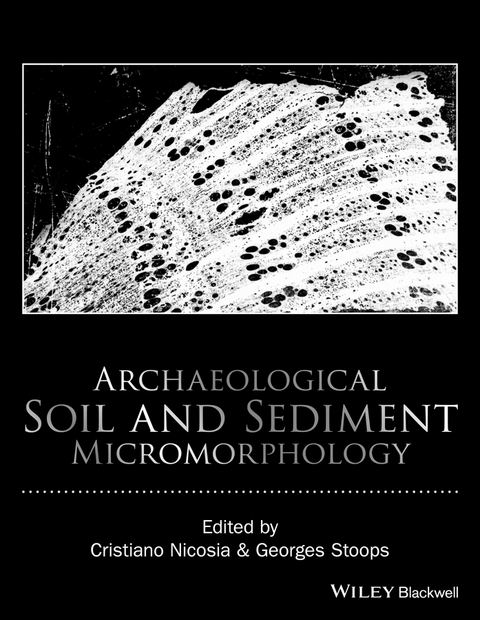
Archaeological Soil and Sediment Micromorphology (eBook)
John Wiley & Sons (Verlag)
978-1-118-94108-9 (ISBN)
Archaeological Soil and Sediment Micromorphology goes beyond a mere review of current literature and features the most up to date contributions from numerous scientists working in the field. The book represents a groundbreaking and comprehensive resource covering the plethora of applications of micromorphology in archaeology. Archaeological Soil and Sediment Micromorphology offers researchers, students and professionals a systematic tool for the interpretation of thin sections of archaeological contexts.
This important resource is also designed to help stimulate the use of micromorphology in archaeology outside Europe, where the technique is less frequently employed. Moreover, the authors hope to strengthen the proper application of soil micromorphology in archaeology, by illustrating its possibilities and referring in several cases to more specialized publications (for instance in the field of plant remains, pottery and phytoliths). Written for anyone interested in the topic, this important text offers:
- Contributions from most of the world's leading authorities on soil micromorphology
- A series of chapters on the major topics selected among the most recurrent in literature about archaeological soil micromorphology
- Systematic descriptions of all important micromorphological features
- Special analytical tools employed on thin sections, such as SEM/EDS, image analysis, fluorescence microscopy, mass spectrometry, among others
- Numerous cross-references
- 400 illustrated full-colour plates
The resource provides the most current and essential information for archaeologists, geoarchaeologists, soil scientists and sedimentologists. Comprehensive in scope, Archaeological Soil and Sediment Micromorphology offers professionals and students a much-needed tool for the interpretation of thin sections of archaeological contexts.
Dr. Cristiano Nicosia, Centre de Recherches en Archéologie et Patrimoine, Universitè Libre de Bruxelles, Belgium
Em. Prof. Dr. Georges Stoops, Vakgroep Geologie, Universiteit Gent, Belgium
Archaeological Soil and Sediment Micromorphology goes beyond a mere review of current literature and features the most up to date contributions from numerous scientists working in the field. The book represents a groundbreaking and comprehensive resource covering the plethora of applications of micromorphology in archaeology. Archaeological Soil and Sediment Micromorphology offers researchers, students and professionals a systematic tool for the interpretation of thin sections of archaeological contexts. This important resource is also designed to help stimulate the use of micromorphology in archaeology outside Europe, where the technique is less frequently employed. Moreover, the authors hope to strengthen the proper application of soil micromorphology in archaeology, by illustrating its possibilities and referring in several cases to more specialized publications (for instance in the field of plant remains, pottery and phytoliths). Written for anyone interested in the topic, this important text offers: Contributions from most of the world's leading authorities on soil micromorphology A series of chapters on the major topics selected among the most recurrent in literature about archaeological soil micromorphology Systematic descriptions of all important micromorphological features Special analytical tools employed on thin sections, such as SEM/EDS, image analysis, fluorescence microscopy, mass spectrometry, among others Numerous cross-references 400 illustrated full-colour plates The resource provides the most current and essential information for archaeologists, geoarchaeologists, soil scientists and sedimentologists. Comprehensive in scope, Archaeological Soil and Sediment Micromorphology offers professionals and students a much-needed tool for the interpretation of thin sections of archaeological contexts.
Dr. Cristiano Nicosia, Centre de Recherches en Archéologie et Patrimoine, Universitè Libre de Bruxelles, Belgium Em. Prof. Dr. Georges Stoops, Vakgroep Geologie, Universiteit Gent, Belgium
"An impressive and appealing handbook and sourcebook on the materials, problems, techniques, achievement, and prospects of the subject." Geoscientist Online
Contributors
Ivana Angelini
Dipartimento dei Beni Culturali
Università degli Studi di Padova
Italy
ivana.angelini@unipd.it
Diego E. Angelucci
Dipartimento di Lettere e Filosofia
Università degli Studi di Trento
Italy
diego.angelucci@unitn.it
Manuel Arroyo‐Kalin
Institute of Archaeology
University College London
London
United Kingdom
m.arroyo‐kalin@ucl.ac.uk
Gilberto Artioli
CIRCe Centre, Università di Padova, Italy
and
Dipartimento di Geoscienze
Università degli Studi di Padova
Via G. Gradenigo 6
35131 Padova
Italy
gilberto.artioli@unipd.it
Francesco Berna
Department of Archaeology
Simon Fraser University
Burnaby
Canada
francesco_berna@sfu.ca
Christoph Berthold
Competence Center Archaeometry – Baden‐Wuerttemberg (CCA‐BW)
Applied Mineralogy
Department of Geosciences
University of Tübingen
Tübingen
Germany
christoph.berthold@uni‐tuebingen.de
Jacques Élie Brochier
Aix‐Marseille Université (AMU)
UMR 7269 LAMPEA
Aix‐en‐Provence
France
jacques.brochier@univ‐amu.fr
David Brönnimann
IPAS – Integrative Prehistory and Archaeological Science
University of Basel
Switzerland
david.broennimann@unibas.ch
Matthew G. Canti
Historic England
Eastney
United Kingdom
Matthew.Canti@historicengland.org.uk
Judit Deák
Office du Patrimoine et de l’Archéologie Neuchâtel
Section Archéologie
Switzerland
judit.deak@ne.ch
Yannick Devos
Centre de Recherches en Archéologie et Patrimoine
Université Libre de Bruxelles
Bruxelles, Belgium
yadevos@ulb.ac.be
Carlo Dietl
Gesteinslabor Dr. Eberhard Jahns
Heilbad Heiligenstadt
Germany
dietl@gesteinslabor.de
Natàlia Égüez
Institute for Pre‐and Protohistoric Archaeology
Christian‐Albrechts‐Universität zu Kiel
Germany
neguez@gshdl.uni‐kiel.de
David E. Friesem
McDonald Institute for Archaeological Research
University of Cambridge
United Kingdom
df360@cam.ac.uk
Anne Gebhardt
UMR 7362, LIVE, Équipe Dynamique des Paysages
Université de Strasbourg, INRAP
France
anne.gebhardt‐even@inrap.fr
Paul Goldberg
Department of Archaeology
Boston University
Boston
USA
Institute for Archaeological Sciences
University of Tübingen
Germany
School of Earth and Environmental Sciences
University of Wollongong
New South Wales
Australia
paulberg@bu.edu
Dirk J. Huisman
Cultural Heritage Agency of the Netherlands
Amersfoort
The Netherlands
H.Huisman@cultureelerfgoed.nl
Kristin Ismail‐Meyer
IPAS – Integrative Prehistory and Archaeological Science
University of Basel
Switzerland
kristin.meyer@unibas.ch
Miranda M. Jans
JOINT POW/MIA
Accounting Command Central Identification Laboratory
JBPHH, HI
USA
Miranda.m.jans.civ@mail.mil
Selim Kapur
Department of Archaeometry
University of Çukurova
Adana
Turkey
kapurs@cu.edu.tr
Panagiotis Karkanas
The Malcolm H. Wiener Laboratory for Archaeological Science
American School of Classical Studies
Athens
Greece
tkarkanas@ascsa.edu.gr
Matthieu Le Bailly
University of Bourgogne Franche‐Comte
CNRS UMR Chrono‐environment
Besançon cedex
France
matthieu.lebailly@univ‐fcomte.fr
Heejin Lee
Department of Archaeology and Art History
Korea Institute for Archaeology and Environment
Korea University
South Korea
ddangpa@korea.ac.kr
Helen Lewis
School of Archaeology
University College Dublin
Republic of Ireland
helen.lewis@ucd.ie
Bertrand Ligouis
Institut für Naturwissenschaftliche Archäologie Abt. Organische Petrologie
Eberhard‐Karls‐Universität Tübingen
Tübingen, Germany
and
Labor für Angewandte Organische Petrologie – LAOP
Eberhard‐Karls‐Universiät Tu¨ingen
Tübingen
Germany
bertrand.ligouis@uni‐tuebingen.de
Lenka Lisá
Institute of Geology
Czech Academy of Science
Czech Republic
lisa@gli.cas.cz
Richard I. Macphail
Institute of Archaeology
University College London
London
United Kingdom
r.macphail@ucl.ac.uk
Carolina Mallol
Departamento de Geografía e Historia
Universidad de La Laguna
Campus de Guajara
Tenerife
Spain
Instituto Universitario de Bio‐Orgánica Antonio González
La Laguna
Campus de GuajaraTenerife
Spain
cmallol@ull.es
Lara Maritan
Dipartimento di Geoscienze
Università di Padova
Italy
lara.maritan@unipd.it
Susan M. Mentzer
Institute for Archaeological Sciences
University of Tübingen
Tübingen
Germany
School of Anthropology
University of Arizona
Tucson
USA
susan.mentzer@ifu.uni‐tuebingen.de
and
Senckenberg Centre for Human Evolution and Paleoenvironment
University of Tübingen
Tübingen
Germany
Karen B. Milek
Department of Archaeology
School of Geosciences
University of Aberdeen
United Kingdom
k.milek@abdn.ac.uk
Christopher E. Miller
Institute for Archaeological Sciences
University of Tübingen
Tübingen
Germany
and
Senckenberg Centre for Human Evolution and Paleoenvironment
University of Tübingen
Tübingen
Germany
christopher.miller@uni‐tuebingen.de
Dominique J. M. Ngan‐Tillard
Section Geo Engineering
Department of Geoscience and Engineering
Delft University of Technology
The Netherlands
d.j.m.ngan‐tillard@tudelft.nl
Cristiano Nicosia
Centre de Recherches en Archéologie et Patrimoine
Université Libre de Bruxelles
Belgium
cristianonicosia@gmail.com
Marylise Onfray
Département DMOS
Agro‐Paris‐Tech
Thiverval‐Grignon
France
onfray.marylise@live.fr
Université Paris 1‐ Panthéon‐Sorbonne
UMR 8215 ‐ Trajectoires
France
Ákos Pető
Institute of Nature Conservation and Landscape Management
Department of Nature Conservation and Landscape Ecology
Gödöllő
Hungary
peto.akos@mkk.szie.hu
Sandra Pichler
IPAS – Integrative Prehistory and Archaeological Science
University of Basel
Switzerland
sandra.pichler@unibas.ch
Christine Pümpin
IPAS – Integrative Prehistory and Archaeological Science
University of Basel
Switzerland
christine.puempin@unibas.ch
Philippe Rentzel
IPAS – Integrative Prehistory and Archaeological Science
University of Basel
Switzerland
philippe.rentzel@unibas.ch
Astrid Röpke
Labor für Archäobotanik
Ur‐ und Frühgeschichte
Universität zu Köln
Germany
astrid.roepke@uni‐koeln.de
Koen Sabbe
Protistology and Aquatic Ecology
Universiteit Gent
Belgium
Koen.sabbe@ugent.be
Ruth Shahack‐Gross
Laboratory for Sedimentary Archaeology
Department of Maritime Civilizations
University of Haifa
Israel
rgross@univ.haifa.ac.il
Lisa‐Marie Shillito
School of History, Classics and Archaeology
Faculty of Humanities and Social Sciences
Newcastle University
United Kingdom
lisa‐marie.shillito@ncl.ac.uk
Georges Stoops
Vakgroep Geologie
Faculteit Wetenschappen
Universiteit Gent
Belgium
georges.stoops@UGent.be
Alexander Tsatskin
Zinman Institute of Archaeology
University of Haifa
Haifa
Israel
tsatskin@research.haifa.ac.il
Maria Raimonda Usai
Department of Architecture and Design
University of Sassari
Alghero
Italy
Mariaraimonda.usai@gmail.com
Elie Verleyen
Protistology and Aquatic Ecology
Universiteit Gent
Belgium
elie.verleyen@ugent.be
Ximena S. Villagran
Museum of Archaeology and Ethnology
University of Sao Paulo
Brazil
villagran@usp.br
Luc Vrydaghs
Centre de Recherches en Archéologie et Patrimoine Université Libre de Bruxelles
Bruxelles,...
| Erscheint lt. Verlag | 10.8.2017 |
|---|---|
| Sprache | englisch |
| Themenwelt | Geisteswissenschaften ► Archäologie |
| Geschichte ► Allgemeine Geschichte ► Vor- und Frühgeschichte | |
| Naturwissenschaften ► Geowissenschaften ► Geologie | |
| Weitere Fachgebiete ► Land- / Forstwirtschaft / Fischerei | |
| Schlagworte | Archaeological Soil and Sediment Micromorphology • archaeologists and micromorphology • archaeology • Archaeology Special Topics • Archäologie • archeological deposits • Bodenkunde • Bodenkunde, Geoarchäologie • comprehensive coverage of micromorphology • Cristiano Nicosia • earth sciences • experts on micromorphology • Georges R. Stoops • Geowissenschaften • image analysis of soil deposits • micromorphological features • micromorphology in archaeology • Mikromorphologie • Plant remains • pottery and phytoliths • Quartärforschung • Quartärforschung, Glaziologie • Quaternary Science & Glaciology • sedimentologists micromorphology • Soil micromorphology • Soil Science & Geoarchaeology • soil scientists micromorphology • Spezialthemen Archäologie • study of archeological deposits • Study of micromorphology • study of micromorphology in Asia • study of micromorphology in Europe • study of micromorphology in North America • Topics on micromorphology |
| ISBN-10 | 1-118-94108-X / 111894108X |
| ISBN-13 | 978-1-118-94108-9 / 9781118941089 |
| Informationen gemäß Produktsicherheitsverordnung (GPSR) | |
| Haben Sie eine Frage zum Produkt? |
 EPUB (Adobe DRM)
Kopierschutz: Adobe-DRM
Adobe-DRM ist ein Kopierschutz, der das eBook vor Mißbrauch schützen soll. Dabei wird das eBook bereits beim Download auf Ihre persönliche Adobe-ID autorisiert. Lesen können Sie das eBook dann nur auf den Geräten, welche ebenfalls auf Ihre Adobe-ID registriert sind.
Details zum Adobe-DRM
Dateiformat: EPUB (Electronic Publication)
EPUB ist ein offener Standard für eBooks und eignet sich besonders zur Darstellung von Belletristik und Sachbüchern. Der Fließtext wird dynamisch an die Display- und Schriftgröße angepasst. Auch für mobile Lesegeräte ist EPUB daher gut geeignet.
Systemvoraussetzungen:
PC/Mac: Mit einem PC oder Mac können Sie dieses eBook lesen. Sie benötigen eine
eReader: Dieses eBook kann mit (fast) allen eBook-Readern gelesen werden. Mit dem amazon-Kindle ist es aber nicht kompatibel.
Smartphone/Tablet: Egal ob Apple oder Android, dieses eBook können Sie lesen. Sie benötigen eine
Geräteliste und zusätzliche Hinweise
Buying eBooks from abroad
For tax law reasons we can sell eBooks just within Germany and Switzerland. Regrettably we cannot fulfill eBook-orders from other countries.
aus dem Bereich