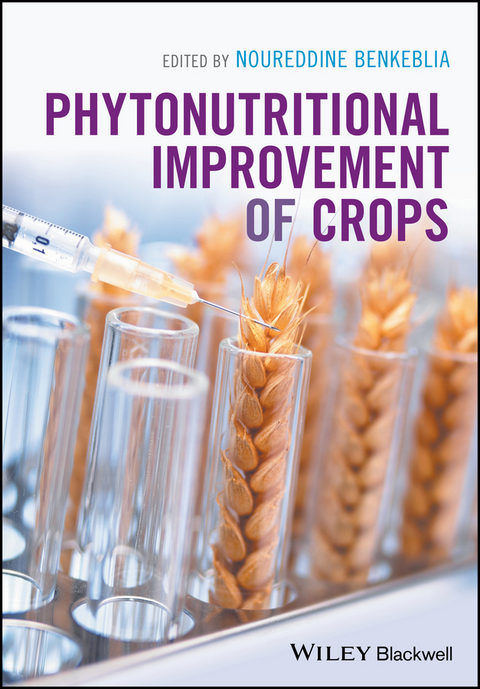
An in-depth treatment of cutting-edge work being done internationally to develop new techniques in crop nutritional quality improvement
Phytonutritional Improvement of Crops explores recent advances in biotechnological methods for the nutritional enrichment of food crops. Featuring contributions from an international group of experts in the field, it provides cutting-edge information on techniques of immense importance to academic, professional and commercial operations.
World population is now estimated to be 7.5 billion people, with an annual growth rate of nearly 1.5%. Clearly, the need to enhance not only the quantity of food produced but its quality has never been greater, especially among less developed nations. Genetic manipulation offers the best prospect for achieving that goal. As many fruit crops provide proven health benefits, research efforts need to be focused on improving the nutritional qualities of fruits and vegetables through increased synthesis of lycopene and beta carotene, anthocyanins and some phenolics known to be strong antioxidants. Despite tremendous growth in the area occurring over the past several decades, the work has only just begun. This book represents an effort to address the urgent need to promote those efforts and to mobilise the tools of biotechnical and genetic engineering of the major food crops. Topics covered include:
- New applications of RNA-interference and virus induced gene silencing (VIGS) for nutritional genomics in crop plants
- Biotechnological techniques for enhancing carotenoid in crops and their implications for both human health and sustainable development
- Progress being made in the enrichment and metabolic profiling of diverse carotenoids in a range of fruit crops, including tomatoes, sweet potatoes and tropical fruits
- Biotechnologies for boosting the phytonutritional values of key crops, including grapes and sweet potatoes
- Recent progress in the development of transgenic rice engineered to massively accumulate flavonoids in-seed
Phytonutritional Improvement of Crops is an important text/reference that belongs in all universities and research establishments where agriculture, horticulture, biological sciences, and food science and technology are studied, taught and applied.
Noureddine Benkeblia, PhD is Professor of Crop Science in the Department of Life Sciences, the University of the West Indies, Jamaica. He is involved in food science research focusing on food-plant biochemistry and physiology, and he is recognised internationally for his work on pre- and postharvest metabolism in crops. Prof. N. Benkeblia is the recipient of many awards, among them the UWI-Award for the 'Most Outstanding Research,' 2011 and 2013.
An in-depth treatment of cutting-edge work being done internationally to develop new techniques in crop nutritional quality improvement Phytonutritional Improvement of Crops explores recent advances in biotechnological methods for the nutritional enrichment of food crops. Featuring contributions from an international group of experts in the field, it provides cutting-edge information on techniques of immense importance to academic, professional and commercial operations. World population is now estimated to be 7.5 billion people, with an annual growth rate of nearly 1.5%. Clearly, the need to enhance not only the quantity of food produced but its quality has never been greater, especially among less developed nations. Genetic manipulation offers the best prospect for achieving that goal. As many fruit crops provide proven health benefits, research efforts need to be focused on improving the nutritional qualities of fruits and vegetables through increased synthesis of lycopene and beta carotene, anthocyanins and some phenolics known to be strong antioxidants. Despite tremendous growth in the area occurring over the past several decades, the work has only just begun. This book represents an effort to address the urgent need to promote those efforts and to mobilise the tools of biotechnical and genetic engineering of the major food crops. Topics covered include: New applications of RNA-interference and virus induced gene silencing (VIGS) for nutritional genomics in crop plants Biotechnological techniques for enhancing carotenoid in crops and their implications for both human health and sustainable development Progress being made in the enrichment and metabolic profiling of diverse carotenoids in a range of fruit crops, including tomatoes, sweet potatoes and tropical fruits Biotechnologies for boosting the phytonutritional values of key crops, including grapes and sweet potatoes Recent progress in the development of transgenic rice engineered to massively accumulate flavonoids in-seed Phytonutritional Improvement of Crops is an important text/reference that belongs in all universities and research establishments where agriculture, horticulture, biological sciences, and food science and technology are studied, taught and applied.
Noureddine Benkeblia, PhD is Professor of Crop Science in the Department of Life Sciences, the University of the West Indies, Jamaica. He is involved in food science research focusing on food-plant biochemistry and physiology, and he is recognised internationally for his work on pre- and postharvest metabolism in crops. Prof. N. Benkeblia is the recipient of many awards, among them the UWI-Award for the "Most Outstanding Research," 2011 and 2013.
List of Contributors
- Mukhtar Ahmad
- Department of Agronomy
- PMAS-Arid Agriculture University Rawalpindi
- Punjab, Pakistan
- Seetharam Annadana
- Technology Lead for an MNC
- Krishi, 29, CR Layout
- Sarakki Main Road
- Bengaluru
- India
- Bangalore Prabhashankar Arathi
- Department of Biotechnology
- Jnana Bharathi Campus
- Bangalore University
- Bengaluru, India
- Muhammad Asif
- Department of Agricultural
- Food and Nutritional Science
- University of Alberta
- Edmonton, AB, Canada
- Atanas Atanassov
- JGC, Sofia
- Bulgaria
- Ilian Badjakov
- Agrobioinstitute
- Sofia
- Bulgaria
- Vallikannan Baskaran
- Department of Biochemistry and Nutrition
- CSIR-Central Food Technological Research Institute
- Mysuru
- India
- Saikat Kumar Basu
- Department of Biological Sciences
- University of Lethbridge
- Lethbridge, AB
- Canada
- Avik Basu
- Calcutta Medical College
- Kolkata, WB
- India
- Noureddine Benkeblia
- Laboratory of Crop Science
- Department of Life Sciences
- The University of the West Indies
- Mona campus
- Kingston
- Jamaica
- Congxi Cai
- Department of Horticulture
- Zhejiang University
- Hangzhou, Zhejiang
- China
- William Cetzal-Ix
- Instituto Tecnológico de Chiná
- Calle 11 entre 22 y 28
- Colonia Centro Chiná 24050
- Campeche
- México
- Jiaqi Chang
- Department of Horticulture
- Zhejiang University
- Hangzhou, Zhejiang
- China
- Dai-Fu Ma
- Xuzhou Sweetpotato Research Center
- Xuzhou Academy of Agricultural Science
- Xuzhou, Jiangsu
- China
- Mingdan Deng
- Department of Horticulture
- Zhejiang University
- Hangzhou, Zhejiang
- China
- Danapati Dhungyel
Renewable Natural Resources Research and Development Centre (RNR RDC)
Wengkhar
Mongar, Bhutan
- Ivayla Dincheva
- Agrobioinstitute
- Sofia
- Bulgaria
- Teodora Dzhambazova
- Agrobioinstitute
- Sofia
- Bulgaria
- Vasil Georgiev
- Center for Viticulture and Small Fruit Research
- College of Agriculture and Food Science
- Florida A&M University
- Tallahassee, FL
- USA
- Arvind Hirani
- Department of Plant Science
- University of Manitoba
- Winnipeg, MB
- Canada
- Tshitila Jongthap
Medicinal and Aromatic Plants
Renewable Natural Resources Research and Development Centre (RNR RDC) Yusipang
Ministry of Agriculture and Forests
Government of Bhutan
Thimphu, Bhutan
- Miroslava Kakalova
- University of Food Technologies
- Plovdiv
- Bulgaria
- Ivanka Kamenova
- Agrobioinstitute
- Sofia
- Bulgaria
- Rajan Katoch
- Biochemistry Laboratory Department of Crop Improvement
- CSKHPKV, Palampur
- India
- George G. Khachatourians
- Departments of Food and Bioproduct Sciences
- College of Agriculture and Bioresources
- University of Saskatchewan
- Saskatoon
- Canada
- Rangaswamy Lakshminarayana
- Department of Biotechnology
- Jnana Bharathi Campus
- Bangalore University
- Bengaluru
- India
- Xianping Li
- Industrial Crop Research Institute
- Yunnan Academy of Agricultural Sciences
- Kunming, Yunnan
- China
- Yanshan Li
- Industrial Crop Research Institute
- Yunnan Academy of Agricultural Sciences
- Kunming, Yunnan
- China
- Shuo Li
- Department of Horticulture
- Zhejiang University
- Hangzhou, Zhejiang
- China
- Marta R.M. Lima
- CBQF-Centro de Biotecnologia e Química Fina
- Escola Superior de Biotecnologia
- Universidade Católica Portuguesa
- Porto, Portugal
- Yuanyuan Liu
- Department of Horticulture
- Zhejiang University
- Hangzhou, Zhejiang
- China
- Lihong Liu
- Department of Horticulture
- Zhejiang University
- Hangzhou, Zhejiang
- China
- Haoran Liu
- Department of Horticulture
- Zhejiang University
- Hangzhou, Zhejiang
- China
- Tianyu Liu
- Department of Horticulture
- Zhejiang University
- Hangzhou, Zhejiang
- China
- Ambrose Obongo Mbuya
- Department of Theology
- Great Lakes University of Kisumu (GLUK)-Kenya
- Kisumu
- Kenya
- Huiying Miao
- Department of Horticulture
- Zhejiang University
- Hangzhou, Zhejiang
- China
- Dasha Mihaylova
- University of Food Technologies
- Plovdiv
- Bulgaria
- Plamen Mollov
- University of Food Technologies
- Plovdiv
- Bulgaria
- Yuko Ogo
- National Institute of Agrobiological Sciences
- Transgenic Crop Research and Development Center
- Kannondai, Tsukuba, Ibaraki
- Japan
- Basavaprabhu L. Patil
- Senior Scientists
- National Research Center on Plant Biotechnology
- Pusa, New Delhi
- India
- Atanas Pavlov
- University of Food Technologies
- Plovdiv, Bulgaria
- Hongmei Qian
- Department of Horticulture
- Zhejiang University
- Hangzhou, Zhejiang
- China
- Chavali Kameswara Rao
- Foundation for Biotechnology Awareness and Education
- Bangalore
- India
- Muhammad Sajad
- Department of Plant Breeding and Genetics
- University College of Agriculture and Environmental Sciences
- The Islamia University of Bahawalpur
- Punjab
- Pakistan
- Carla S. Santos
- CBQF-Centro de Biotecnologia e Química Fina
- Escola Superior de Biotecnologia
- Universidade Católica Portuguesa
- Porto, Portugal
- Ratnabali Sengupta
- Department of Zoology
- WB State University
- Barasat, WB
- India
- Zhiyong Shao
- Department of Horticulture
- Zhejiang University
- Hangzhou, Zhejiang
- China
- Yan-Xi Shi
- Qingdao Agricultural University
- Chengyang, Qingdao
- Shandong, China
- Sunil Kumar Singh
National Research Centre on Plant Biotechnology
IARI, New DelhiIndia
- Subodh Kumar Sinha
- Senior Scientists
- National Research Center on Plant Biotechnology
- Pusa, New Delhi
- India
- Francisco Solorio-Sánchez
- Campus de Ciencias Biológicas y Agropecuarias
Universidad Autónoma de Yucatán - Mérida, Yucatán
- México
- Poorigali Raghavendra-Rao Sowmya
- Department of Biotechnology
- Jnana Bharathi Campus
- Bangalore University
- Bengaluru, India
- Bo Sun
- Department of Horticulture
- Zhejiang University
- Hangzhou, Zhejiang
- China
- Fumio Takaiwa
- National Institute of Agrobiological Sciences
- Transgenic Crop Research and Development Center
- Tsukuba,...
| Erscheint lt. Verlag | 25.7.2017 |
|---|---|
| Sprache | englisch |
| Themenwelt | Naturwissenschaften ► Biologie |
| Technik ► Umwelttechnik / Biotechnologie | |
| Weitere Fachgebiete ► Land- / Forstwirtschaft / Fischerei | |
| Schlagworte | Agriculture • biotechnological techniques for improved anthocyanains synthesis • biotechnological techniques for improved carotenoid synthesis • biotechnological techniques for improved phenolic synthesis • biotechnological techniques for improving crop nutrition • biotechnological techniques for improving the nutritional qualities of fruits and vegetables • biotechnological techniques for increased lycopene synthesis • Biowissenschaften • Botanik • Botanik / Biotechnologie • breakthrough in crop plant dna splicing • breakthroughs in gm crops • crops • Feldfrüchte • food biotechnology • Food Science & Technology • genetically modified fruits • genetically modified vegetables • genetic manipulation for enhanced nutrition • genetic manipulation of fruits • genetic manipulation of vegetables • Landwirtschaft • Lebensmittel • Lebensmittel / Biotechnologie • Lebensmittelforschung u. -technologie • Life Sciences • metabolic profiling of carotenoids in fruits • metabolic profiling of carotenoids in vegetables • Nutritional genomics • nutritionally enhanced sweet potatoes • nutritionally enhanced tropical fruits • Pflanzliches Lebensmittel • phytonutritional improvement of crops • Plant Biotechnology • Transgenic rice |
| ISBN-10 | 1-119-07998-5 / 1119079985 |
| ISBN-13 | 978-1-119-07998-9 / 9781119079989 |
| Informationen gemäß Produktsicherheitsverordnung (GPSR) | |
| Haben Sie eine Frage zum Produkt? |
 EPUB (Adobe DRM)
Kopierschutz: Adobe-DRM
Adobe-DRM ist ein Kopierschutz, der das eBook vor Mißbrauch schützen soll. Dabei wird das eBook bereits beim Download auf Ihre persönliche Adobe-ID autorisiert. Lesen können Sie das eBook dann nur auf den Geräten, welche ebenfalls auf Ihre Adobe-ID registriert sind.
Details zum Adobe-DRM
Dateiformat: EPUB (Electronic Publication)
EPUB ist ein offener Standard für eBooks und eignet sich besonders zur Darstellung von Belletristik und Sachbüchern. Der Fließtext wird dynamisch an die Display- und Schriftgröße angepasst. Auch für mobile Lesegeräte ist EPUB daher gut geeignet.
Systemvoraussetzungen:
PC/Mac: Mit einem PC oder Mac können Sie dieses eBook lesen. Sie benötigen eine
eReader: Dieses eBook kann mit (fast) allen eBook-Readern gelesen werden. Mit dem amazon-Kindle ist es aber nicht kompatibel.
Smartphone/Tablet: Egal ob Apple oder Android, dieses eBook können Sie lesen. Sie benötigen eine
Geräteliste und zusätzliche Hinweise
Buying eBooks from abroad
For tax law reasons we can sell eBooks just within Germany and Switzerland. Regrettably we cannot fulfill eBook-orders from other countries.
aus dem Bereich