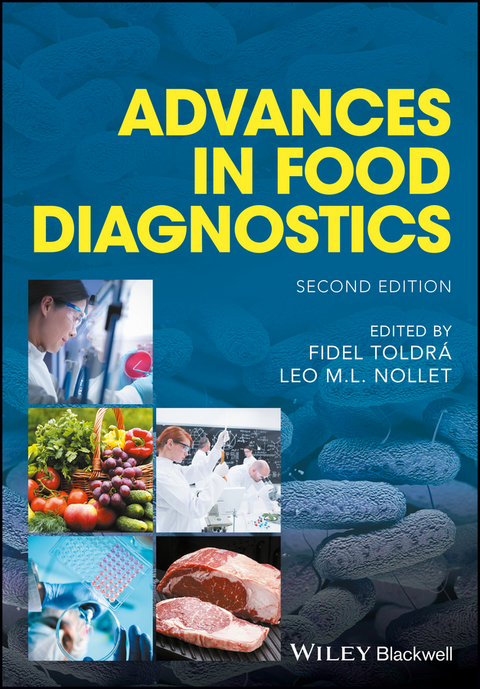
Advances in Food Diagnostics (eBook)
John Wiley & Sons (Verlag)
978-1-119-10590-9 (ISBN)
Still the most up-to-date, comprehensive, and authoritative book on food diagnostics available
Featuring seven entirely new chapters, the second edition of this critically acclaimed guide has been extensively revised and updated. Once again delivering food professionals the latest advances in food diagnostics and analysis, the book approaches the topic in several different ways: reviewing novel technologies to evaluate fresh products; describing and analysing in depth specific modern diagnostics; providing analyses of data processing; and discussing global marketing, with insights into future trends.
Written by an international team of experts, this volume not only covers most conventional lab-based analytical methods, but also focuses on leading-edge technologies which are being or are about to be introduced.
Advances in Food Diagnostics, Second Edition:
- Covers ultrasound, RMN, chromatography, electronic noses, immunology, GMO detection and microbiological and molecular methodologies for rapid detection of pathogens
- Explores the principles and applications of immunodiagnostics in food safety and the use of molecular biology to detect and characterize foodborne pathogens
- Includes DNA-based and protein-based technologies to detect and identify genetically-modified food or food components
- Focuses on the translation of diagnostics tests from bench to the market in order to illustrate the benefits to the food industry
- Provides an overview of the business end of food diagnostics; identifying the markets, delineating the sellers and the buyers, comparing current technology with traditional methods, certifying operations and procedures, and analysing diagnostic devices within the food and related industries
This is an indispensable resource for food scientists, food quality analysts, food microbiologists and food safety professionals. It also belongs on the reference shelves of labs conducting food diagnostics for the analysis of the sensory, quality and safety aspects of food.
FIDEL TOLDRÁ, PhD, is a Research Professor at the Department of Food Science, Instituto de Agroquímica y Tecnología de Alimentos (CSIC), Spain. He serves as European Editor of Trends in Food Science and Technology. His research interests are devoted to food biochemistry and analysis, especially focused on foods of animal origin.
LEO M.L. NOLLET, PhD, is a retired professor of University College Ghent, Belgium. His research interests are in the domain of food analysis, chromatography, and analysis of environmental parameters.
Still the most up-to-date, comprehensive, and authoritative book on food diagnostics available Featuring seven entirely new chapters, the second edition of this critically acclaimed guide has been extensively revised and updated. Once again delivering food professionals the latest advances in food diagnostics and analysis, the book approaches the topic in several different ways: reviewing novel technologies to evaluate fresh products; describing and analysing in depth specific modern diagnostics; providing analyses of data processing; and discussing global marketing, with insights into future trends. Written by an international team of experts, this volume not only covers most conventional lab-based analytical methods, but also focuses on leading-edge technologies which are being or are about to be introduced. Advances in Food Diagnostics, Second Edition: Covers ultrasound, RMN, chromatography, electronic noses, immunology, GMO detection and microbiological and molecular methodologies for rapid detection of pathogens Explores the principles and applications of immunodiagnostics in food safety and the use of molecular biology to detect and characterize foodborne pathogens Includes DNA-based and protein-based technologies to detect and identify genetically-modified food or food components Focuses on the translation of diagnostics tests from bench to the market in order to illustrate the benefits to the food industry Provides an overview of the business end of food diagnostics; identifying the markets, delineating the sellers and the buyers, comparing current technology with traditional methods, certifying operations and procedures, and analysing diagnostic devices within the food and related industries This is an indispensable resource for food scientists, food quality analysts, food microbiologists and food safety professionals. It also belongs on the reference shelves of labs conducting food diagnostics for the analysis of the sensory, quality and safety aspects of food.
FIDEL TOLDRÁ, PhD, is a Research Professor at the Department of Food Science, Instituto de Agroquímica y Tecnología de Alimentos (CSIC), Spain. He serves as European Editor of Trends in Food Science and Technology. His research interests are devoted to food biochemistry and analysis, especially focused on foods of animal origin. LEO M.L. NOLLET, PhD, is a retired professor of University College Ghent, Belgium. His research interests are in the domain of food analysis, chromatography, and analysis of environmental parameters.
List of Contributors
- Uroš Andjelković
- Department of Biotechnology
- University of Rijeka
- Croatia
- M-Concepción Aristoy
- Instituto de Agroquímica y Tecnología de
- Alimentos (CSIC)
- Valencia
- Spain
- António S. Barros
- Departamento de Química & QOPNA
- Universidade de Aveiro
- Portugal
- Spyridoula M. Bratakou
- Laboratory of Inorganic and Analytical
- Chemistry
- School of Chemical Engineering
- National Technical University of Athens
- Athens
- Greece
- Mark Buecking
- Fraunhofer Institute for Molecular Biology and Applied Ecology IME
- Auf dem Aberg 1
- Schmallenberg-Grafschaft
- Germany
- Ulrich Busch
- Bavarian Health and Food Safety
- Authority (LGL)
- Molecular Biology Unit
- Oberschleißheim
- Germany
- G. Castillo
- Faculty of Mathematics, Physics and
- Informatics
- Comenius University in Bratislava
- Bratislava
- Slovakia
- Manuel A. Coimbra
- Departamento de Química & QOPNA
- Universidade de Aveiro
- Portugal
- Sara Corral
- Instituto de Agroquímica y Tecnología de
- Alimentos (CSIC)
- Valencia
- Spain
- Luís G. Dias
- Escola Superior Agrária
- Instituto Politécnico de Bragança
- Campus Santa Apolónia
- Bragança
- Portugal
and
- CQ-VR
- Centro de Química – Vila Real
- University of Trás-os-Montes e Alto Douro
- Vila Real
- Portugal
- Geraldine Duffy
- Teagasc Food Research Centre
- Teagasc
- Ashtown
- Dublin
- Ireland
- Anastasios Economou
- Laboratory of Analytical Chemistry
- Department of Chemistry
- University of Athens
- Athens
- Greece
- Karl-Heinz Engel
- Technische Universität München
- Center of Food and Life Sciences
- Freising-Weihenstephan
- Germany
- Madeshwari Ezhilan
- Nano Sensors Lab @ Centre for Nano
- Technology & Advanced Biomaterials
- (CeNTAB)
- School of Electrical & Electronics
- Engineering (SEEE)
- SASTRA University
- Tamil Nadu
- India
- Mónica Flores
- Instituto de Agroquímica y Tecnología de
- Alimentos (CSIC)
- Valencia
- Spain
- Z. Garaiova
- Faculty of Mathematics, Physics and
- Informatics
- Comenius University in Bratislava
- Bratislava
- Slovakia
- Patrick Guertler
- Bavarian Health and Food Safety
- Authority (LGL)
- Molecular Biology Unit
- Oberschleißheim
- Germany
- Alexandra Hahn
- GALAB Laboratories GmbH
- Hamburg
- Germany
- Kati Hanhineva
- Univ Eastern Finland
- Institute of Public Health & Clinical Nutrition
- Kuopio
- Finland
- T. Hianik
- Faculty of Mathematics, Physics and
- Informatics
- Comenius University in Bratislava
- Bratislava
- Slovakia
- Hans Hoogland
- LEMKEN Nederland B.V., Zeewolde The Netherlands
- Djuro Josić
- Department of Biotechnology
- University of Rijeka
- Croatia
- and
- Warren Alpert Medical School
- Brown University
- Providence
- Rhode Island
- USA
- Stephanos K. Karapetis
- Laboratory of Inorganic and Analytical
- Chemistry
- School of Chemical Engineering
- National Technical University of Athens
- Athens
- Greece
- Canan Kartal
- Ege University
- Faculty of Engineering
- Department of Food Engineering
- Bornova
- Izmir
- Turkey
- Arockia Jayalatha Kulandaisamy
- Nano Sensors Lab @ Centre for Nano
- Technology & Advanced Biomaterials
- (CeNTAB)
- School of Electrical & Electronics
- Engineering (SEEE)
- SASTRA University
- Tamil Nadu
- India
- Riccardo Leardi
- Department of Pharmacy
- University of Genova
- Genova
- Italy
- Huub Lelieveld
- Ensahlaan, HT Bilthoven The Netherlands
- Catherine M. Logue
- Department of Veterinary Microbiology
- and Preventive Medicine
- Iowa State University
- Ames
- USA
- Ganesh Kumar Mani
- Nano Sensors Lab @ Centre for Nano
- Technology & Advanced Biomaterials
- (CeNTAB)
- School of Electrical & Electronics
- Engineering (SEEE)
- SASTRA University
- Tamil Nadu
- India
- and
- Micro/Nano Technology Center
- Tokai University
- Japan
- Tamara Martinović
- Department of Biotechnology
- University of Rijeka
- Croatia
- Cátia Martins
- Departamento de Química & QOPNA
- Universidade de Aveiro
- Portugal
- Chantal W. Nde
- Food Safety and Microbiology
- Kraft Heinz Company
- Northfield
- USA
- Georgia-Paraskevi Nikoleli
- Laboratory of Inorganic and Analytical
- Chemistry
- School of Chemical Engineering
- National Technical University of Athens
- Athens
- Greece
- Dimitrios P. Nikolelis
- Laboratory of Environmental Chemistry
- Department of Chemistry
- University of Athens
- Athens
- Greece
- Semih Otles
- Ege University
- Faculty of Engineering
- Department of Food Engineering
- Bornova
- Izmir
- Turkey
- Sandra Kraljević Pavelić
- Department of Biotechnology
- University of Rijeka
- Croatia
- António M. Peres
- Laboratory of Separation and Reaction
- Engineering – Laboratory of Catalysis
- and Materials (LSRE-LCM)
- Escola Superior Agrária
- Instituto Politécnico de Bragança
- Campus Santa Apolónia
- Bragança
- Portugal
- John Bosco Balaguru Rayappan
- Nano Sensors Lab @ Centre for Nano
- Technology & Advanced Biomaterials
- (CeNTAB)
- School of Electrical & Electronics
- Engineering (SEEE)
- SASTRA University
- Tamil Nadu
- India
- Milagro Reig
- Instituto de Ingeniería de Alimentos para el Desarrollo
- Universidad Politécnica de Valencia
- Valencia
- Spain
- Dina Rešetar
- Department of Biotechnology
- University of Rijeka
- Croatia
- Sílvia M. Rocha
- Departamento de Química & QOPNA
- Universidade de Aveiro
- Portugal
- Gerhard Schiefer
- University of Bonn
- Bonn
- Germany
- Christina G. Siontorou
- Laboratory of Simulation of Industrial Processes
- Department of Industrial Management and Technology
- School of Maritime and Industry
- University of Piraeus
- Greece
- Parthasarathy Srinivasan
- Nano Sensors Lab @ Centre for Nano
- Technology & Advanced Biomaterials
- (CeNTAB)
- School of Electrical & Electronics
- Engineering (SEEE)
- SASTRA University
- Tamil Nadu
- India
- Alfredo Teixeira
- Escola Superior...
| Erscheint lt. Verlag | 28.6.2017 |
|---|---|
| Sprache | englisch |
| Themenwelt | Naturwissenschaften ► Biologie |
| Naturwissenschaften ► Chemie | |
| Technik ► Lebensmitteltechnologie | |
| Weitere Fachgebiete ► Land- / Forstwirtschaft / Fischerei | |
| Schlagworte | advances in food diagnostics • Chemie • Chemistry • dna-based technologies for detecting genetically modified food • electronic nose for food quality and safety • Food Analysis • food analysis chromatography • food analysis rapid detection of pathogens • Food Biochemistry • Food chemistry • food diagnosic tests • food diagnostic hardware • food diagnostics • food diagnostic software • food diagnostic technologies • food diagnostic tests • Food Quality Assurance • food safety analysis • food safety testing • Food Science & Technology • GMO detection • immunodiagnosics in food safety • Lebensmittelchemie • Lebensmittelforschung u. -technologie • Lebensmittel / Qualitätskontrolle • microbiological methodologies in food analysis • molecular biology to detect and characterize foodborne pathogens • molecular methodologies in food diagnosis • nmr for food quality • Qualitätssicherung in der Chemie • Quality assurance • trends in food diagnostics • ultrasound analysis in food diagnostics • ultrasound for food quality assurance |
| ISBN-10 | 1-119-10590-0 / 1119105900 |
| ISBN-13 | 978-1-119-10590-9 / 9781119105909 |
| Informationen gemäß Produktsicherheitsverordnung (GPSR) | |
| Haben Sie eine Frage zum Produkt? |
 EPUB (Adobe DRM)
Kopierschutz: Adobe-DRM
Adobe-DRM ist ein Kopierschutz, der das eBook vor Mißbrauch schützen soll. Dabei wird das eBook bereits beim Download auf Ihre persönliche Adobe-ID autorisiert. Lesen können Sie das eBook dann nur auf den Geräten, welche ebenfalls auf Ihre Adobe-ID registriert sind.
Details zum Adobe-DRM
Dateiformat: EPUB (Electronic Publication)
EPUB ist ein offener Standard für eBooks und eignet sich besonders zur Darstellung von Belletristik und Sachbüchern. Der Fließtext wird dynamisch an die Display- und Schriftgröße angepasst. Auch für mobile Lesegeräte ist EPUB daher gut geeignet.
Systemvoraussetzungen:
PC/Mac: Mit einem PC oder Mac können Sie dieses eBook lesen. Sie benötigen eine
eReader: Dieses eBook kann mit (fast) allen eBook-Readern gelesen werden. Mit dem amazon-Kindle ist es aber nicht kompatibel.
Smartphone/Tablet: Egal ob Apple oder Android, dieses eBook können Sie lesen. Sie benötigen eine
Geräteliste und zusätzliche Hinweise
Buying eBooks from abroad
For tax law reasons we can sell eBooks just within Germany and Switzerland. Regrettably we cannot fulfill eBook-orders from other countries.
aus dem Bereich