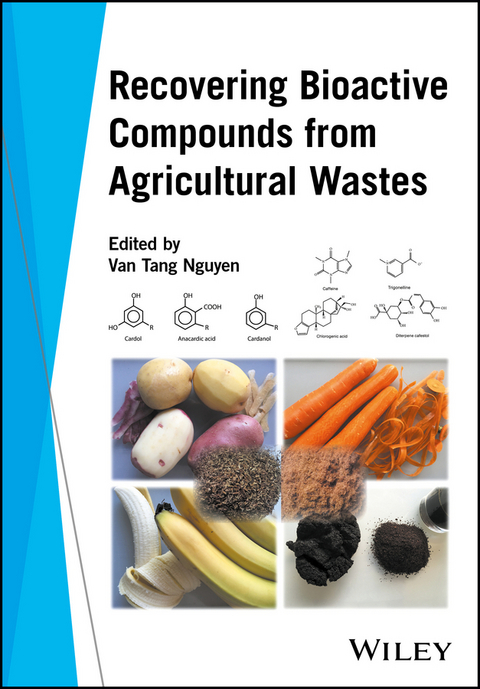
Recovering Bioactive Compounds from Agricultural Wastes (eBook)
280 Seiten
John Wiley & Sons (Verlag)
978-1-119-16883-6 (ISBN)
Recovering Bioactive Compounds from Agricultural Wastes offers a guide to the many uses of agricultural wastes from the production of major food types including tea, coffee, cacao, cashew, fruit and vegetables, wine, edible oils, sugar, starch and more. Written by a noted expert in the field, the text explores the various methods for extraction, isolation and purification of bioactive compounds from agricultural wastes. The author also makes recommendations concerning the most effective applications of bioactive compounds and discusses the economics and market for recovered bioactive compounds.
Recent studies reveal that bioactive compounds have been directly linked to biological activity such as antioxidant, anticancer, antidiabetic, anti-cardiovascular capacities, etc. In particular, agricultural wastes are considered as potential and inexpensive sources of bioactive compounds. Recovering Bioactive Compounds from Agricultural Wastes fills a gap in the literature by providing a text that explores this important topic and examines the:
* Sustainability of waste management and shows how to extract, isolate and purify bioactive compounds from agricultural wastes, and their most effective application
* Wide range of agricultural food produce that can be processed and the special techniques used for recovering the bioactive compounds from these sources
* Health applications of bioactive compounds that have been directly linked to pharmacological activities including antioxidant, anticancer, and more
Designed for use by researchers and producers in the agriculture, pharmaceuticals and nutraceuticals, Recovering Bioactive Compounds from Agricultural Wastes contains the knowledge, history and definition, classification and synthesis, and extraction techniques of bioactive compounds.
About the Editor Van Tang Nguyen is a Demonstrator at the School of Environmental and Life Sciences, University of Newcastle, Australia, and a Lecturer at the Faculty of Food Technology, Nha Trang University, Vietnam.
List of Contributors xi
About the Editor xiii
Preface xv
Acknowledgements xvii
1 Potential of Agricultural Wastes: Uses and Future Perspectives 1
Van Tang Nguyen
1.1 Introduction 1
1.2 Potential of AgriculturalWastes 1
1.3 Uses of AgriculturalWastes and Recovered Bioactive Compounds 21
1.4 Future Perspectives on the Use of AgriculturalWastes and Recovered Bioactive Compounds 30
1.5 Conclusion 30
References 30
2 Bioactive Compounds and Extraction Techniques 33
Md. Ariful Alam, Kashif Ghafoor, Sahena Ferdosh, Rukshana Akter Happy and Md. Zaidul IslamSarker
2.1 History and Definition of Bioactive Compounds 33
2.2 Classification and Synthesis of Bioactive Compounds 35
2.3 Extraction of Bioactive Compounds 35
Acknowledgement 44
References 44
3 Recovering Bioactive Compounds from Tea, Coffee, Cacao and Cashew Wastes 55
Van Tang Nguyen
3.1 Introduction 55
3.2 Recovering Bioactive Compounds from TeaWastes 55
3.3 Recovering Bioactive Compounds from CoffeeWastes 61
3.4 Recovering Bioactive Compounds from CacaoWastes 66
3.5 Recovering Bioactive Compounds from CashewWastes 70
3.6 Conclusion 75
References 75
4 Recovering Bioactive Compounds from Fruit and VegetableWastes 81
Hong Ngoc Thuy Pham
4.1 Introduction 81
4.2 Bioactive Compound Resources in Fruit and VegetableWastes 81
4.3 Recovering Bioactive Compounds from Fruit and VegetableWastes 82
4.4 Conclusion 94
References 94
5 Recovering Bioactive Compounds fromWineWastes 101
Van Tang Nguyen
5.1 Introduction 101
5.2 Recovering Bioactive Compounds fromWineWastes 102
5.3 Conclusion 125
References 125
6 Recovering Bioactive Compounds from Edible OilWastes 129
Hoang Quoc Tuan and Nguyen Thi Thao
6.1 Introduction 129
6.2 Edible Oil Processing and Byproducts 130
6.3 Recovering Bioactive Compounds from Edible OilWastes 133
6.4 Conclusion 151
References 151
7 Recovering Bioactive Compounds from Cane SugarWastes 157
Nguyen Thi Thao and Hoang Quoc Tuan
7.1 Introduction 157
7.2 Chemical Composition and Functional Properties of Sugarcane 158
7.3 Cane Sugar Production and Its Byproducts/Wastes 161
7.4 Recovering Bioactive Compounds from Cane Sugar Byproducts/Wastes 162
7.5 Conclusion 169
References 169
8 Recovering Bioactive Compounds from StarchWastes 173
Thang Trung Khong and Van Tang Nguyen
8.1 Introduction 173
8.2 Recovery of Bioactive Compounds from PotatoWastes 174
8.3 Recovery of Bioactive Compounds from Rice and WheatWastes 179
8.4 Recovery of Bioactive Compounds from Other StarchWastes 189
8.5 Conclusion 193
References 193
9 Recovering Bioactive Compounds from Other AgriculturalWastes 197
Giovani L. Zabot and Fiorella P. Cárdenas Toro
9.1 Introduction 197
9.2 Recovering Bioactive Compounds from PepperWaste 198
9.3 Recovering Bioactive Compounds from OnionWaste 207
9.4 Recovering Bioactive Compounds from CottonWaste 212
9.5 Conclusion 215
Acknowledgements 215
References 216
10 Economics and Market for Recovered Bioactive Compounds from AgriculturalWastes 221
Van Tang Nguyen and Thang Trung Khong
10.1 Introduction 221
10.2 Economic Analysis of Recovered Bioactive Compounds 222
10.3 Market Analysis of Recovered Bioactive Compounds 240
10.4 Conclusion 248
References 248
Index 251
| Erscheint lt. Verlag | 12.6.2017 |
|---|---|
| Sprache | englisch |
| Themenwelt | Naturwissenschaften ► Biologie |
| Technik ► Lebensmitteltechnologie | |
| Technik ► Umwelttechnik / Biotechnologie | |
| Weitere Fachgebiete ► Land- / Forstwirtschaft / Fischerei | |
| Schlagworte | Agriculture • Chemie • Chemistry • Food Science & Technology • Functional Food, Nutraceuticals • Functional Foods & Nutraceuticals • Landwirtschaft • Lebensmittelforschung u. -technologie • Nachhaltiger u. organischer Landbau • Nachhaltige u. Grüne Chemie • Sustainable & Organic Agriculture • Sustainable Chemistry & Green Chemistry |
| ISBN-10 | 1-119-16883-X / 111916883X |
| ISBN-13 | 978-1-119-16883-6 / 9781119168836 |
| Informationen gemäß Produktsicherheitsverordnung (GPSR) | |
| Haben Sie eine Frage zum Produkt? |
 PDF (Adobe DRM)
Kopierschutz: Adobe-DRM
Adobe-DRM ist ein Kopierschutz, der das eBook vor Mißbrauch schützen soll. Dabei wird das eBook bereits beim Download auf Ihre persönliche Adobe-ID autorisiert. Lesen können Sie das eBook dann nur auf den Geräten, welche ebenfalls auf Ihre Adobe-ID registriert sind.
Details zum Adobe-DRM
Dateiformat: PDF (Portable Document Format)
Mit einem festen Seitenlayout eignet sich die PDF besonders für Fachbücher mit Spalten, Tabellen und Abbildungen. Eine PDF kann auf fast allen Geräten angezeigt werden, ist aber für kleine Displays (Smartphone, eReader) nur eingeschränkt geeignet.
Systemvoraussetzungen:
PC/Mac: Mit einem PC oder Mac können Sie dieses eBook lesen. Sie benötigen eine
eReader: Dieses eBook kann mit (fast) allen eBook-Readern gelesen werden. Mit dem amazon-Kindle ist es aber nicht kompatibel.
Smartphone/Tablet: Egal ob Apple oder Android, dieses eBook können Sie lesen. Sie benötigen eine
Geräteliste und zusätzliche Hinweise
Buying eBooks from abroad
For tax law reasons we can sell eBooks just within Germany and Switzerland. Regrettably we cannot fulfill eBook-orders from other countries.
aus dem Bereich