Creating Organic Standards in U.S. States (eBook)
226 Seiten
Lexington Books (Verlag)
978-1-4985-5441-1 (ISBN)
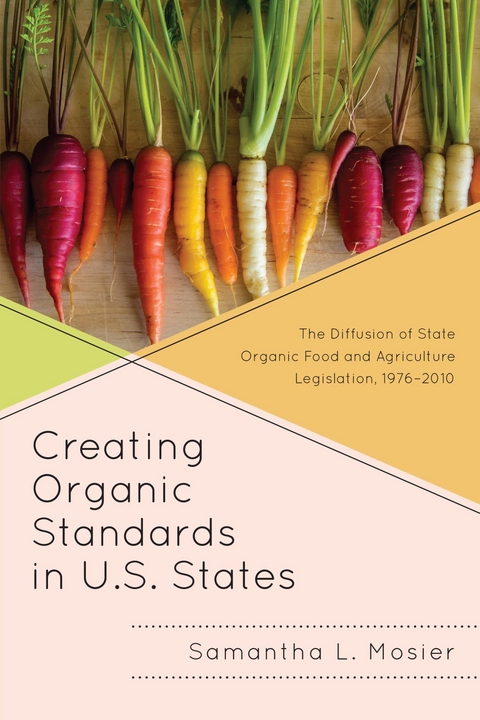
The organic food and agriculture market has greatly expanded over the course of the past forty years. Once considered a fringe practice and market, organic food and agriculture now receives mainstream acceptance and political support in the United States. The USDA's National Organic Program regulates the current U.S. market, but organic regulations were originally developed in the states starting in the 1970s. From 1976-2010, thirty-eight states adopted organic food and agriculture regulatory legislation. A majority of state legislatures adopted initial legislation in 1989 and 1990, the same year as Congress passed the Organic Foods Production Act that effective began the development of national level standards. Grounded in the policy diffusion and diffusion of innovation literature, Creating Organic examines why and how state legislatures decide to adopt legislation that regulate the organic food and agriculture market. The consequences for early and continual state involvement in this policy domain impact national policy trajectories and reshape the sustainable agriculture market. The evidence from this evaluation demonstrates a host of conditions led to the diffusion and evolution of organic regulatory legislation in the U.S. California, Vermont, and Georgia are case studies that illuminate the complexities of adoption decisions and evolution of state regulations over time. In turn, there are a number of lessons to be derived for how state regulatory design has influenced today's organic market and federal policy development.
Samantha L. Mosier is assistant professor of political science at Missouri State University.
List of TablesList of FiguresAcknowledgmentsAbbreviationsChapter 1: Approaching the Study of Organic Policy DiffusionChapter 2: Revolutionary Idea: Organic as an InnovationChapter 3: Organic Policy in the StatesChapter 4: Organic in California: A Leading InnovatorChapter 5: Organic in Vermont: A Critical Mass AdopterChapter 6: Organic in Georgia: A LaggardChapter 7: Creating Organic AppendicesAbout the Author
| Erscheint lt. Verlag | 2.6.2017 |
|---|---|
| Zusatzinfo | 65 Illustrations including: - 38 Black & White Illustrations; - 27 Tables. |
| Sprache | englisch |
| Themenwelt | Sozialwissenschaften ► Politik / Verwaltung ► Staat / Verwaltung |
| Weitere Fachgebiete ► Land- / Forstwirtschaft / Fischerei | |
| Schlagworte | Agriculture • California Organic Policy • Food and Agriculture Legislation • Food Policy • Georgia Organic Policy • organic agriculture • organic food • Organic Standards • Policy Diffusion • Public Policy • U.S. Organic Policy • Vermon Organic Policy |
| ISBN-10 | 1-4985-5441-5 / 1498554415 |
| ISBN-13 | 978-1-4985-5441-1 / 9781498554411 |
| Informationen gemäß Produktsicherheitsverordnung (GPSR) | |
| Haben Sie eine Frage zum Produkt? |
 EPUB (Adobe DRM)
Kopierschutz: Adobe-DRM
Adobe-DRM ist ein Kopierschutz, der das eBook vor Mißbrauch schützen soll. Dabei wird das eBook bereits beim Download auf Ihre persönliche Adobe-ID autorisiert. Lesen können Sie das eBook dann nur auf den Geräten, welche ebenfalls auf Ihre Adobe-ID registriert sind.
Details zum Adobe-DRM
Dateiformat: EPUB (Electronic Publication)
EPUB ist ein offener Standard für eBooks und eignet sich besonders zur Darstellung von Belletristik und Sachbüchern. Der Fließtext wird dynamisch an die Display- und Schriftgröße angepasst. Auch für mobile Lesegeräte ist EPUB daher gut geeignet.
Systemvoraussetzungen:
PC/Mac: Mit einem PC oder Mac können Sie dieses eBook lesen. Sie benötigen eine
eReader: Dieses eBook kann mit (fast) allen eBook-Readern gelesen werden. Mit dem amazon-Kindle ist es aber nicht kompatibel.
Smartphone/Tablet: Egal ob Apple oder Android, dieses eBook können Sie lesen. Sie benötigen eine
Geräteliste und zusätzliche Hinweise
Buying eBooks from abroad
For tax law reasons we can sell eBooks just within Germany and Switzerland. Regrettably we cannot fulfill eBook-orders from other countries.
aus dem Bereich