


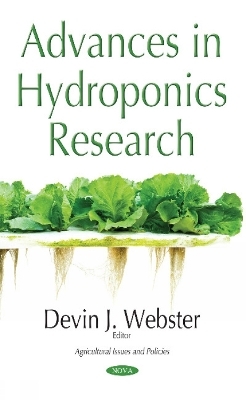
Advances in Hydroponics Research
Seiten
2017
Nova Science Publishers Inc (Verlag)
978-1-5361-2131-5 (ISBN)
Nova Science Publishers Inc (Verlag)
978-1-5361-2131-5 (ISBN)
- Titel ist leider vergriffen;
keine Neuauflage - Artikel merken
Describing the irrigation management techniques that are currently used for scheduling irrigation in a hydroponic culture, this volume covers research information about the nitrogen forms used in hydroponics, their relationships and peculiarities, as well as information on the use of silicon, its available sources and more.
This book begins by describing the irrigation management techniques that are currently used for scheduling irrigation in a hydroponic culture, presented in Chapter One. Chapter Two covers research information about the nitrogen forms used in hydroponics, their relationships and peculiarities, as well as information on the use of silicon, its available sources and role in mitigating the toxic effects of ammonium. In Chapter Three, Centella asiatica was tested for the effects of Pb exposure on Cu accumulation and antioxidant activities which includes the activities of ascorbate peroxidase (APX), catalase (CAT), superoxide dismutase (SOD), and guaiacol peroxidase (GPX). Chapter Four discusses the phytoextraction potential of the free floating aquatic plant for heavy metals from aqueous solution. Chapter Five analyses the use of wastewaters to formulate nutritive solutions represents a rational alternative to wastewaters disposal and adds value to what is currently considered a waste product. Chapter Six provides a brief review of hydroponics used in fishery waste reuse. Chapter Seven discusses the results of physicochemical characterisation of Human urine, Cassava Wastewater and alternative nutrient solution prepared through these effluents as an alternative for its use in agroecological systems of agricultural cultivation. Chapter Eight describes recent progress and findings on the hydroponic culture of edible Opuntia. Finally, the book concludes with an expert commentary that argues that plant factories are powerful tools to cultivate and improve the quality of edible cacti.
This book begins by describing the irrigation management techniques that are currently used for scheduling irrigation in a hydroponic culture, presented in Chapter One. Chapter Two covers research information about the nitrogen forms used in hydroponics, their relationships and peculiarities, as well as information on the use of silicon, its available sources and role in mitigating the toxic effects of ammonium. In Chapter Three, Centella asiatica was tested for the effects of Pb exposure on Cu accumulation and antioxidant activities which includes the activities of ascorbate peroxidase (APX), catalase (CAT), superoxide dismutase (SOD), and guaiacol peroxidase (GPX). Chapter Four discusses the phytoextraction potential of the free floating aquatic plant for heavy metals from aqueous solution. Chapter Five analyses the use of wastewaters to formulate nutritive solutions represents a rational alternative to wastewaters disposal and adds value to what is currently considered a waste product. Chapter Six provides a brief review of hydroponics used in fishery waste reuse. Chapter Seven discusses the results of physicochemical characterisation of Human urine, Cassava Wastewater and alternative nutrient solution prepared through these effluents as an alternative for its use in agroecological systems of agricultural cultivation. Chapter Eight describes recent progress and findings on the hydroponic culture of edible Opuntia. Finally, the book concludes with an expert commentary that argues that plant factories are powerful tools to cultivate and improve the quality of edible cacti.
Preface; Irrigation Management Techniques Used in Soilless Cultivation; Nitrate-Ammonium Ratios & Silicon Used in Hydroponics; Interactive Effects of Copper & Lead on Metal Uptake & Antioxidative Metabolism of Centella asiatica under Experimental Hydroponic Systems; Phytoaccumulation of Heavy Metals from Water Using Floating Plants by Hydroponic Culture; Development of Nutritive Solutions for Hydroponics Using Wastewater; Hydroponics for Feasibility Test of Biodegraded Fishery Waste/Wastewater as Biofertilizer; Human Urine Associated with Cassava Wastewater as a Nutritive Solution with Potential to Agricultural Use; Application of Hydroponic Culture for the Cultivation of Edible Cacti; Index.
| Erscheinungsdatum | 22.07.2017 |
|---|---|
| Verlagsort | New York |
| Sprache | englisch |
| Maße | 155 x 230 mm |
| Gewicht | 406 g |
| Themenwelt | Technik |
| Weitere Fachgebiete ► Land- / Forstwirtschaft / Fischerei | |
| ISBN-10 | 1-5361-2131-2 / 1536121312 |
| ISBN-13 | 978-1-5361-2131-5 / 9781536121315 |
| Zustand | Neuware |
| Informationen gemäß Produktsicherheitsverordnung (GPSR) | |
| Haben Sie eine Frage zum Produkt? |
Mehr entdecken
aus dem Bereich


aus dem Bereich
Baumarten, Verjüngungsziele, Mischungsformen
Buch | Hardcover (2025)
Stocker, L (Verlag)
CHF 39,20
erfolgreich produzieren & selbst vermarkten
Buch | Hardcover (2023)
Stocker Verlag
CHF 34,95
Buch | Hardcover (2023)
Haymarket Media (Verlag)
CHF 44,50


