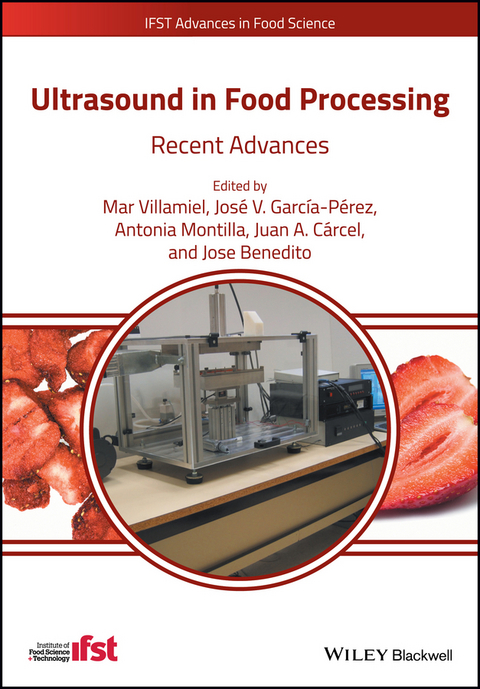
Ultrasound in Food Processing (eBook)
John Wiley & Sons (Verlag)
978-1-118-96417-0 (ISBN)
Part I: Fundamentals of ultrasound
This part will cover the main basic principles of ultrasound generation and propagation and those phenomena related to low and high intensity ultrasound applications. The mechanisms involved in food analysis and process monitoring and in food process intensification will be shown.
Part II: Low intensity ultrasound applications
Low intensity ultrasound applications have been used for non-destructive food analysis as well as for process monitoring. Ultrasonic techniques, based on velocity, attenuation or frequency spectrum analysis, may be considered as rapid, simple, portable and suitable for on-line measurements. Although industrial applications of low-intensity ultrasound, such as meat carcass evaluation, have been used in the food industry for decades, this section will cover the most novel applications, which could be considered as highly relevant for future application in the food industry. Chapters addressing this issue will be divided into three subsections: (1) food control, (2) process monitoring, (3) new trends.
Part III: High intensity ultrasound applications
High intensity ultrasound application constitutes a way to intensify many food processes. However, the efficient generation and application of ultrasound is essential to achieving a successful effect. This part of the book will begin with a chapter dealing with the importance of the design of efficient ultrasonic application systems. The medium is essential to achieve efficient transmission, and for that reason the particular challenges of applying ultrasound in different media will be addressed.
The next part of this section constitutes an up-to-date vision of the use of high intensity ultrasound in food processes. The chapters will be divided into four sections, according to the medium in which the ultrasound vibration is transmitted from the transducers to the product being treated. Thus, solid, liquid, supercritical and gas media have been used for ultrasound propagation. Previous books addressing ultrasonic applications in food processing have been based on the process itself, so chapters have been divided in mass and heat transport, microbial inactivation, etc. This new book will propose a revolutionary overview of ultrasonic applications based on (in the authors' opinion) the most relevant factor affecting the efficiency of ultrasound applications: the medium in which ultrasound is propagated. Depending on the medium, ultrasonic phenomena can be completely different, but it also affects the complexity of the ultrasonic generation, propagation and application.
In addition, the effect of high intensity ultrasound on major components of food, such as proteins, carbohydrates and lipids will be also covered, since this type of information has not been deeply studied in previous books.
Other aspects related to the challenges of food industry to incorporate ultrasound devices will be also considered. This point is also very important since, in the last few years, researchers have made huge efforts to integrate fully automated and efficient ultrasound systems to the food production lines but, in some cases, it was not satisfactory. In this sense, it is necessary to identify and review the main related problems to efficiently produce and transmit ultrasound, scale-up, reduce cost, save energy and guarantee the production of safe, healthy and high added value foods.
About the Editors
Mar Villamiel and Antonia Montilla, Department of Bioactivity and Food Analysis, Institute of Food Science Research (CSIC-UAM), Spain
José V. García-Pérez, Juan A. Cárcel, and Jose Benedito Analysis and Simulation of Agrofood Processes Group (ASPA), Food Technology Department, Universitat Politècnica de València, Valencia, Spain
Part I: Fundamentals of ultrasound This part will cover the main basic principles of ultrasound generation and propagation and those phenomena related to low and high intensity ultrasound applications. The mechanisms involved in food analysis and process monitoring and in food process intensification will be shown. Part II: Low intensity ultrasound applicationsLow intensity ultrasound applications have been used for non-destructive food analysis as well as for process monitoring. Ultrasonic techniques, based on velocity, attenuation or frequency spectrum analysis, may be considered as rapid, simple, portable and suitable for on-line measurements. Although industrial applications of low-intensity ultrasound, such as meat carcass evaluation, have been used in the food industry for decades, this section will cover the most novel applications, which could be considered as highly relevant for future application in the food industry. Chapters addressing this issue will be divided into three subsections: (1) food control, (2) process monitoring, (3) new trends. Part III: High intensity ultrasound applicationsHigh intensity ultrasound application constitutes a way to intensify many food processes. However, the efficient generation and application of ultrasound is essential to achieving a successful effect. This part of the book will begin with a chapter dealing with the importance of the design of efficient ultrasonic application systems. The medium is essential to achieve efficient transmission, and for that reason the particular challenges of applying ultrasound in different media will be addressed.The next part of this section constitutes an up-to-date vision of the use of high intensity ultrasound in food processes. The chapters will be divided into four sections, according to the medium in which the ultrasound vibration is transmitted from the transducers to the product being treated. Thus, solid, liquid, supercritical and gas media have been used for ultrasound propagation. Previous books addressing ultrasonic applications in food processing have been based on the process itself, so chapters have been divided in mass and heat transport, microbial inactivation, etc. This new book will propose a revolutionary overview of ultrasonic applications based on (in the authors opinion) the most relevant factor affecting the efficiency of ultrasound applications: the medium in which ultrasound is propagated. Depending on the medium, ultrasonic phenomena can be completely different, but it also affects the complexity of the ultrasonic generation, propagation and application.In addition, the effect of high intensity ultrasound on major components of food, such as proteins, carbohydrates and lipids will be also covered, since this type of information has not been deeply studied in previous books.Other aspects related to the challenges of food industry to incorporate ultrasound devices will be also considered. This point is also very important since, in the last few years, researchers have made huge efforts to integrate fully automated and efficient ultrasound systems to the food production lines but, in some cases, it was not satisfactory. In this sense, it is necessary to identify and review the main related problems to efficiently produce and transmit ultrasound, scale-up, reduce cost, save energy and guarantee the production of safe, healthy and high added value foods.
About the Editors Mar Villamiel and Antonia Montilla, Department of Bioactivity and Food Analysis, Institute of Food Science Research (CSIC-UAM), Spain José V. García-Pérez, Juan A. Cárcel, and Jose Benedito Analysis and Simulation of Agrofood Processes Group (ASPA), Food Technology Department, Universitat Politècnica de València, Valencia, Spain
Title Page 5
Copyright Page 6
Contents 7
About the IFST Advances in Food Science Book Series 18
List of Contributors 19
Preface 22
Part 1 Fundamentals of Ultrasound 25
Chapter 1 Basic Principles of Ultrasound 27
1.1 Introduction 28
1.2 Generation and Detection of Ultrasonic Waves: Basic Transducer Types 29
1.3 Basic Principles of Ultrasonic Wave Propagation 36
1.4 Basic Principles of Ultrasound Applications 39
1.4.1 Low-intensity Applications 39
1.4.1.1 Non-destructive Testing of Materials 39
1.4.1.2 Ultrasonic Imaging 41
1.4.1.3 Process Control 42
1.4.2 High-intensity Effects and Applications: Power Ultrasound 42
1.4.2.1 Cleaning 46
1.4.2.2 Atomization 46
1.4.2.3 Mixing, Homogenization, and Emulsification 46
1.4.2.4 Defoaming 46
1.4.2.5 Drying and Dewatering 47
1.4.2.6 Supercritical Fluid Extraction Assisted by Ultrasound 47
1.4.2.7 Bioremediation 47
1.4.2.8 Particle Agglomeration 47
1.4.2.9 Sonochemical Processes 47
1.5 Conclusions 47
Acknowledgments 48
References 48
Part 2 Low-intensity Ultrasound Applications 51
Section 2.1 Food and Process Control 53
Chapter 2 Ultrasonic Particle Sizing in Emulsions 54
2.1 Introduction 54
2.2 Definitions: Emulsions and Ultrasound 56
2.3 Theoretical Models of Ultrasound Propagation in Emulsions 59
2.4 Diffraction and Scattering 65
2.5 Multiple Scattering 68
2.6 Mode Conversions 70
2.7 Perturbation Solutions 73
2.8 Two-particle Models 77
2.9 Practical Particle Sizing Techniques 79
2.10 Conclusion 84
Acknowledgements 84
References 84
Chapter 3 Ultrasonic Applications in Bakery Products 89
3.1 Introduction 89
3.2 Ultrasonic Properties of Materials 91
3.2.1 Ultrasonic Velocity 92
3.2.2 Attenuation 93
3.2.3 Acoustic Impedance 93
3.3 Experimental Set-up for Ultrasonic Measurements 94
3.3.1 Bread Dough 94
3.3.2 Cake Batter 95
3.4 Experimental Results and Discussion 95
3.4.1 Wheat Dough 96
3.4.2 Rice Dough 102
3.4.3 Cake Batter 105
3.5 Discussion and Conclusion 106
References 106
Chapter 4 Characterization of Pork Meat Products using Ultrasound 110
4.1 Introduction 110
4.2 Ultrasonic Measurements: Devices and Parameters 113
4.3 Assessment of Fat Properties 115
4.3.1 Influence of Temperature on Ultrasonic Velocity 115
4.3.2 Classification of Meat Products by means of their Fat Melting/Crystallization Behavior 116
4.3.3 Monitoring of Fat Melting/Crystallization 121
4.4 Composition Assessment 125
4.5 Textural Properties 128
4.6 New Trends 132
Acknowledgements 134
References 134
Chapter 5 The Application of Ultrasonics for Oil Characterization 139
5.1 Introduction 140
5.1.1 Classical Methods for the Investigation of Physicochemical Parameters of Oils and Liquid Foodstuffs 141
5.1.2 Ultrasonic Methods 141
5.1.3 High-pressure Physicochemical Properties of Oils 144
5.2 Physicochemical Parameters of Liquids (Oils) that can be Evaluated by means of Ultrasonic Methods 145
5.2.1 Ultrasonic Wave Velocity and Density Measurement 145
5.2.1.1 Adiabatic Compressibility 145
5.2.1.2 Isothermal Compressibility 146
5.2.1.3 Intermolecular Free Path Length 146
5.2.1.4 Surface Tension 146
5.2.1.5 Thermal Expansion Coefficient 146
5.2.1.6 Specific Heat Capacity at Constant Pressure 147
5.2.1.7 Specific Heat Ratio 147
5.2.1.8 Van der Waals Constant 147
5.2.1.9 Effective Debye Temperature 147
5.2.1.10 Grüneisen Parameter 148
5.2.1.11 Nonlinearity Parameter 148
5.2.2 Measurement of Sound Velocity, Density, and Liquid Viscosity 148
5.2.2.1 Internal Pressure 148
5.2.2.2 Free Volume 148
5.2.2.3 Viscous Relaxation Time 149
5.2.2.4 Absorption Coefficient 149
5.2.2.5 Optical Refractive Index 149
5.3 Ultrasonic Measurements 149
5.3.1 Sound Velocity 149
5.3.1.1 Measurement of Ultrasonic Wave Velocity in Liquids using the Cross?correlation Method 151
5.3.1.2 Uncertainty Analysis 152
5.3.2 Viscosity 152
5.3.3 Attenuation 153
5.4 Measurements of Selected Physicochemical Parameters of Oils at Elevated Pressures and Various Values of Temperature 154
5.4.1 Sound Velocity 155
5.4.2 Density 155
5.4.3 Numerical Approximation of Density and Sound Velocity 155
5.4.4 Adiabatic Compressibility 156
5.4.5 Isothermal Compressibility 157
5.4.6 Isobaric Thermal Expansion Coefficient 158
5.4.7 Specific Heat Capacity 158
5.4.8 Surface Tension 158
5.4.9 Investigation of High-pressure Phase Transitions in Oils by Ultrasonic Methods 159
5.4.9.1 Viscosity 160
5.4.9.2 Kinetics of High-pressure Phase Transformations 160
5.5 Conclusions 162
List of Symbols 163
References 165
Chapter 6 Bioprocess Monitoring using Low-intensity Ultrasound: Measuring Transformations in Liquid Compositions 170
6.1 Introduction 171
6.2 Physical Models for Bioprocess?related Media 173
6.2.1 Modelling the Medium 173
6.2.1.1 Pure Liquids 173
6.2.1.2 Homogeneous Liquid Mixtures 174
6.2.1.3 Viscoelastic Models 177
6.2.1.4 Suspensions 178
6.2.2 Modelling the Bioprocess: Obtaining Information about the Medium Composition 178
6.3 Ultrasonic Measurement Techniques for Bioprocess Monitoring and Instrumentation 180
6.3.1 Measurement Based on Pulsed-wave Techniques 180
6.3.1.1 Sound Speed Measurement 181
6.3.1.2 Attenuation Measurement 181
6.3.1.3 Impedance Measurement 182
6.3.2 Measurement Based on Resonance Techniques 182
6.3.2.1 Sound Speed Measurement 183
6.3.2.2 Attenuation Measurements 183
6.3.2.3 Impedance Measurements 184
6.3.3 Control of External Conditions: Temperature and Pressure 185
6.4 Applications of Ultrasonic Technologies to Bioprocess Monitoring 185
6.4.1 Enzymatic Processes 185
6.4.1.1 Sucrose Hydrolysis 186
6.4.1.2 Starch Hydrolysis 188
6.4.2 Fermentative Processes 189
6.4.2.1 Ultrasonic Monitoring of Alcoholic Fermentation 190
6.4.3 Microbial Growth 192
6.4.3.1 Ultrasonic Detection of Biological Contaminations in Food 192
6.4.3.2 Biofilm Monitoring 194
References 195
Section 2.2 New Trends in Ultrasonic Non-destructive Testing 199
Chapter 7 Air-coupled Ultrasonic Transducers 200
7.1 Introduction 201
7.1.1 Low-frequency (< 60?kHz), High-power Transducers
7.1.2 Low to Medium Frequency (< 120?kHz), Relatively Low-power Transducers
7.1.3 High-frequency (> 100?kHz), Relatively Low-power Transducers
7.2 High-frequency Transduction Technologies 202
7.2.1 Capacitive Transducers 203
7.2.2 Piezoelectric Transducers 203
7.2.3 Ferroelectret Polymer Film Transducers 206
7.3 Uses and Applications of High-frequency (> 100 kHz) Ultrasonic Air-coupled Transducers
7.4 Design Criteria for High-frequency Air-coupled Transducers 211
7.4.1 Requirements Imposed by the Sample Insertion Loss 211
7.4.2 Main Design Parameters 215
7.5 Design of Wideband and High-frequency (> 100 kHz) Air-coupled Piezoelectric Transducers
7.5.1 Materials Selection 220
7.5.1.1 Active Materials 220
7.5.1.2 Passive Materials 222
7.5.2 The Ideal Piezoelectric Air-coupled Transducer 224
7.5.3 The Realistic Piezoelectric Air-coupled Transducer 225
7.5.4 Why can Piezoelectric Transducers not be Designed Following the Optimum Design? 230
7.5.4.1 Matching Layers Mounting 231
7.5.4.2 Open Porosity in the Matching Layers 231
7.5.5 Realistic Alternatives for the Design of Air-coupled Piezoelectric Transducers 231
7.5.6 Optimization under Realistic Constrains: The ML Detuning Technique 233
7.5.6.1 First Stage: Optimization Considering Realistic Materials 233
7.5.6.2 Second Stage: Optimization Considering Realistic Bonding between Layers – Transducer Optimization by ML Detuning 234
7.6 High-frequency and Wideband Piezoelectric Transducers: Realizations in the Frequency Range 0.20–2.0 MHz 237
7.7 Focusing Techniques 240
7.7.1 Geometrically Focused Transducer Aperture 241
7.7.2 Fresnel Zone Plates 241
7.7.3 Off-axis Parabolic Mirror 242
References 242
Chapter 8 Acoustic Microscopy 253
8.1 Introduction 254
8.2 Acoustic Microscope Theory 255
8.3 Acoustic Contrast 256
8.4 Focusing 257
8.5 Spatial Resolution 259
8.6 Temperature Effects 261
8.7 Generation of an Acoustic Image 262
8.8 Components and Operation of an Acoustic Microscope 262
8.8.1 Transducer 262
8.8.2 Sample Unit 266
8.8.3 Positioning System 268
8.8.4 Pulser and Receiver 268
8.8.5 Control Software 268
8.8.6 Sample Preparation and Operating Considerations 268
8.9 Combination of Acoustic Microscopy with other Techniques 269
8.10 Uses of Acoustic Microscopes in the Food Industry 269
8.11 Future Trends for Acoustic Microscopes in the Food Industry 273
8.11.1 Reduced Scanning Time 274
8.11.2 Easier Sample Preparation 274
8.11.3 Non-immersion Operation 274
8.11.4 Non-contact Scanning 274
8.12 Additional Resources 274
Acknowledgements 274
References 275
Part 3 High-intensity Ultrasound Applications 279
Section 3.1 Ultrasound Applications in Liquid Systems 281
Chapter 9 The Use of Ultrasound for the Inactivation of Microorganisms and Enzymes 282
9.1 Introduction 283
9.2 Microbial Inactivation by Ultrasound 283
9.2.1 A Hint of History 283
9.2.2 Mode of Action and Structural Studies 284
9.2.3 Kinetics of Inactivation 288
9.2.4 Factors Affecting the Lethal Effect of Ultrasound 288
9.2.4.1 Factors Depending on the Microorganism and its Growth History 288
9.2.4.2 Factors Depending on the Treatment Medium 290
9.2.4.3 Factors Depending on the Ultrasound Treatment Conditions 290
9.2.4.4 Factors Depending on the Recovery Conditions 296
9.2.5 Ultrasound in Combination with other Hurdles 296
9.3 Enzyme Inactivation by Ultrasound 296
9.3.1 Alkaline Phosphatase (EC Number 3.1.3.1) 297
9.3.2 Lactoperoxidase (EC Number 1.11.1.7) 298
9.3.3 Lipase (EC Number 3.1.1.3) 298
9.3.4 Lipoxygenase (EC Number 1.13.11.12) 299
9.3.5 Pectin Methylesterase (EC Number 3.1.1.11) 299
9.3.6 Peroxidases (EC Number 1.11.1.7) 300
9.3.7 Polyphenol Oxidases (EC Number 1.14.18.1) 301
9.3.8 Proteases 301
9.4 Conclusions and Future Trends 302
References 302
Chapter 10 Ultrasonic Preparation of Food Emulsions 311
10.1 Introduction 311
10.2 Formation of Emulsions 312
10.3 Conventional Emulsification Techniques 314
10.3.1 High-shear Mixer 314
10.3.2 Pressure Homogenizers 315
10.4 Ultrasonic Emulsification 316
10.5 Factors Affecting Sono-emulsification 317
10.5.1 Sonication Frequency 317
10.5.2 Sonication Power 318
10.5.3 Solution Temperature 319
10.5.4 Sonication Time 319
10.6 Role of Food Additives during Emulsification 319
10.6.1 Emulsifiers 319
10.6.2 Stabilizers 320
10.7 Case Studies on Ultrasonic Emulsification 321
10.8 Advantages of US over Other Emulsification Techniques 326
10.9 Conclusions 330
References 330
Chapter 11 Osmotic Dehydration and Blanching: Ultrasonic Pre-treatments 335
11.1 Introduction 336
11.2 Fundamentals 336
11.3 Tissue Structure 339
11.4 Pre-treatment Equipment 339
11.5 Mass Balances 339
11.5.1 Fick’s Law 339
11.5.2 Mass Transfer Model 341
11.5.3 Correlations 342
11.5.4 Water Loss and Sugar Gain 342
11.6 Osmotic Solutes 343
11.6.1 Binary Solutions 343
11.6.2 Ternary Solutions 344
11.7 Operating Conditions 344
11.7.1 Ultrasound Frequency 344
11.7.2 Osmotic Solution Concentration 345
11.7.3 Temperature 345
11.7.4 Immersion Time 345
11.8 Preservation 345
11.9 Quality Aspects 346
11.9.1 Vitamin C Content 346
11.9.2 Phenolics and Carotenoid Content 347
11.9.3 Sensory Evaluation 347
11.9.4 Color 347
11.9.5 Mechanical Behavior 348
References 349
Chapter 12 Ultrasonically Assisted Extraction in Food Processing and the Challenges of Integrating Ultrasound into the Food Industry 353
12.1 General Introduction 354
12.2 Extraction Methods for Food Technology 355
12.2.1 Conventional Methods 355
12.2.1.1 Solvent Extraction 355
12.2.1.2 Distillation 355
12.2.1.3 Cold Compression 355
12.2.2 Non-conventional Methods 355
12.2.2.1 Supercritical Fluid Extraction 355
12.2.2.2 Turbo (Vortex) Extraction 356
12.2.2.3 Electrical Energy Extraction 356
12.2.2.4 Microwave-assisted Extraction 356
12.2.2.5 Ultrasonically Assisted Extraction 356
12.2.3 Ultrasonically Assisted Extraction 356
12.2.4 Conclusions 365
12.3 The Challenges of Integrating Ultrasound in the Food Industry 365
12.3.1 The Scale-up of Liquid Processing 367
12.3.1.1 Batch Processes 368
12.3.1.2 Flow Processes 368
12.4 Concluding Remarks 373
References 374
Section 3.2 Ultrasound Applications in Gas and Supercritical Fluids Systems 378
Chapter 13 Ultrasonic Levitation Technologies 379
13.1 Introduction 379
13.2 Near-field Acoustic Levitation of a Planer Object 380
13.2.1 Overview of Near-field Acoustic Levitation 380
13.2.2 Model of Levitation 381
13.2.3 Levitation of Large Plate 383
13.3 Non-contact Transport of a Glass Plate 384
13.3.1 Combination with a Motorized Stage 384
13.3.2 Horizontal Force 384
13.3.3 Non-contact Transport Utilizing Traveling Wave Vibrations 385
13.3.4 Large-scale Transporter 387
13.4 Levitation of Droplets in Standing Wave Field in Air 388
13.5 Non-contact Manipulation of a Small Particle or Droplet in Air 390
13.5.1 High-speed Transport of Particle/Droplet 390
13.5.2 Step-by-step Transport 391
13.5.3 Contactless Mixing of Two Droplets 392
13.6 Summary 393
References 393
Chapter 14 Ultrasonically Assisted Drying 395
14.1 Introduction 396
14.2 Why Ultrasound can Intensify Drying Processes 397
14.3 Application of Ultrasound in Gas Media 397
14.4 Influence of Process Variables on the Ultrasonically Assisted Drying Rate 399
14.4.1 Drying Temperature 399
14.4.2 Air Velocity 400
14.4.3 Applied Ultrasonic Power 401
14.4.4 Product Structure 402
14.5 Influence of Ultrasound Application on the Quality of Dried Products 404
14.5.1 Microstructure 404
14.5.2 Physical Properties of Dried Materials 407
14.5.3 Chemical Composition 408
14.5.3.1 Maillard Reaction 408
14.5.3.2 Antioxidant Activity 409
14.5.3.3 Phenolic Compounds 409
14.5.3.4 Vitamin Content 411
14.6 Main Conclusions and Research Trends 412
Acknowledgements 412
References 412
Chapter 15 Microbial and Enzyme Inactivation by Ultrasound-assisted Supercritical Fluids 416
15.1 Introduction 417
15.2 Microbial and Enzyme Inactivation by High-power Ultrasound 417
15.3 Microbial and Enzyme Inactivation by Supercritical Carbon Dioxide 418
15.3.1 Microbial Inactivation Mechanisms by SC-CO2 418
15.3.2 Factors Affecting SC-CO2 Microbial Inactivation 420
15.3.3 Mechanisms and Factors in the SC-CO2 Enzyme Inactivation 423
15.4 Combination of HPU and SC-CO2 for Microbial/Enzyme Inactivation 424
15.4.1 Synergistic Effect of HPU in the SC-CO2 Inactivation Process 424
15.4.2 Effect of Temperature, Pressure, and Culture Media on SC-CO2+HPU Treatments 426
15.4.2.1 SC-CO2+HPU Microbial Inactivation Kinetics in Culture Media 426
15.4.2.2 SC-CO2+HPU Microbial Inactivation Kinetics in Juices 428
15.4.2.3 SC-CO2+HPU Enzyme Inactivation Kinetics in Juices 430
15.4.3 Effect of the SC-CO2+HPU Treatment on Cell Morphology and Regrowth Capacity 430
15.4.4 Effect of the Type of Microorganism/Enzyme 435
15.5 Conclusions 436
15.6 Recommendations 436
Acknowledgements 437
References 437
Section 3.3 Effect of Ultrasound on Food Constituents 441
Chapter 6 Impact of High-intensity Ultrasound on Protein Structure and Functionality during Food Processing 442
16.1 Introduction 442
16.2 Effect of High-intensity Ultrasound on Protein Structure and the Physicochemical Properties of Food Proteins 444
16.3 Effect of High-intensity Ultrasound on the Technological Properties of Food Proteins 447
16.4 Effect of High-intensity Ultrasound on Protein Glycation by the Maillard Reaction 450
16.5 Effect of High-intensity Ultrasound on the Biological Properties of Food Proteins 452
16.6 Conclusions and Future Trends 454
Acknowledgements 455
References 455
Chapter 17 Ultrasound Effects on Processes and Reactions Involving Carbohydrates 461
17.1 Introduction 462
17.2 Sonophysical Effects 463
17.2.1 Depolymerization 463
17.2.2 Effects of Ultrasound on Functional Properties of Carbohydrates 465
17.2.2.1 Technological Properties 465
17.2.2.2 Bioactive Properties 467
17.2.3 Use of Ultrasound in Carbohydrate Chemistry 467
17.2.3.1 Acylation 467
17.2.3.2 Esterification 467
17.2.3.3 Oligomerization 468
17.2.3.4 Oxidation 468
17.2.3.5 Isomerization 468
17.2.4 Crystallization 468
17.3 Sonochemical Effects on Carbohydrate Depolymerization 470
17.4 Effects of Ultrasound on Biotechnological Processes 472
17.4.1 Depolymerization 473
17.4.1.1 Simultaneous Application 474
17.4.1.2 Sequential Application 475
17.4.2 Other Bioprocesses 477
17.4.2.1 Hydrolysis 477
17.4.2.2 Enzymatic Synthesis of Carbohydrate Derivatives 478
17.4.2.3 Fermentation 479
17.5 Conclusions and Future Trends 481
Acknowledgements 482
References 482
Chapter 18 Effect of Ultrasound on the Physicochemical Properties of Lipids 488
18.1 Introduction 488
18.2 Background 489
18.2.1 Definition of Ultrasound 489
18.2.2 Mechanism of Action of HIU 490
18.3 Modifying the Physical Properties of Lipids with HIU 491
18.3.1 Effect on the Induction Times of Crystallization 492
18.3.2 Effect on Microstructure 492
18.3.3 Effect on Solid Fat Content 496
18.3.4 Effect on Texture and Viscoelasticity 498
18.3.5 Effect on Melting Profile 499
18.3.6 Effect on Polymorphism 500
18.3.7 Effect on Phase Separation 501
18.3.8 Combination with Other Process Variables 501
18.3.9 Effect on Oxidation 502
18.3.10 Use of HIU in a Flow Cell 504
18.4 Concluding Remarks and Future Research 504
Acknowledgments 506
References 506
Chapter 19 Effect of Ultrasound on Anthocyanins 509
19.1 Introduction 509
19.2 Anthocyanins: Chemistry and Sources 513
19.3 Degradation of Anthocyanins 514
19.4 Ultrasound-assisted Extraction and Processing of Anthocyanins 515
19.5 Effect of Sonication on Anthocyanins 516
19.6 Mechanism of Anthocyanin Degradation 518
19.7 Kinetics of Anthocyanin Degradation 520
19.8 Conclusions 522
References 523
Epilogue 530
Index 532
Supplemental Images 540
EULA 548
| Erscheint lt. Verlag | 19.4.2017 |
|---|---|
| Reihe/Serie | IFST Advances in Food Science | IFST Advances in Food Science |
| Sprache | englisch |
| Themenwelt | Naturwissenschaften ► Biologie |
| Naturwissenschaften ► Chemie | |
| Technik ► Lebensmitteltechnologie | |
| Weitere Fachgebiete ► Land- / Forstwirtschaft / Fischerei | |
| Schlagworte | Advances • Different • disciplines • emerged • Food • Food Processing • Food Processing, Production & Manufacture • Food Science & Technology • Food Science & Technology Special Topics • fundamentals • Green • Herstellung u. Verarbeitung von Lebensmitteln • Lebensmittelforschung u. -technologie • lowintensity • Main • Microbiology, Food Safety & Security • Mikrobiologie u. Nahrungsmittelsicherheit • Nondestructive • Principles • Promising • recognized • sections • Spezialthemen Lebensmittelforschung u. -technologie • theory • Three • Tool • Ultrasound • useful |
| ISBN-10 | 1-118-96417-9 / 1118964179 |
| ISBN-13 | 978-1-118-96417-0 / 9781118964170 |
| Informationen gemäß Produktsicherheitsverordnung (GPSR) | |
| Haben Sie eine Frage zum Produkt? |
 PDF (Adobe DRM)
Kopierschutz: Adobe-DRM
Adobe-DRM ist ein Kopierschutz, der das eBook vor Mißbrauch schützen soll. Dabei wird das eBook bereits beim Download auf Ihre persönliche Adobe-ID autorisiert. Lesen können Sie das eBook dann nur auf den Geräten, welche ebenfalls auf Ihre Adobe-ID registriert sind.
Details zum Adobe-DRM
Dateiformat: PDF (Portable Document Format)
Mit einem festen Seitenlayout eignet sich die PDF besonders für Fachbücher mit Spalten, Tabellen und Abbildungen. Eine PDF kann auf fast allen Geräten angezeigt werden, ist aber für kleine Displays (Smartphone, eReader) nur eingeschränkt geeignet.
Systemvoraussetzungen:
PC/Mac: Mit einem PC oder Mac können Sie dieses eBook lesen. Sie benötigen eine
eReader: Dieses eBook kann mit (fast) allen eBook-Readern gelesen werden. Mit dem amazon-Kindle ist es aber nicht kompatibel.
Smartphone/Tablet: Egal ob Apple oder Android, dieses eBook können Sie lesen. Sie benötigen eine
Geräteliste und zusätzliche Hinweise
Buying eBooks from abroad
For tax law reasons we can sell eBooks just within Germany and Switzerland. Regrettably we cannot fulfill eBook-orders from other countries.
aus dem Bereich