Food Authentication (eBook)
John Wiley & Sons (Verlag)
978-1-118-81025-5 (ISBN)
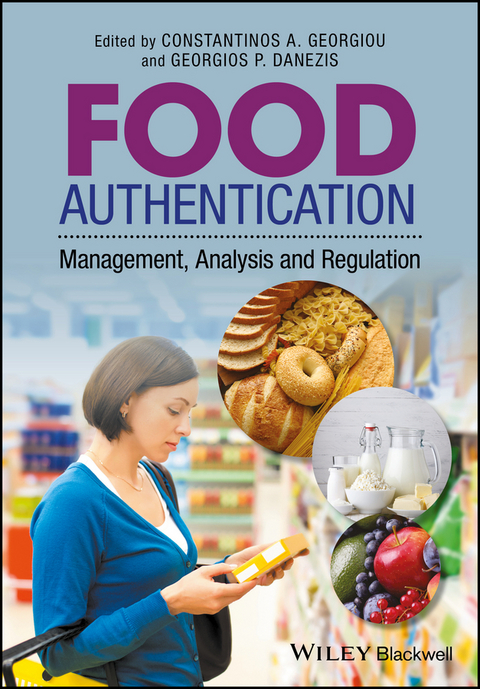
The determination of food authenticity is a vital component of quality control. Its importance has been highlighted in recent years by high-profile cases in the global supply chain such as the European horsemeat scandal and the Chinese melamine scandal which led to six fatalities and the hospitalisation of thousands of infants. As well as being a safety concern, authenticity is also a quality criterion for food and food ingredients. Consumers and retailers demand that the products they purchase and sell are what they purport to be.
This book covers the most advanced techniques used for the authentication of a vast number of products around the world. The reader will be informed about the latest pertinent analytical techniques. Chapters focus on the novel techniques & markers that have emerged in recent years. An introductory section presents the concepts of food authentication while the second section examines in detail the analytical techniques for the detection of fraud relating to geographical, botanical, species and processing origin and production methods of food materials and ingredients. Finally, the third section looks at consumer attitudes towards food authenticity, the application of bioinformatics to this field, and the Editor's conclusions and future outlook.
Beyond being a reference to researchers working in food authentication it will serve as an essential source to analytical scientists interested in the field and food scientists to appreciate analytical approaches. This book will be a companion to under- and postgraduate students in their wander in food authentication and aims to be useful to researchers in universities and research institutions.
The determination of food authenticity is a vital component of quality control. Its importance has been highlighted in recent years by high-profile cases in the global supply chain such as the European horsemeat scandal and the Chinese melamine scandal which led to six fatalities and the hospitalisation of thousands of infants. As well as being a safety concern, authenticity is also a quality criterion for food and food ingredients. Consumers and retailers demand that the products they purchase and sell are what they purport to be. This book covers the most advanced techniques used for the authentication of a vast number of products around the world. The reader will be informed about the latest pertinent analytical techniques. Chapters focus on the novel techniques & markers that have emerged in recent years. An introductory section presents the concepts of food authentication while the second section examines in detail the analytical techniques for the detection of fraud relating to geographical, botanical, species and processing origin and production methods of food materials and ingredients. Finally, the third section looks at consumer attitudes towards food authenticity, the application of bioinformatics to this field, and the Editor s conclusions and future outlook. Beyond being a reference to researchers working in food authentication it will serve as an essential source to analytical scientists interested in the field and food scientists to appreciate analytical approaches. This book will be a companion to under- and postgraduate students in their wander in food authentication and aims to be useful to researchers in universities and research institutions.
Constantinos A. Georgiou, Agricultural University of Athens, Greece Georgios P. Danezis, Agricultural University of Athens, Greece
Chapter 1
Introduction, Definitions and Legislation
Demetrios G. Sotirchos, Georgios P. Danezis and Constantinos A. Georgiou
Chemistry Laboratory, Department of Food Science and Human Nutrition, Agricultural University of Athens, Athens, Greece
1.1 Introduction
Consumers have always wanted to know where their food came from and what it consisted of. In recent days, especially in more economically developed countries (MEDC), consumers have demanded to know without any doubt the origin and content of the food and whether it is safe to eat; in certain cases, consumers are willing to pay more for specific quality attributes (Aprile et al. 2012). Apart from being assured of the quality of the product they purchase, there is also strong interest in adulteration and fraud which, as well as financially damaging, can represent significant health hazards.
The proper description of food (and beverages) and its ingredients is enforced by labeling legislation which aims to reassure the consumer by giving them all the available information needed by issuing guidelines on the proper description of food. In order to enforce this legislation, state inspection bodies use various scientific methods to certify that the food products available in the market fully comply with label description.
Authenticity means the quality of being authentic or genuineness (www.dictionary.com). This word originates from the Greek word authentikós which means original, primary, at first hand, equivalent to authént (ēs) one who does things himself (aut- aut- + -hentēs doer). Similar definitions identify authentication with genuineness and truthfulness of origins, attributions, commitments, sincerity, and intentions; if something is authentic, it is not a copy or forgery.
The concept of authentic, defined by something original, true, undoubted, etc. applied to food, certifies that these products are of a certain origin in concordance with standards and force rules and with the inscriptions of the presentation label (Pascu 2013). Authenticity is of great concern for producers, manufacturers, traders, consumers, and state inspection bodies.
Food authentication is the process by which a food is verified as complying with its label description. Labeling and compositional regulations, which may differ from country to country, have a fundamental place in determining which scientific tests are appropriate for a particular issue (Dennis 1998). This is a brief definition of the principle of “food authentication”, but food authentication includes or may include many different attributes that give each food product its unique character.
1.2 Definitions
1.2.1 Food Origin
This may refer to the place or region in which the food or its ingredients were produced. It also refers to the botanical species and/or raw material used. In the case of meat products, this includes the wild or farmed species. A tool for covering these prerequisites is traceability. Traceability in most developed countries is a legal obligation of the production and marketing, but is also a major part of quality management schemes and standards (i.e., HACCP, ISO 22000:2005, FSSC 22000, EurepGAP, BRC, etc.). “Traceability” means that the path that led the product and its ingredients from its initial origin to the point that it became available to the final (or the intermediate) consumer(s) is known. All the information of the pathway that the product and its ingredients followed is recorded to the final point of sales. However, any systems involved in defining traceability are only as strong as their weakest link. In the EU, the main tool which enforces traceability is Regulation 178/2002 which came into force in 2005, although since 1993 the legislation (Directive 93/43) had made mandatory the existence of an active hazard analysis and critical control point (HACCP) plan in most enterprises that handled food, and traceability is sine qua non in any such scheme.
1.2.2 Label
The description of any food product is presented on its label. Although the main role of the label is to give the purchaser all the description details of the product needed to make an informed choice, it is often connected with legal aspects concerning the protection of the specific brand of the company that handles the product such as: brand protection (from counterfeit/fraud, misbranding); trademark; trade dress; trade secret; and liability of the production or marketing company(ies). Other data that the label may provide are nutritional properties, date of production (or year of harvest), date of manufacture, expiration date, and the type of technology used to produce or process the food. When a company addresses its products to a specific target group of consumers, specific labeling often combined with certain certifications and logos can be used. Examples of this practice include: related religion practices (i.e., kosher for Jews, musbooh and halal for Muslims, no beef for Hindu); groups of people with special dietary needs or health concerns (i.e., diabetics, high cholesterol, infants, children, lactose intolerant, vegan, vegetarian, gluten free, potential allergens); and lifestyle choices (organic, biodynamic agricultural products, low carbon footprint, fair trade, sugar free, low calorie content, low fat content).
1.2.3 Adulteration and Fraud
Fraud of foods or food ingredients is usually defined as a deliberate alteration of the product in order to increase profit. The UK's Food Standards Agency (FSA) describes two main types of fraud: (1) the sale of food which is unfit and potentially harmful; and (2) the deliberate misdescription of food (FSA 2015). Although the misdescription of the product results in financial loss for the consumer, in most cases it rarely intends to harm (Brereton 2013; Braden 2014). Nevertheless, it can reduce consumer confidence and raise obstacles in authentic products sales. In 2009 the US Food and Drug Administration (FDA) adopted the following working definition of fraud or economically motivated adulteration (EMA) (Braden 2014):
fraudulent, intentional substitution or addition of a substance in a product for the purpose of increasing the apparent value of the product or reducing the cost of its production, i.e., for economic gain. EMA includes dilution of products with increased quantities of an already-present substance (e.g., increasing inactive ingredients of a drug with a resulting reduction in strength of the finished product, or watering down of juice) to the extent that such dilution poses a known or possible health risk to consumers, as well as the addition or substitution of substances in order to mask dilution.
Adulteration is generally described as the addition of inferior ingredients. Adulteration is not a new practice; it has been carried out since antiquity and probably since the beginning of trade. Pliny the Elder (AD 23–79) describes the ways in which traders used to adulterate wine, pepper, and balsam, all commodities of high added value and price (Rackham 1960). Such practices continued throughout the Middle Ages and until the present days. In 1820, German chemist Fredrick Accum (1769–1838) published his book “A Treatise on Adulterations of Food and Culinary Poisons” in which he described methods of adulteration and analytical techniques to detect them, focusing on valuable commodities of his era such as tea, coffee, bread, beer, and pepper. He also emphasized the quality of the water used for food and drug production (Accum, 1820), a key element even in the quality and safety schemes of the present day. His book was a best seller and was reprinted in Germany and USA; some consider it as milestone in the history of adulteration (Wilson 2008; Shears 2010).
Tähkäpää et al. (2015) describe food frauds/adulterations cases published in the EU Rapid Alert System for Food and Feed (RASFF) as well as the notifications of recalls published by the Finnish Food Safety Authority (Evira) during the period 2008–2012. Most cases (92%) originated outside EU, although the suggested reason for this is that the RASFF system “is tailored especially to report non-EU cases of frauds or adulterations.” Another reason for this conclusion is that many EU regulations regarding the organization of the common market lay provisions of sampling checks of products on the internal market; on the other hand, checks for imported products from third countries are obligatory for almost all products with some exceptions (e.g., if a third country has requested European Commission approval and received certification; such approval is published in the C series of the Official Journal of the European Union).
1.3 Geographical Indications
When we are discussing the origin of food, one of the main issues is the link between origin and the particular geographical area where specific goods (and services) are originated. This link is covered by the generic terms “geographical indications (GI)” or “indications of geographical origin (IGO)”, depending on the international and regional law. Such a link could give food added value reflected in its price.
According to the WTO (article 22.1 of the Trade-Related Aspects of Intellectual Property Rights, TRIPS Agreement 1994), geographical indications are: “indications which identify a good as originating in the territory of a Member, or a region or locality in that territory, where a given quality, reputation or other characteristic of the good is essentially attributable to its geographical origin” (WTO 1994).
Similar...
| Erscheint lt. Verlag | 27.2.2017 |
|---|---|
| Sprache | englisch |
| Themenwelt | Naturwissenschaften ► Biologie |
| Technik ► Lebensmitteltechnologie | |
| Weitere Fachgebiete ► Land- / Forstwirtschaft / Fischerei | |
| Schlagworte | Analytical Chemistry • Analytische Chemie • authenticity • cases • Chain • Chemie • Chemistry • Component • Control • Determination • European • Food • Food Quality Assurance • Food Science & Technology • Global • highprofile • Hospitalization • importance • Infants • latter • Lebensmittel • Lebensmittelforschung u. -technologie • Lebensmittel / Qualitätskontrolle • Lebensmittel / Qualitätskontrolle • Lebensmittelsicherheit • Microbiology, Food Safety & Security • Mikrobiologie • Mikrobiologie u. Nahrungsmittelsicherheit • quality • Safety • six fatalities • Supply • thousands • Vital • years |
| ISBN-10 | 1-118-81025-2 / 1118810252 |
| ISBN-13 | 978-1-118-81025-5 / 9781118810255 |
| Informationen gemäß Produktsicherheitsverordnung (GPSR) | |
| Haben Sie eine Frage zum Produkt? |
 EPUB (Adobe DRM)
Kopierschutz: Adobe-DRM
Adobe-DRM ist ein Kopierschutz, der das eBook vor Mißbrauch schützen soll. Dabei wird das eBook bereits beim Download auf Ihre persönliche Adobe-ID autorisiert. Lesen können Sie das eBook dann nur auf den Geräten, welche ebenfalls auf Ihre Adobe-ID registriert sind.
Details zum Adobe-DRM
Dateiformat: EPUB (Electronic Publication)
EPUB ist ein offener Standard für eBooks und eignet sich besonders zur Darstellung von Belletristik und Sachbüchern. Der Fließtext wird dynamisch an die Display- und Schriftgröße angepasst. Auch für mobile Lesegeräte ist EPUB daher gut geeignet.
Systemvoraussetzungen:
PC/Mac: Mit einem PC oder Mac können Sie dieses eBook lesen. Sie benötigen eine
eReader: Dieses eBook kann mit (fast) allen eBook-Readern gelesen werden. Mit dem amazon-Kindle ist es aber nicht kompatibel.
Smartphone/Tablet: Egal ob Apple oder Android, dieses eBook können Sie lesen. Sie benötigen eine
Geräteliste und zusätzliche Hinweise
Buying eBooks from abroad
For tax law reasons we can sell eBooks just within Germany and Switzerland. Regrettably we cannot fulfill eBook-orders from other countries.
aus dem Bereich