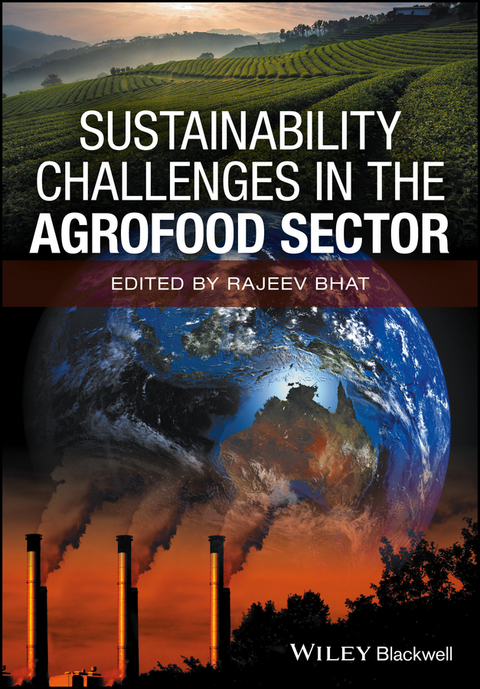
Sustainability Challenges in the Agrofood Sector (eBook)
John Wiley & Sons (Verlag)
978-1-119-07275-1 (ISBN)
About the Editor
Dr Rajeev Bhat is currently working as Associate Professor and Head of Food Science Department at the Fiji National University, Fiji Islands. Dr Bhat has nearly 17 years of research experience, gained by working in India, South Korea, Malaysia and Germany. His major theme of research revolves around food security, food safety and sustainable food production.
Sustainability Challenges in the Agrofood Sector covers a wide range of agrofood-related concerns, including urban and rural agriculture and livelihoods, water-energy management, food and environmental policies, diet and human health. Significant and relevant research topics highlighting the most recent updates will be covered, with contributions from leading experts currently based in academia, government bodies and NGOs (see list of contributors below). Chapters will address the realities of sustainable agrofood, the issues and challenges at stake, and will propose and discuss novel approaches to these issues. This book will be the most up-to-date and complete work yet published on the topic, with new and hot topics covered as well as the core aspects and challenges of agrofood sustainability.
About the Editor Dr Rajeev Bhat is currently working as Associate Professor and Head of Food Science Department at the Fiji National University, Fiji Islands. Dr Bhat has nearly 17 years of research experience, gained by working in India, South Korea, Malaysia and Germany. His major theme of research revolves around food security, food safety and sustainable food production.
1
Food Sustainability Challenges in the Developing World
Rajeev Bhat
Food Science Department, College of Engineering, Science & Technology (CEST) School of Sciences, Campus – Nabua, Fiji National University, Fiji Islands
SUMMARY
This chapter highlights some of the current issues and topics of concern facing the agriculture and food sustainability sectors. Special emphasis is placed on the various challenges facing low‐ and medium‐income countries. Some of the major obstacles to sustainability and the factors affecting it are examined, as are novel approaches to the management strategies employed for various issues in agriculture (e.g. biodiversity, agricultural development, pests/rodents, organic farming, livestock, poultry and aquaculture) and food security (e.g. poverty, hidden hunger and diseases, stability of food supply and access to safe, high‐quality food, food diversification, dietary health supplements, food wastage, food safety and challenges in the food industry).
1.1 Introduction
In a global context, ‘sustainability’ has been defined as ‘the ability to accomplish the needs of our present generation by ensuring that the desires of the future generation remain uncompromised’. According to Asheim (1994), sustainability is expressed as a requirement of the present generation to manage its resources in such a way that the current average quality of life can potentially be enjoyed by all future generations. Sustainability is from the Latin (sustinere) and means to ‘hold up’, ‘support’ or ‘maintain.’ However, according to Phillis and Andriantiatsaholiniaina (2001), sustainability is very difficult to define or to be measured as it is an ambiguous and complex concept about which there is no consensus as to its definition or on how it is to be measured. And so Phillis and Andriantiatsaholiniaina developed the Sustainability Assessment by Fuzzy Evaluation model, which provided a reliable mechanism to measure sustainability development that considers both ecological and human inputs.
Before we look at sustainability issues in any depth and the various challenges the world is facing now, a few basic questions need to be answered. For example: Why sustainability? Does sustainability matter? If it does matter, then to whom? Why do we need to be concerned about the agrofood sector? Well, the answer to all these questions is simple: there is only one earth where rich biodiversity and life exists, and hence sustainability matters! The majority of the world’s population, it seems, including expert researchers, believes that sustainability is just about ecology and going green. However, technically, sustainability goes beyond this. Indeed, what does ‘agriculture sustainability’ and ‘food sustainability’ mean precisely? Are there any appropriate definitions available? What is the link between these two concepts? This chapter focuses on current sustainability issues and the trends and challenges facing the agrofood sector, especially in the developing regions of the world.
1.2 Agriculture and the Food Sustainability Sector
According to the Food and Agriculture Organization of the United Nations (FAO), ‘Sustainable agriculture needs to nurture healthy ecosystems and support the sustainable management of land, water and natural resources, while ensuring world food security.’ Besides, it has been clearly stated (FAO 2015a) that sustainable agriculture should encompass a global governance system which can respond to the various issues of food security (e.g. trade regime, trade policies and agricultural policies) in order to promote agricultural marketing locally and regionally. When agriculture is of concern, sustainability is referred to as a complete system involved in producing high‐quality and safe agrofood products that also takes care of the social and economic conditions of farmers, as well as that of the surrounding environment.
Theoretically, sustainable agriculture symbolizes a system that integrates socio‐economic equity with that of economic success and environmental health. The concept of agricultural sustainability is presented effectively by Corwin et al. (1999), who stated that this is about finding the elusive balance between maximizing crop productivity while minimizing destructive effects on the environment and sustaining the economic stability of the whole system. Several novel methods have been proposed and reviewed with regard to agricultural sustainability, all of which concentrate on sustainability indicators, including considering socio‐economic and environmental issues (Binder et al. 2010; Rao and Rogers 2006; Roy and Chan 2012; Speelman et al. 2006). And yet an agricultural system that aims at sustainability can also have a negative impact. In many developing countries, the inappropriate sharing of knowledge on technological innovations and engineering, and mistimed practical applications of the new techniques, have had a devastating effect on the natural flora and fauna of the agriculture region. Today’s modern agricultural practices have added to global warming (e.g. deforestation to grow crops as well as to raise livestock), climatic changes, increased greenhouse gases (e.g. methane released from agriculture farms and nitrous oxide from fertilizers) and polluted water and soil (e.g. run‐off water from fields nourished with fertilizers and organic manure). The scarcity of natural water resources and the depletion of groundwater resources have tremendously increased in recent years, owing to human intervention (Hoekstra 2015; Pfeiffer 2006). In fact, stress has been laid on the importance of rain‐dependent agriculture in order to improve global food security and assure environmental sustainability (Bastos et al. 2013; Yang et al. 2006). Approximately 85% of the natural water resource in developing countries is used for irrigation (IAASTD 2008). The importance and threats of cultural eutrophication, acidification of fresh water, depletion of natural resources or biodiversity and emerging respiratory diseases (owing to elevated levels of nitrate concentrations in the water as well as in the air) have been identified by the European Nitrogen Assessment forum (Sutton et al. 2011). Added to this, natural disasters can have serious implications for the agriculture system as a whole. According to Misselhorn et al. (2012), almost one billion people experience famine or suffer from malnutrition in the world today. Developing an ecological and agriculture/food footprint as well as a water footprint for an individual region/country is very important to overcome recurring issues. In Figure 1.1, a conceptual model based on the concepts of ecological footprints, trust and human values is depicted.
Figure 1.1 Conceptual model.
Source: Grebitus et al. 2015. Reproduced with permission of Elsevier.
Further, when it comes to food sustainability, can ‘food sustainability’ or ‘sustainable foods’ be segregated from ‘agriculture sustainability’ or are they interdependent concepts? From a broader perspective, food sustainability encompasses a wide array of multidisciplinary themes, which can have an extensive paradigm (development and implementation of novel concepts, hypotheses, policies, theories and ideas, etc.) relevant to the socio‐economic state of affairs of the agro‐ecological food sector. Food sustainability is linked to ensuring food security (quality and safety, overcoming hidden hunger, population explosion and poverty, food loss/wastage, food governance and food crisis, food trade, etc.) as well as attaining successful sustainable food production. Food sustainability relies on ensuring nutritional security without foregoing the long‐term health of the surrounding ecosystem and the vital cultural scenario providing the basic food needs. Further, according to the FAO, and as outlined by the Panel of Experts on food security and nutrition ‘a sustainable food system is a food system that delivers food security and nutrition for all in such a way that the economic, social and environmental bases to generate food security and nutrition for future generations are not compromised’ (FAO 2016). Hence, ultimately, is it ‘sustainable foods’, ‘sustaining the foods’ or ‘sustainable food production’ that we need to refer to?
The success of sustainability in any region or country depends directly on the linkages between food, energy and water (Bhat 2015). Hence, it is vital to assure these three components go hand‐in‐hand. Moreover, population increase, food scarcity, scarcity of fertile agricultural land, recurring environmental issues (mainly climate change) and high levels of economic instability can be the major challenges to be overcome in low‐ or medium‐income countries. For the majority of developing countries (or rather low‐ and medium‐income groups of countries), sustainable production and the sustainable consumption of food is vital to fulfil the ever‐growing demands of local populations without depleting natural resources or causing any ill effects on human health (Bhat 2015; Pretty 2008; Verain et al. 2015).
Further, when a ‘sustainable agrofood system’ is referred to, it indicates a consolidation of crops and livestock production and effective land use,...
| Erscheint lt. Verlag | 16.2.2017 |
|---|---|
| Sprache | englisch |
| Themenwelt | Naturwissenschaften ► Biologie |
| Naturwissenschaften ► Geowissenschaften | |
| Technik ► Lebensmitteltechnologie | |
| Weitere Fachgebiete ► Land- / Forstwirtschaft / Fischerei | |
| Schlagworte | Agriculture • agrofood sustainability, food security, food sustainability, Food Diversification, Soil Health, Crop Productivity, Agricultural Wastes, Life Cycle Analysis, Agricultural Marketing • Food Management • Food Processing, Production & Manufacture • Food Science & Technology • Herstellung u. Verarbeitung von Lebensmitteln • Landwirtschaft • Lebensmittel • Lebensmittelforschung u. -technologie • Lebensmittel-Management • Nachhaltiger u. organischer Landbau • Nachhaltigkeit • Sustainable & Organic Agriculture |
| ISBN-10 | 1-119-07275-1 / 1119072751 |
| ISBN-13 | 978-1-119-07275-1 / 9781119072751 |
| Informationen gemäß Produktsicherheitsverordnung (GPSR) | |
| Haben Sie eine Frage zum Produkt? |
 EPUB (Adobe DRM)
Kopierschutz: Adobe-DRM
Adobe-DRM ist ein Kopierschutz, der das eBook vor Mißbrauch schützen soll. Dabei wird das eBook bereits beim Download auf Ihre persönliche Adobe-ID autorisiert. Lesen können Sie das eBook dann nur auf den Geräten, welche ebenfalls auf Ihre Adobe-ID registriert sind.
Details zum Adobe-DRM
Dateiformat: EPUB (Electronic Publication)
EPUB ist ein offener Standard für eBooks und eignet sich besonders zur Darstellung von Belletristik und Sachbüchern. Der Fließtext wird dynamisch an die Display- und Schriftgröße angepasst. Auch für mobile Lesegeräte ist EPUB daher gut geeignet.
Systemvoraussetzungen:
PC/Mac: Mit einem PC oder Mac können Sie dieses eBook lesen. Sie benötigen eine
eReader: Dieses eBook kann mit (fast) allen eBook-Readern gelesen werden. Mit dem amazon-Kindle ist es aber nicht kompatibel.
Smartphone/Tablet: Egal ob Apple oder Android, dieses eBook können Sie lesen. Sie benötigen eine
Geräteliste und zusätzliche Hinweise
Buying eBooks from abroad
For tax law reasons we can sell eBooks just within Germany and Switzerland. Regrettably we cannot fulfill eBook-orders from other countries.
aus dem Bereich