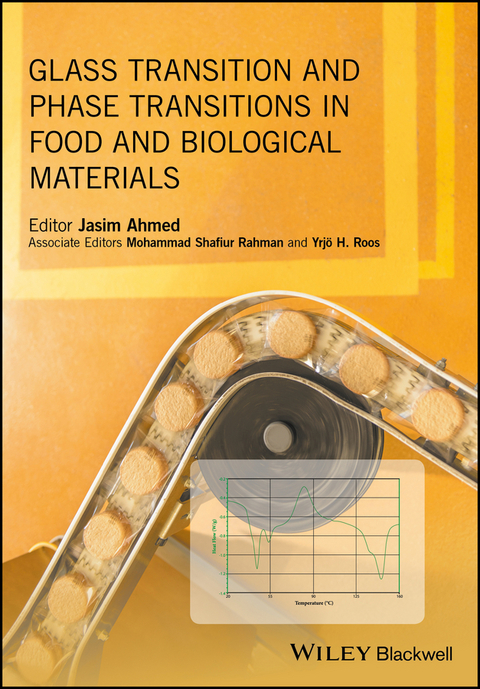
Glass Transition and Phase Transitions in Food and Biological Materials (eBook)
John Wiley & Sons (Verlag)
978-1-118-93569-9 (ISBN)
About the Editor:
Jasim Ahmed is Research Scientist, Kuwait Institute for Scientific Research, Kuwait.
Associate Editors:
Mohammad Shafiur Rahman is Professor, Sultan Qaboos University, Sultanate of Oman.
Yrjö H. Roos is Professor, School of Food and Nutritional Sciences, University College Cork, Ireland.
Glass and State Transitions in Food and Biological Materials describes how glass transition has been applied to food micro-structure, food processing, product development, storage studies, packaging development and other areas. This book has been structured so that readers can initially grasp the basic principles and instrumentation, before moving through the various applications. In summary, the book will provide the missing link between food science and material science/polymer engineering. This will allow food scientists to better understand the concept and applications of thermal properties.
About the Editor: Jasim Ahmed is Research Scientist, Kuwait Institute for Scientific Research, Kuwait. Associate Editors: Mohammad Shafiur Rahman is Professor, Sultan Qaboos University, Sultanate of Oman. Yrjö H. Roos is Professor, School of Food and Nutritional Sciences, University College Cork, Ireland.
Chapter 1
Thermal and Relaxation Properties of Food and Biopolymers with Emphasis on Water
Jan Swenson1 and Helén Jansson2
1Department of Physics, Chalmers University of Technology, Göteborg, Sweden
2Department of Civil and Environmental Engineering, Chalmers University of Technology, Göteborg, Sweden
1.1 Introduction
Thermal and relaxation properties of food and biological materials can hardly be discussed without considering the role of the surrounding water. In fact, we would not even have living organisms or food without water. Biomolecules, such as proteins, nucleic acids, polysaccharides and other smaller molecules that make up living organisms, need water for their structure and function. The water determines their mobility, allows them to associate and dissociate, enables proton transfer, and facilitates a large number of biochemical processes (Franks et al. 1983; Luby-Phelps et al. 1988; Rupley et al. 1991; Zimmerman et al. 1993). Since the water molecules are small and fast moving compared to most biomolecules their presence tends to speed up the dynamics of the biomolecules. When this is the case, water is said to act as a plasticizer for the biomaterial. Generally, this plasticizing effect of water can be huge and decrease the glass transition temperature of food and biomaterials by more than 100 K (Jansson et al. 2005). The strong influence on the water content is also of high medical and industrial importance since drying of food and biomaterial can considerably increase the stability and storage time at a given temperature, by simply increasing the glass transition temperature to above the storage temperature (Levine et al. 1990). However, it should here be noted that water has a large tendency to form hydrogen bonds to other molecules, and this can give rise to “superstructural units”, with an increased relaxation (Sjostrom et al. 2011), and/or an increased interaction between different biomolecules, leading to an antiplasticizing effect of the water. Although such antiplasticizing effects are fairly uncommon they can be strong (Sjostrom et al. 2011). Furthermore, as will be discussed in some detail in this chapter, water influences the dynamics of other glass forming materials very differently at low and very high water contents. This further implies that equations like the empirical Gordon-Taylor equation (Gordon et al. 1952) (Eq. 1.1), commonly used to predict the glass transition temperature over wide concentration ranges, cannot be used to estimate the glass transition temperature of pure water.
In this equation Tg denotes the glass transition temperature of a two-component mixture and the subscripts 1 and 2 denote the components 1 and 2, respectively. The weight fraction of the components is denoted by w, and k is a system-dependent constant.
Sugar and other carbohydrates are essential components in plants, fruits, vegetables and all living organisms, where they have structural, cryoprotective and metabolic roles (Mathews et al. 2000). The cryoprotective role of carbohydrates are also of importance for the food industry, where cooling and drying are frequently used methods for food storage (Levine et al. 1990). In addition, glassy carbohydrates are commonly used in the encapsulation and stabilization of labile food ingredients (Gunning et al. 1999) and pharmaceuticals (Shamblin et al. 1999). Since the properties of carbohydrates are strongly dependent on the water-rich environment in which they are generally working, also their cryoprotective properties are controlled by their water-dependent molecular dynamics at low temperatures around their glass transition.
The properties of carbohydrates and carbohydrate-rich food and biological materials are thus strongly dependent on the associated water. However, the influence of water is probably even larger for the dynamics and biological functions of proteins. A protein is inactive in its dehydrated state up to a hydration level h=0.2 (g of water)/(g of protein), whereas for full activity roughly the same mass of water as protein is required (Rupley et al. 1983; Frauenfelder et al. 1986). This importance of water has been supported by several experiments (Fenimore et al. 2004; Frauenfelder et al. 2009) and molecular dynamics (MD) simulation studies (Vitkup et al. 2000; Tarek et al. 2002), which have shown that the protein motions are mainly determined by the water dynamics. Hence, the protein motions, which, in turn, are necessary for the biological activity of the protein, are “slaved” (or “driven”) by the water motions (Frauenfelder et al. 2009). This “slaving” does not mean that the time scale of a protein motion is the same as for its surrounding water, but that the relaxation times of the two processes show similar temperature dependences, that is, similar activation energies at a given temperature. It should here be pointed out that water does not show unique properties as a solvent in all aspects. Provided that the folded protein structure can be kept basically intact in the solvent, it is mainly the viscosity of the solvent that determines the biologically most important global protein fluctuations. This can be achieved in a solvent such as glycerol (Rariy et al. 1997), or even in an environment of a polymer surfactant (Gallat et al. 2012), but not in, for example, ordinary alcohols, which causes denaturation of the protein. However, due to the higher viscosity of, for example, glycerol compared to water the global protein fluctuations, and related biological activities, are slowed down. In fact, the accumulation of low molecular weight carbohydrates such as glycerol in the body is the reason for why, for instance, various types of tree frogs can survive in climates of longer times of subzero temperatures without cold- and freezing-induced damage by the stabilization of protein and protection of membranes (Goldstein et al. 2010; Rexer-Huber et al. 2011) (and references therein). However, water has, as mentioned above, other unique properties as a solvent, which implies that the water in our bodies cannot be completely replaced by another solvent, but this will not be further discussed in this chapter.
In this chapter we will not only discuss the slaving behaviour of protein dynamics, as mentioned above, but also discuss the currently debated (Doster et al. 1986; Sartor et al. 1994; Jansson et al. 2010; Jansson et al. 2011) origin and broadness of the calorimetric glass transition of protein systems. Further focus will be on the thermal and relaxation properties of sugar solutions and sugar-rich materials like fruits and vegetables. As for the proteins, we will discuss their relaxation properties and the related calorimetric glass transition. Finally, we will show that the structural and dynamical properties of water in solutions are very different at low and high solute concentrations, and that this leads to a failure of the Gordon-Taylor equation (Gordon et al. 1952) at high water contents. Since calorimetric glass transitions and other thermal events, such as melting and crystallizations, are most directly measured by differential scanning calorimetry (DSC) and associated relaxation properties are easiest studied by broadband dielectric spectroscopy, experimental data from these two techniques will be presented and provide the base for our conclusions.
1.2 Glass Transition and Relaxation Dynamics of Sugar Solutions and Sugar-Rich Food
In general, it is complicated to determine the glass transition temperature (Tg) of aqueous solutions of higher water contents due to that crystallisation normally occurs at sub-zero temperatures. Even if the crystallisation temperature of water in general is substantially lowered by both the addition of solutes, like sugar molecules, and/or by using high cooling rates, crystallisation of bulk water and aqueous solutions of higher water contents will always occur in the temperature range 150–230 K (Sellberg et al. 2014). This region, which is visualized in Figure 1.1, is called the “No man's land” of water due to its inaccessibility in a non-crystalline state.
Figure 1.1 Schematic description of the so-called “No man's land” of water between 150 and 230 K. In this region crystallisation of bulk water and aqueous solutions of higher water contents cannot be avoided. 273 K is the melting temperature of bulk water.
One way to overcome the problem to determine the glass transition temperature, and especially to study the properties of water and diluted aqueous solutions in the “No man's land”, is to confine the liquids in porous materials or on surfaces. When water is confined, the water molecules are affected by surfaces, which will induce a layering effect (Antognozzi et al. 2001; Jensen et al. 2004). This in turn changes the orientation of adjacent water molecules in a way that depends on the chemical nature of the surface (i.e., whether the surface is hydrophilic or hydrophobic, or positively or negatively charged) (Jensen et al. 2004) (and references therein). This orientation will in turn affect the interaction between the water molecules and, as a result, reducing the probability of forming the network structure necessary for crystallization (Takahara et al. 1999; Ricci et al. 2000; Raviv et al. 2001; Rovere...
| Erscheint lt. Verlag | 9.2.2017 |
|---|---|
| Mitarbeit |
Stellvertretende Herausgeber: Mohammad Shafiur Rahman, Yrjo H. Roos |
| Sprache | englisch |
| Themenwelt | Naturwissenschaften ► Biologie |
| Technik ► Lebensmitteltechnologie | |
| Weitere Fachgebiete ► Land- / Forstwirtschaft / Fischerei | |
| Schlagworte | Biopolymere • biopolymers • Food chemistry • food engineering • food micro-structure, food processing, storage studies, packaging development, glass transition, plasticization effect, foods and biomaterials, drying, freezing, extrusion, frying process on thermal properties, moisture-nutrient behaviour, agglomeration, crystallisation and storage • Food Science & Technology • Lebensmittelchemie • Lebensmittelforschung u. -technologie • Lebensmitteltechnik • Polymer Science & Technology • Polymerwissenschaft u. -technologie |
| ISBN-10 | 1-118-93569-1 / 1118935691 |
| ISBN-13 | 978-1-118-93569-9 / 9781118935699 |
| Informationen gemäß Produktsicherheitsverordnung (GPSR) | |
| Haben Sie eine Frage zum Produkt? |
 EPUB (Adobe DRM)
Kopierschutz: Adobe-DRM
Adobe-DRM ist ein Kopierschutz, der das eBook vor Mißbrauch schützen soll. Dabei wird das eBook bereits beim Download auf Ihre persönliche Adobe-ID autorisiert. Lesen können Sie das eBook dann nur auf den Geräten, welche ebenfalls auf Ihre Adobe-ID registriert sind.
Details zum Adobe-DRM
Dateiformat: EPUB (Electronic Publication)
EPUB ist ein offener Standard für eBooks und eignet sich besonders zur Darstellung von Belletristik und Sachbüchern. Der Fließtext wird dynamisch an die Display- und Schriftgröße angepasst. Auch für mobile Lesegeräte ist EPUB daher gut geeignet.
Systemvoraussetzungen:
PC/Mac: Mit einem PC oder Mac können Sie dieses eBook lesen. Sie benötigen eine
eReader: Dieses eBook kann mit (fast) allen eBook-Readern gelesen werden. Mit dem amazon-Kindle ist es aber nicht kompatibel.
Smartphone/Tablet: Egal ob Apple oder Android, dieses eBook können Sie lesen. Sie benötigen eine
Geräteliste und zusätzliche Hinweise
Buying eBooks from abroad
For tax law reasons we can sell eBooks just within Germany and Switzerland. Regrettably we cannot fulfill eBook-orders from other countries.
aus dem Bereich