Handbook of Drying for Dairy Products (eBook)
John Wiley & Sons (Verlag)
978-1-118-93050-2 (ISBN)
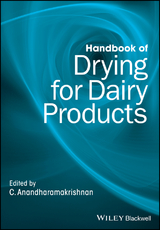
Handbook of Drying for Dairy Products is a complete guide to the field's principles and applications, with an emphasis on best practices for the creation and preservation of dairy-based food ingredients.
- Details the techniques and results of drum drying, spray drying, freeze drying, spray-freeze drying, and hybrid drying
- Contains the most up-to-date research for optimizing the drying of dairy, as well as computer modelling options
- Addresses the effect of different drying techniques on the nutritional profile of dairy products
- Provides essential information for dairy science academics as well as technologists active in the dairy industry
About the editor
C. Anandharamakrishnan is Director at the Indian Institute of Crop Processing Technology (IICPT), Thanjavur, India. Before assuming responsibility as Director, IICPT, he was Principal Scientist in the Food Engineering Department of the CSIR - Central Food Technological Research Institute, Mysore, India. He has been active in the field of spray drying for the past 10 years, working on the micro- and nanoencapsulation of nutraceuticals and computational fluid dynamics modelling of spray drying. He completed a PhD on spray drying and spray-freeze drying of proteins at Loughborough University, UK.
Handbook of Drying for Dairy Products is a complete guide to the field s principles and applications, with an emphasis on best practices for the creation and preservation of dairy-based food ingredients. Details the techniques and results of drum drying, spray drying, freeze drying, spray-freeze drying, and hybrid drying Contains the most up-to-date research for optimizing the drying of dairy, as well as computer modelling options Addresses the effect of different drying techniques on the nutritional profile of dairy products Provides essential information for dairy science academics as well as technologists active in the dairy industry
About the editor C. Anandharamakrishnan is Director at the Indian Institute of Crop Processing Technology (IICPT), Thanjavur, India. Before assuming responsibility as Director, IICPT, he was Principal Scientist in the Food Engineering Department of the CSIR - Central Food Technological Research Institute, Mysore, India. He has been active in the field of spray drying for the past 10 years, working on the micro- and nanoencapsulation of nutraceuticals and computational fluid dynamics modelling of spray drying. He completed a PhD on spray drying and spray-freeze drying of proteins at Loughborough University, UK.
Chapter 1
Introduction to Drying
C. Anandharamakrishnan
Indian Institute of Crop Processing Technology, Ministry of Food Processing Industries, Government of India, Thanjavur, Tamil Nadu, India
1.1 Introduction
The history of drying dates back to 12000 BC, when people dried meat and fish under the sun. Since then, drying technology has evolved and it is presently an indispensable process in the industrial sector. Drying involves removal of relatively small proportions of volatile liquid from a product by thermal means via the vapour phase. With respect to food products, the volatile liquid is almost always water, present in bound or unbound form. Bound water is that which is physically and/or chemically entrapped within the microstructure of the food matrix; anything in excess of this is known as unbound water. In addition, the fraction of bound and unbound water that is removable at a given temperature is known as the free water content. The term drying is often used synonymously with evaporation and dehydration. However, it differs from evaporation in that the final product is a solid rather than a highly viscous liquid; it differs from dehydration in that the final moisture content of the dried food product is more than 2.5%, while that of dehydrated is less than 2.5% (Vega-Mercado et al. 2001).
Drying is one of the oldest methods of food preservation, resulting in shelf-stable products that are of utmost relevance in this era of convenience. The preservation effect is achieved by reducing the water content to a level that reduces the incidence of microbial growth and retards deteriorative chemical reactions such as enzymatic and non-enzymatic browning and rancidity due to lipid oxidation. Nevertheless, owing to the complex nature of foods, the effect of drying is not just limited to reduction in water content. The application of heat during drying causes structural modifications of macromolecular components in foods (carbohydrates, proteins and lipids), by which the final product acquires significant functional characteristics. Also, moisture diffusion from within the product is accompanied by various physical changes, including shrinkage, puffing, crystallization and glass transitions (Mujumdar 2007). Drying can also lead to the encapsulation of active components within a protective outer layer, owing to the difference in drying rate between the feed constituents. Spray drying of milk is a classical example of drying-mediated encapsulation wherein the fat component is encapsulated in the matrix of sugars and proteins. Apart from the above, drying enhances the transportation and packaging properties of food products, attributed to the reduction in weight and volume. Before proceeding to understand the drying process, it is important to become familiar with the important terminologies associated with drying (Box 1.1).
Box 1.1 Lexicon of drying process
- Critical moisture content: The moisture content at which the drying rate starts to drop under constant drying conditions.
- Equilibrium moisture content: At a given temperature and pressure, the moisture content of a moist solid is in equilibrium with the gas–vapour mixture (zero for non-hygroscopic solids).
- Bound moisture: The amount of moisture tightly bound to the food matrix with properties different from those of bulk water; this also represents the portion of water that is unfreezable.
- Unbound moisture: Moisture in excess of the equilibrium moisture content, corresponding to saturated humidity.
- Free moisture: Amount of moisture mechanically entrapped in the void spaces of the system, having nearly all properties similar to those of bulk water.
- Relative humidity: Ratio of the partial pressure of water vapour in a gas–vapour mixture to equilibrium vapour pressure at the same temperature.
- Water activity: Relative humidity divided by 100.
- Moisture sorption isotherm: A graphical representation of the relationship between moisture content and equilibrium humidity (or) water activity at a specified temperature.
- Dry bulb temperature: Temperature measured by a (dry) thermometer immersed in a vapour–gas mixture.
- Wet bulb temperature (Twb): The liquid temperature attained when large amounts of air–vapour mixture is contacted with the surface. In purely convective drying, the drying surface reaches Twb during the constant rate period.
1.2 Fundamental principles of drying: the concept of simultaneous heat and mass transfer
Drying is a simultaneous heat- and mass-transfer process. This is reasonable as the phase transition of any component is associated with the evolution of latent heat. In any process that involves a net transfer of mass from one phase to another, the heat-transfer rate is the limiting factor of the rate at which the mass is transferred (Foust et al. 2008).
1.2.1 Heat transfer during the drying process
Heat transfer occurs from the drying medium to the product surface and also from one point to another within the product. This is accomplished by one or a combination of the following mechanisms: conduction, convection, radiation and dielectric heating. These mechanisms vary with respect to the type of drying medium, mode of contact between the product and drying medium, and the scale of heat transfer within the product, that is, molecular or bulk transport, and the direction of heat transfer. However, irrespective of the above, the driving force for heat transfer is the temperature gradient that exists between the product and water surfaces at some location within the product (Singh & Heldman 2014). This can be appreciated from the equations governing heat transfer for each mechanism. The mode of heat transfer during drying also forms the basis of dryer classification, which is discussed in subsequent sections.
1.2.1.1 Conduction drying
Conduction drying, also known as indirect or contact drying, occurs when heat is transferred to the product through contact with a metal surface that separates the product and the heating medium. Conduction heating involves transport of energy in a solid medium through vibration and collision of molecules and free electrons. The molecules vibrate by virtue of the heat energy absorbed from the drying medium. As a result, the molecules at higher temperature vibrate faster and transfer part of their kinetic energy to those at lower temperature by means of collision. However, only energy is transferred between the molecules and there is no change in their position.
A typical conduction dryer is made of a metal-walled, heat-jacketed arrangement that is either stationary or rotating. The jacketed vessel is heated by the circulation of condensed steam, flue gases, hot water, combustion gas, electricity or thermal fluids (e.g. silicone oil), which in turn transfers the heat to the metal surface of the dryer. Removal of vaporized water is independent of the heating medium. These dryers can operate in both batch and continuous modes. A drum dryer is a classical example of continuous conduction dryer, where the feed slurry is spread as a thin sheet over the surface of a rotating drum heated by steam. Heat transfer by conduction occurs from the heated drum to the sheet of feed slurry. The typical pattern of heat transfer in a conduction dryer is depicted in Figure 1.1.
Figure 1.1 Principle of heating during conduction drying.
The governing equation for heat transfer by conduction is given by Fourier's law (Eq. 1.1).
where Q is the rate of heat transfer (W), k is the thermal conductivity (W/(m·K)), Tm is the surface temperature of the product, which is at or slightly above the boiling point of water (K), To is the temperature of the drying medium (K), A is the area of heat transfer and x is the characteristic dimension of the product. The above equation is important as the rate of heat transfer has a significant influence on the extent of drying. There exists a positive correlation between heat-transfer rate and the temperature of the metal surface, but this is limited by the case-hardening phenomenon. Case hardening is the formation of surface shell during the early stages of drying, which is influenced by the temperature and velocity of drying medium (Chen 2008).
The thermal efficiency of conduction dryers is high as they consume only as much energy as is required to heat the product to its drying temperature. The operational temperature range is quite wide, from below the freezing point of water to close to the temperature of steam. This facilitates handling of products with different levels of heat sensitivity. Conduction dryers are also capable of operating under sub-atmospheric pressure and inert atmosphere. This enables the drying of food products that are susceptible to volatile loss and oxidation. Apart from drum dryers, other examples of conduction dryers include steam tube rotary dryers and cylinder dryers (continuous operation), vacuum tray dryers, freeze dryers and agitated pan dryers (batch operation) (Chakraverty & Singh 2014).
1.2.1.2 Convection drying
In convection drying, also referred to as direct drying, heat transfer is accomplished by direct contact between the wet product and a stream of hot air (Das & Chakraverty 2003; Figure 1.2). On contrary to conduction, convection involves bulk heat transfer by movement of energy as eddies...
| Erscheint lt. Verlag | 7.2.2017 |
|---|---|
| Sprache | englisch |
| Themenwelt | Naturwissenschaften ► Biologie |
| Technik ► Lebensmitteltechnologie | |
| Weitere Fachgebiete ► Land- / Forstwirtschaft / Fischerei | |
| Schlagworte | Dairy Food • dairy industry • dried dairy products • drum drying • food drying techniques • food engineering • food industry • food science • Food Science & Technology • Freeze drying • ingredients • Lebensmittelforschung u. -technologie • Lebensmitteltechnik • Milchprodukte • Spray Drying • spray-freeze drying • Zusatzstoffe |
| ISBN-10 | 1-118-93050-9 / 1118930509 |
| ISBN-13 | 978-1-118-93050-2 / 9781118930502 |
| Informationen gemäß Produktsicherheitsverordnung (GPSR) | |
| Haben Sie eine Frage zum Produkt? |
 EPUB (Adobe DRM)
Kopierschutz: Adobe-DRM
Adobe-DRM ist ein Kopierschutz, der das eBook vor Mißbrauch schützen soll. Dabei wird das eBook bereits beim Download auf Ihre persönliche Adobe-ID autorisiert. Lesen können Sie das eBook dann nur auf den Geräten, welche ebenfalls auf Ihre Adobe-ID registriert sind.
Details zum Adobe-DRM
Dateiformat: EPUB (Electronic Publication)
EPUB ist ein offener Standard für eBooks und eignet sich besonders zur Darstellung von Belletristik und Sachbüchern. Der Fließtext wird dynamisch an die Display- und Schriftgröße angepasst. Auch für mobile Lesegeräte ist EPUB daher gut geeignet.
Systemvoraussetzungen:
PC/Mac: Mit einem PC oder Mac können Sie dieses eBook lesen. Sie benötigen eine
eReader: Dieses eBook kann mit (fast) allen eBook-Readern gelesen werden. Mit dem amazon-Kindle ist es aber nicht kompatibel.
Smartphone/Tablet: Egal ob Apple oder Android, dieses eBook können Sie lesen. Sie benötigen eine
Geräteliste und zusätzliche Hinweise
Buying eBooks from abroad
For tax law reasons we can sell eBooks just within Germany and Switzerland. Regrettably we cannot fulfill eBook-orders from other countries.
aus dem Bereich