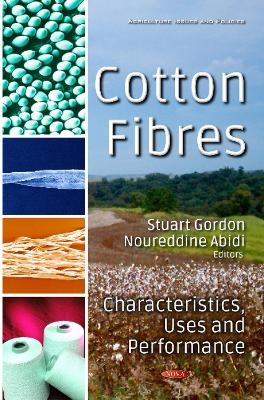
Cotton Fibres
Nova Science Publishers Inc (Verlag)
978-1-5361-0913-9 (ISBN)
- Titel ist leider vergriffen;
keine Neuauflage - Artikel merken
This book is divided into three parts. The first part, covering seven chapters, describes the chemical and physical properties of cotton fibre. These chapters focus on the differences between cotton and polyester fibre properties, and highlight areas researchers will need to pursue to keep cotton competitive. Two lesser discussed properties receive attention: Cotton fibre’s wax layer and cotton cellulose’s glass transition temperature. The hydrophobic wax layer that protects cotton during mechanical processing and aids the dispersal of its seed by water, has been central in the development of the spinning technology used by cotton and polyester fibre alike. The wax provides lubrication between the fibre surface and the processing surfaces during opening, carding and spinning. The chapter on cotton cellulose’s glass transition temperature introduces the less appreciated concept that cotton’s cellulose can be plasticized at particular temperatures and moisture contents, wherein cotton’s mechanical properties, e.g. elongation to break, can be improved. The range of fibre property values and the variation found in cotton stand as markers for future researchers to improve by way of plant and crop management, breeding (including genetic modification), and chemical processing. Long standing objectives include longer, stronger and finer fibre, which all translate to better looking and performing yarn and fabric. However, properties that give cotton fabric improved resilience, drape and dyed-colour appearance also stand as objectives to improve cotton’s competitiveness.
The second part of the book introduces uses of cotton that are less considered; cotton nonwovens, bandages impregnated with natural anti-microbial agents and cellulose aerogels are products with excellent potential, and deserve further research and development. Standard textile products are not discussed in this section. These are discussed in the third and final part of the book. The final four chapters focus on the current performance of cotton in different apparel and home furnishing markets, in the commodity marketplace, and in spinning and dyeing. These final chapters point to a challenging future for cotton if the industry and its researchers curtail their pursuit of better crop productivity, fibre quality, processing technology and product development.
Editors: Stuart Gordon (CSIRO Manufacturing, Advanced Fibres and Industrial Chemistry Program, Australia)
Noureddine Abidi (Fiber and Biopolymer Research Institute, Department of Plant and Soil Science, Texas Tech University, USA)
Foreword
Part I - Cotton Fibre Characteristics
Chapter 1. Chemical, Compositional and Structural Characterisation of Cotton Fibres
(Yongliang Liu, United States Department of Agriculture, New Orleans, LA, USA)
Chapter 2. Cotton Fibre Wax and Surface Properties
(Jeffrey Church and Andrea Woodhead, Commonwealth Scientific and Industrial Research Organisation, Geelong, Australia)
Chapter 3. The Glass Transition of Cotton
(Mickey Huson and Chantal Denham, Commonwealth Scientific and Industrial Research Organisation, Geelong, VIC, Australia)
Chapter 4. Cotton Fibre Cross-Section Properties
(Stuart Gordon, Commonwealth Scientific and Industrial Research Organisation, Geelong, VIC Australia, and James Rodgers, United States Department of Agriculture, New Orleans, LA, USA)
Chapter 5. Cotton Fibre Length
(Axel Drieling, Faserinstitut Bremen e.V., Bremen, Germany)
Chapter 6. Cotton Fibre Tensile Properties
(Wafa Mahjoub, Omar Harzallah and Jean-Yves Drean, Université de Haute Alsace, Mulhouse, France)
Chapter 7. Cotton Appearance
(Marinus H. J. van der Sluijs, Commonwealth Scientific and Industrial Organisation, Geelong, VIC, Australia)
Part II - Uses of Cotton Fibre
Chapter 8. Cotton Use in Modern Nonwovens
(Amar Paul Singh Sawhney, United States Department of Agriculture (retired), New Orleans, LA, USA)
Chapter 9. High Pressure Modified Cotton in Wound Dressing Applications
(Stoja Milovanovic, Maja Radetic, Dusan Misic, Jelena Asanin, Vesna Leontijevic, Jasna Ivanovic, and Irena Zizovica, University of Belgrade, Belgrade, Serbia)
Chapter 10. Cellulose Aerogels: Preparation, Characterization and Applications
(Rohan S. Dassanayake and Noureddine Abidi, Texas Tech University, Lubbock, TX, USA)
Part III - The Performance of Cotton Fibre
Chapter 11. Cotton Uses and Performance in the Textile Market
(Mourad Krifa, University of Texas, Austin, TX, USA)
Chapter 12. Threats to Cotton’s Place in the World Fibre Market: Prices, Performance and Demonization
(Terry P. Townsend, Cotton Analytics, Houston, TX, USA)
Chapter 13. Cotton Fibre Spinning
(Urs Meyer, ETH Zurich (retired), Niederglatt, Switzerland)
Chapter 14. Dyeing of Cotton Fabric
(Noureddine Abidi, Texas Tech University, Lubbock, TX, USA)
Index
| Erscheinungsdatum | 12.05.2017 |
|---|---|
| Verlagsort | New York |
| Sprache | englisch |
| Maße | 160 x 280 mm |
| Gewicht | 784 g |
| Themenwelt | Weitere Fachgebiete ► Land- / Forstwirtschaft / Fischerei |
| ISBN-10 | 1-5361-0913-4 / 1536109134 |
| ISBN-13 | 978-1-5361-0913-9 / 9781536109139 |
| Zustand | Neuware |
| Informationen gemäß Produktsicherheitsverordnung (GPSR) | |
| Haben Sie eine Frage zum Produkt? |
aus dem Bereich