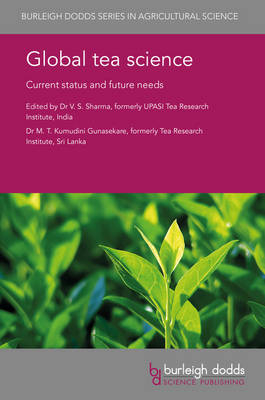
Global Tea Science
Burleigh Dodds Science Publishing Limited (Verlag)
978-1-78676-160-6 (ISBN)
"Global tea science: Current status and future needs would suit the library of any botanical enthusiast or academic, with its comprehensive collection of relevant chapters. The humble tea leaf has might roots indeed."
(Plant Science Bulletin – Botanical Society of America)
Tea is the most widely-consumed beverage in the world. Like other crops, tea cultivation faces a number of challenges. With the challenge of climate change and the competition for scarce resources, there is a need to make tea cultivation more efficient and sustainable. Cultivation needs also to be more resilient to biotic and abiotic stresses, whether it be pests or more extreme weather (e.g. drought) associated with global warming.
Fortunately, there is a range of research addressing these challenges. Drawing on an international range of expertise, this collection summarises this research by focusing on ways of improving the cultivation of tea at each step in the value chain, from breeding through to harvest. Part 1 reviews advances in breeding. Part 2 discusses improvements in cultivation techniques. The book then discusses plant protection and chemistry before concluding with sustainability issues.
As the need for more interdisciplinary and collaborative research increases, this collection will be a standard reference for the tea research community by summarising key research trends in each topic and putting them in the context of tea cultivation as a whole.
Dr V. S. Sharma is Editor-in-Chief of the International Journal of Tea Science; former Director of the UPASI Tea Research Institute, India and former Technical Adviser, The B.B.T.C. Ltd Plantations, for 19 years. Dr M. T. Kumudini Gunasekare is a Project Scientist at the Coordinating Secretariat for Science Technology and Innovation (COSTI); and former Head of the Plant Breeding Division at the Tea Research Institute, Sri Lanka, and Editor of the International Journal of Tea Science. Dr. Ghosh Hajra is currently Chief Consultant of Organic Tea & Agri-Horticultural Consulting, India. He worked as tea expert in World Bank project in Rwanda, Africa and Technical Adviser of Maple Orgtech (India) Ltd. Dr. Ghosh Hajra has more than 25 years of career success in designing, monitoring and evaluating a wide range of sustainable agricultural projects, and has demonstrated competencies in crop agronomy, protection, production and processing of tropical crops. He has lectured national universities and research institutes worldwide. He is a Fellow of the Academy of Plant Sciences in India, and has received the National Plant Scientist Award and International Award. Dr Atik Dharmadi was a Scientist at the Research Institute for Tea and Cinchona (RITC) in Indonesia for over thirty years. He was appointed as Director of the RITC in 2001 and served until 2003. Dr Dharmadi has also held Executive roles for the Indonesia Tea Association and Indonesia Tea Board.
Part 1 Tea Breeding and Germplasm
1.Ensuring the genetic diversity of tea: Jian-Qiang Ma and Liang Chen, Tea Research Institute of the Chinese Academy of Agricultural Sciences (TRI, CAAS), China;
2.Mapping and exploiting the tea genome: Xinchao Wang, Xinyuan Hao, Lu Wang and Yajun Yang, Tea Research Institute of the Chinese Academy of Agricultural Sciences (TRI, CAAS), China;
3.Advances in genetic modification of tea: Mainaak Mukhopadhyay, University of Kalyani, India; Tapan Kumar Mondal, National Bureau of Plant Genetic Resources, India;
Part 2 Cultivation and Agronomy
4.Planting and cultivation of tea: M. A. Wijeratne, Tea Research Institute, Sri Lanka;
5.The effect of cultivation techniques on tea quality: P. Okinda Owuor, Maseno University, Kenya;
6.The role of arbuscular mycorrhizal fungi in tea cultivation: Shipra Singh and Anita Pandey, G. B. Pant National Institute of Himalayan Environment and Sustainable Development, India; and Lok Man S. Palni, Graphic Era University, India;
7.The role of microbes in tea cultivation: P. N. Bhattacharyya and S. R. Sarmah, Tocklai Tea Research Institute, India;
Part 3 Plant Protection
8.Diseases affecting tea plants: G. D. Sinniah, Tea Research Institute, Sri Lanka;
9.Insect pests of tea: shot-hole borers, termites and nematodes: Nalini C. Gnanapragasam, Former Deputy Director (Research), Tea Research Institute, Sri Lanka; currently Agricultural Tea Consultant - Malwatte Valley Plantations PLC, Sri Lanka;
10.Insect pests of tea: caterpillars and other seasonal, occasional and minor pests: Nalini C. Gnanapragasam, Former Deputy Director (Research), Tea Research Institute, Sri Lanka; currently Agricultural Tea Consultant - Malwatte Valley Plantations PLC, Sri Lanka;
11.Integrated pest management of tea insect pests: Nalini C. Gnanapragasam, Former Deputy Director (Research), Tea Research Institute, Sri Lanka; currently Agricultural Tea Consultant - Malwatte Valley Plantations PLC, Sri Lanka;
12.Pesticide residues in tea: challenges in detection and control: A. K. Barooah, Tocklai Tea Research Institute, India;
Part 4 Tea Chemistry and Phytochemicals
13.Instrumentation and methodology for the quantification of phytochemicals in tea: Ting Zhang, China University of Geosciences and Huanggang Normal University, China; Xiaojian Lv, Yin Xu, Lanying Xu and Tao Long, Huanggang Normal University, China; Chi-Tang Ho, Rutgers University, USA; and Shiming Li, Huanggang Normal University, China and Rutgers University, USA;
14.The potential role for tea in combating chronic diseases: Chung S. Yang, Rutgers University, USA;
Part 5 Sustainability
15.Tea cultivation under changing climatic conditions: Wenyan Han, Xin Li, Peng Yan, Liping Zhang and Golam Jalal Ahammed, Tea Research Institute of the Chinese Academy of Agricultural Sciences (TRI, CAAS), China;
16.Assessing and reducing the environmental impact of tea cultivation: Thushari Lakmini Wijeratne, Tea Research Institute, Sri Lanka;
17.Cultivation, production and marketing of organic tea: Nikhil Ghosh Hajra, Organic Tea and Agri-horticultural Consulting, India;
18.Supporting smallholders in tea cultivation: Atik Dharmadi, Research Institute for Tea and Cinchona, Indonesia;
| Erscheinungsdatum | 17.03.2018 |
|---|---|
| Reihe/Serie | Burleigh Dodds Series in Agricultural Science ; 41 |
| Co-Autor | Jian-Qiang Ma, Prof. Liang Chen, Dr Xinchao Wang |
| Zusatzinfo | Colour tables, photos and figures |
| Verlagsort | Cambridge |
| Sprache | englisch |
| Maße | 152 x 229 mm |
| Gewicht | 913 g |
| Themenwelt | Technik |
| Weitere Fachgebiete ► Land- / Forstwirtschaft / Fischerei | |
| ISBN-10 | 1-78676-160-2 / 1786761602 |
| ISBN-13 | 978-1-78676-160-6 / 9781786761606 |
| Zustand | Neuware |
| Informationen gemäß Produktsicherheitsverordnung (GPSR) | |
| Haben Sie eine Frage zum Produkt? |
aus dem Bereich