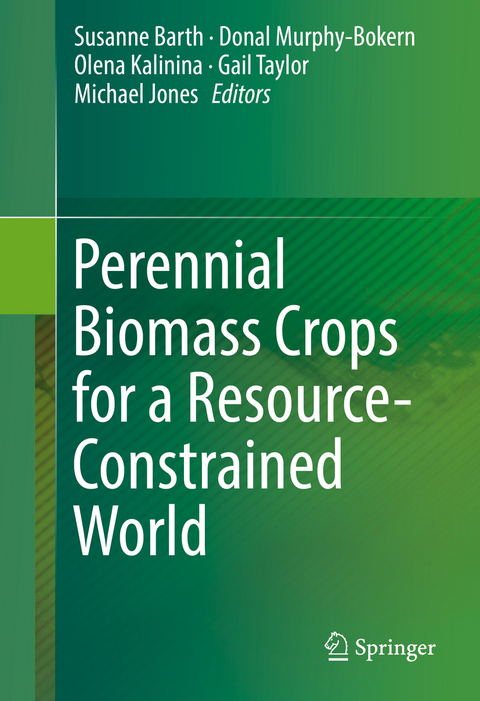
Perennial Biomass Crops for a Resource-Constrained World (eBook)
XVIII, 313 Seiten
Springer-Verlag
978-3-319-44530-4 (ISBN)
This book presents a flavour of activities focussed on the need for sustainably produced biomass to support European strategic objectives for the developing bioeconomy. The chapters cover five broad topic areas relating to the use of perennial biomass crops in Europe. These are: ‘Bioenergy Resources from Perennial Crops in Europe’, ‘European Regional Examples for the Use of Perennial Crops for Bioenergy’, ‘Genotypic Selection of Perennial Biomass Crops for Crop Improvement’, ‘Ecophysiology of Perennial Biomass Crops’ and ‘Examples of End-Use of Perennial Biomass Crops’. Two major issues relating to the future use of biomass energy are the identification of the most suitable second generation biomass crops and the need to utilise land not under intensive agricultural production, broadly referred to as ‘marginal land’. The two main categories of plants that fit these needs are perennial rhizomatous grasses and trees that can be coppiced. The overarching questions that are addressed inthe book relate to the suitability of perennial crops for providing feedstocks for a European bioeconomy and the need to exploit environments for biomass crops which do not compete with food crops. Bioenergy is the subject of a wide range of national and European policy measures. New developments covered are, for example, the use of perennial grasses to produce protein for animal feed and concepts to use perennial biomass crops to mitigate carbon emissions through soil carbon sequestration. Several chapters also show how prudent selection of suitable genotypes and breeding are essential to develop high yielding and sustainable second generation biomass crops which are adapted to a wide range of unfavourable conditions like chilling and freezing, drought, flooding and salinity. The final chapters also emphasise the need to be kept an eye out for potential new end-uses of perennial biomass crops that will contribute further to the developing bioeconomy.
Part 1. Introduction Into Bioenergy Resources from Perennial Crops.- The Role of Perennial Biomass Crops in a Growing Bioeconomy.- Pointers for Bioenergy Policy in a Resource-Constrained World.- Perennial Grasses for sustainable European Protein Production.- Long Term Yields and Soil Carbon Sequestration from Miscanthus – A Review.- Miscanthus-Complemented Grassland in Europe – Additional Source of Biomass for Bioenergy.- Part 2. European Regional Examples for the Use of Perennial Crops for Bioenergy.- ‘Soranovskii’: a New Miscanthus Cultivar Developed in Russia.- Italian Experiences on Arundo Harvesting: Economic and Energy Appraisal.- Biomass Potential of Fibre Nettle in Lithuania.- An Evaluation of Grass Species as Feedstocks for Combustion in Ireland.- Part 3. Genotypic Selection of Perennial Biomass Crops for Crop Improvement.- New Breeding Collections of Miscanthus sinensis, M. sacchariflorus and Hybrids from Primorsky Krai, Far Eastern Russia.- Creation of Novel Tetraploid Miscanthus sinensis Genotypes.- A Review of Frost and Chilling Stress in Miscanthus and Its Importance to Biomass Yield.- Creation of Novel Cold Tolerant Miscanthus Hybrids.- Comparison of Different Miscanthus Genotypes for Ash Melting Behavior at Different Locations.- Bioenergy Trees: Genetic and Genomic Strategies to Improve Yield.- Screening of Giant Reed Clones for Phytoremediation of Lead Contaminated Soils.- Variation in Selected Traditional Grass Species in Relation to Moisture Loss Rate in Biomass Cut at Anthesis.- Part 4. Ecophysiology of Perennial Biomass Crops.- A Systems Approach Guiding Future Biomass Crop Development on Marginal Land.- Mycorrhiza-Based Biofertilizer Application to Improve the quality of Arundo donax L., plantlets.- Biomass Yield and N Uptake in Tall Fescue and Reed Canary Grass Depending on N and PK Fertilization on Two Marginal Sites in Denmark.- Energy Balance of Cardoon (Cynara cardunculus L.) Cultivation and Pyrolysis.- Part 5. Examples for End-Use of Perennial Biomass Crops.- Harvesting and Separation of Different Plant Fractions in Cynara cardunculus L.- Masonry Blocks from Lightweight Concrete on the Basis of Miscanthus as Aggregates.- Miscanthus Horse Bedding Compares Well to Alternatives.
| Erscheint lt. Verlag | 18.11.2016 |
|---|---|
| Zusatzinfo | XVIII, 313 p. 74 illus., 54 illus. in color. |
| Verlagsort | Cham |
| Sprache | englisch |
| Themenwelt | Naturwissenschaften ► Biologie |
| Technik | |
| Weitere Fachgebiete ► Land- / Forstwirtschaft / Fischerei | |
| Schlagworte | Biomass Quality • Climate change impacts • Crop Management and Logistics • Plant Ecosystem • Plant Physiology • Stress tolerance • sustainable agriculture |
| ISBN-10 | 3-319-44530-8 / 3319445308 |
| ISBN-13 | 978-3-319-44530-4 / 9783319445304 |
| Informationen gemäß Produktsicherheitsverordnung (GPSR) | |
| Haben Sie eine Frage zum Produkt? |
 PDF (Wasserzeichen)
DRM: Digitales Wasserzeichen
Dieses eBook enthält ein digitales Wasserzeichen und ist damit für Sie personalisiert. Bei einer missbräuchlichen Weitergabe des eBooks an Dritte ist eine Rückverfolgung an die Quelle möglich.
Dateiformat: PDF (Portable Document Format)
Mit einem festen Seitenlayout eignet sich die PDF besonders für Fachbücher mit Spalten, Tabellen und Abbildungen. Eine PDF kann auf fast allen Geräten angezeigt werden, ist aber für kleine Displays (Smartphone, eReader) nur eingeschränkt geeignet.
Systemvoraussetzungen:
PC/Mac: Mit einem PC oder Mac können Sie dieses eBook lesen. Sie benötigen dafür einen PDF-Viewer - z.B. den Adobe Reader oder Adobe Digital Editions.
eReader: Dieses eBook kann mit (fast) allen eBook-Readern gelesen werden. Mit dem amazon-Kindle ist es aber nicht kompatibel.
Smartphone/Tablet: Egal ob Apple oder Android, dieses eBook können Sie lesen. Sie benötigen dafür einen PDF-Viewer - z.B. die kostenlose Adobe Digital Editions-App.
Buying eBooks from abroad
For tax law reasons we can sell eBooks just within Germany and Switzerland. Regrettably we cannot fulfill eBook-orders from other countries.
aus dem Bereich